

Wayground
Unit 3 States of Matter - Printable Science Worksheets 7th - 7th Grade - Wayground

Unit 3 States of Matter

Jody Vazquez

By Jody Vazquez

21 questions

7th - 7th Grade

Science

495 plays

Updated Mar 2026

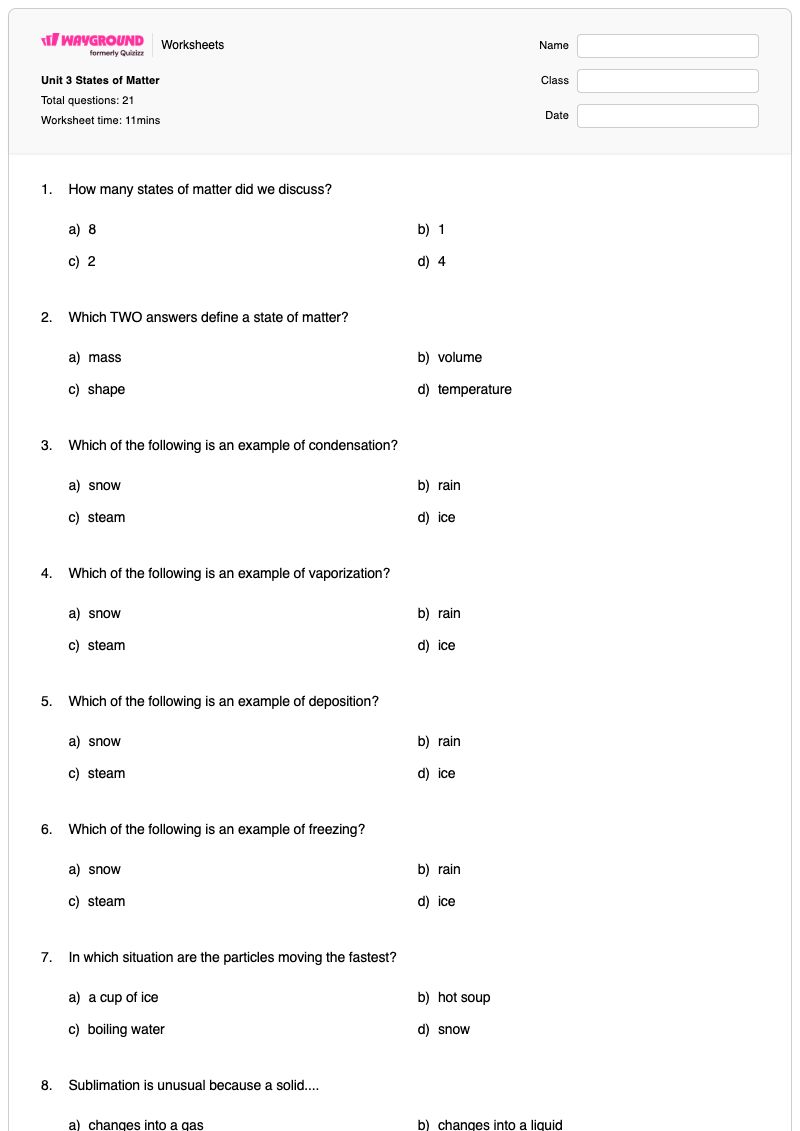
Unit 3 States of Matter is a Grade 7 science worksheet that checks students’ understanding of the four states of matter and how particles behave in each one. Across 21 questions—20 multiple-choice items and one multiple-select item—students identify matter’s defining properties, distinguish solids, liquids, gases, and plasma, interpret particle movement, and connect thermal energy with temperature and molecular speed. The worksheet also provides focused practice with phase changes, including condensation, vaporization, deposition, freezing, and sublimation. Students apply these ideas to everyday examples, temperature ranges, and particle diagrams while reviewing how matter changes from one state to another. This free printable worksheet includes a complete answer key, making it useful for independent practice, review, or a Grade 7 science assessment.

Worksheet settings

Font size

S
M
L
XL
WaygroundWorksheets

Unit 3 States of Matter

Total questions: 21

Name
Class
Date
1.

How many states of matter did we discuss?

a)

8

b)

1

c)

2

d)

4

2.

Which TWO answers define a state of matter?

a)

mass

b)

volume

c)

shape

d)

temperature

3.

Which of the following is an example of condensation?

a)

snow

b)

rain

c)

steam

d)

ice

4.

Which of the following is an example of vaporization?

a)

snow

b)

rain

c)

steam

d)

ice

5.

Which of the following is an example of deposition?

a)

snow

b)

rain

c)

steam

d)

ice

6.

Which of the following is an example of freezing?

a)

snow

b)

rain

c)

steam

d)

ice

7.

In which situation are the particles moving the fastest?

a)

a cup of ice

b)

hot soup

c)

boiling water

d)

snow

8.

Sublimation is unusual because a solid....

a)

changes into a gas

b)

changes into a liquid

c)

changes into all the other states

d)

does not change at all

9.

After waiting 10 minutes for a cup of hot soup to cool off, the molecules______________________.

a)

sped up

b)

did not change

c)

slowed down

d)

jumped out of the cup

10.

Which of the following is an example of plasma?

a)

lightening

b)

ice

c)

steam

d)

liquid water

11.

Which state has a definite shape and volume?

a)

plasma

b)

liquid

c)

gas

d)

solid

12.

The temperature at which a liquid like water can exist is__________?

a)

greater than or equal to 100˚C

b)

1˚C to 99˚C

c)

less than or equal to 0˚C

13.

What is another name for thermal energy?

a)

leaving

b)

movement

c)

heat

d)

cold

14.
Which picture shows the particle movement of a liquid?

Which picture shows the particle movement of a liquid?

a)

left side

b)

middle

c)

right side

15.

T or F? Volume is how much space an object occupies.

a)

True

b)

False

16.

As the amount of thermal energy increases, the _____________ also increases.

a)

particle movement

b)

heat

c)

coolness

d)

shape

17.

Which state of matter has particles packed so closely together, that they can vibrate but not move?

a)

plasma

b)

gas

c)

liquid

d)

solid

18.

T or F? We can add cold to an object to change its state of matter?

a)

True

b)

False

19.

T or F? Energy, motion, and heat are all different names for the same physical property.

a)

True

b)

False

20.

When pressure is added to the states of matter the temperature ___________________.

a)

increases

b)

decreases

21.

___________________are made up of atoms that are chemically bonded together.

a)

elements

b)

molecules

WaygroundAnswer Key

Unit 3 States of Matter

Total questions: 21

1.
d)

4

2.
b)

volume

, c)

shape

3.
b)

rain

4.
c)

steam

5.
a)

snow

6.
d)

ice

7.
c)

boiling water

8.
a)

changes into a gas

9.
c)

slowed down

10.
a)

lightening

11.
d)

solid

12.
b)

1˚C to 99˚C

13.
c)

heat

14.
b)

middle

15.
a)

True

16.
a)

particle movement

17.
d)

solid

18.
b)

False

19.
a)

True

20.
a)

increases

21.
b)

molecules

FAQs

What does the Unit 3 States of Matter worksheet cover?

This Grade 7 science worksheet uses 20 multiple-choice questions and one multiple-select question to assess states of matter, their properties, particle motion, thermal energy, and phase changes. Students identify examples of condensation, vaporization, deposition, freezing, and sublimation; compare particle speed; interpret liquid particle movement; and distinguish which states have definite shape and volume.

How can I use this worksheet to teach states of matter and phase changes?

Introduce the four states of matter with a class chart comparing shape, volume, and particle movement, then model the phase changes named in the worksheet. Have students explain why examples such as rain, steam, snow, and ice represent different changes before completing the questions. Use the particle-movement and temperature items as a closing discussion about how heating and cooling affect molecular speed.

What mistakes should I watch for when students complete this states of matter worksheet?

Watch for students confusing a state’s properties with temperature or mass, especially on the multiple-select item requiring volume and shape. Students may also mix up phase-change examples, reverse sublimation as a change into a liquid, or assume particles stop moving when soup cools. Check that they distinguish the particle patterns for liquids from those for solids and gases and recognize boiling water as the fastest-moving example.

How do I assign and grade the Unit 3 States of Matter worksheet?

The worksheet is available as a printable PDF and as a digital quiz on Wayground, and it includes a complete answer key. For printable submissions, you can scan student work with the Wayground for Teachers app to help grade responses. The PDF option also supports classrooms that are reducing screen time.

How can I differentiate this states of matter worksheet for my students?

Use the worksheet’s Advanced Settings to adjust font spacing or choose a larger font size so the 21 questions, answer choices, and particle-movement items are easier to read. You can also enable a dyslexia-friendly font or translate the worksheet into another language when helpful for students working with the states-of-matter vocabulary.

Where can I find more free worksheets like this on Wayground?

Wayground offers a comprehensive collection of free printable worksheets and practice problems across subjects, with downloadable PDFs and answer keys to support mastery of essential skills and concepts. Browse more resources at https://wayground.com/en-us/worksheets.