Layers of the Earth Pre/Post is a Grade 8 science worksheet that helps students connect Earth’s internal structure with density, composition, seismic waves, magnetic protection, and thermal energy. Its 10 questions use three ordering tasks, two drag-and-drop image-labeling activities, four multiple-choice questions, and one dropdown item to assess both vocabulary and conceptual understanding.
Students reorder the crust, mantle, outer core, and inner core by position and density, identify layer compositions, distinguish how seismic waves travel, and recognize that P waves arrive first. They also analyze density values, explain changes in temperature, pressure, and density toward the core, identify what Earth’s magnetic field protects against, and connect thermal energy to multiple sources. This free printable worksheet includes a complete answer key for efficient review, independent practice, or assessment.
Worksheet settings
Font size
S
M
L
XL
Worksheets
Layers of the Earth Pre/Post
Total questions: 12
Name
Class
Date
1.
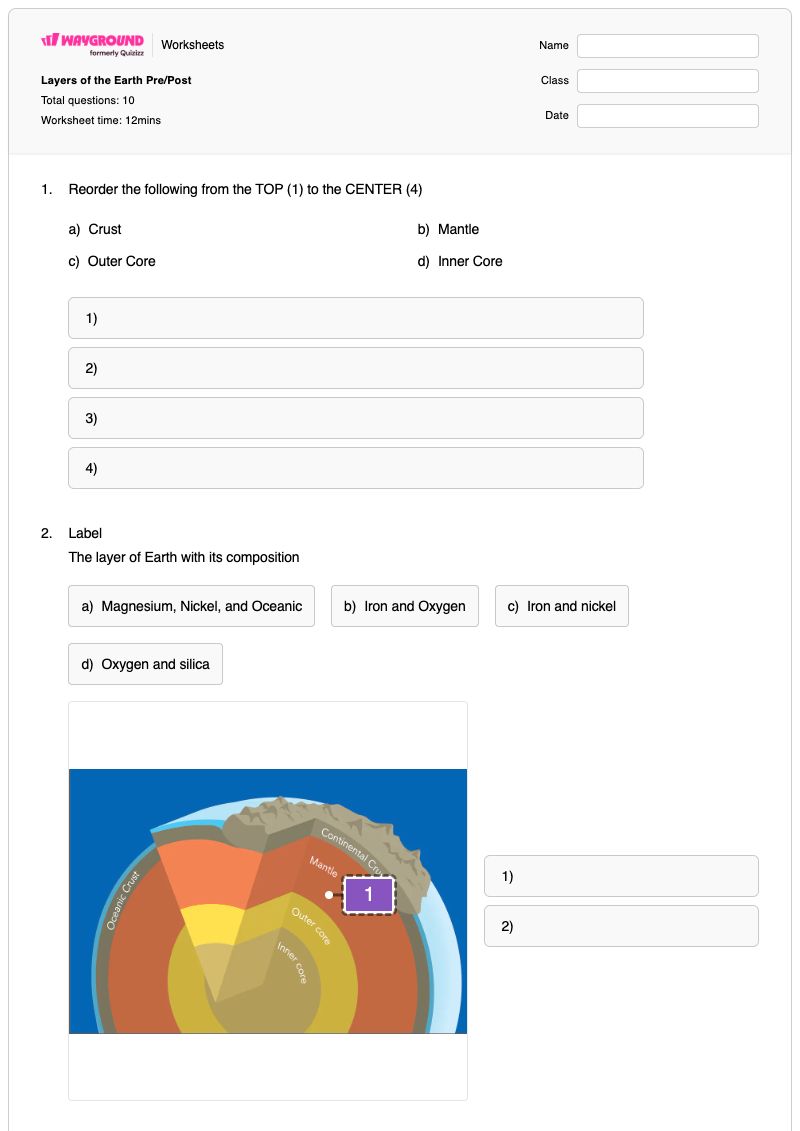
Label
The layer of Earth with its composition
a)
Magnesium, Nickel, and Oceanic
b)
Iron and Oxygen
c)
Iron and nickel
d)
Oxygen and silica
1
2
1)
2)
2.
This layer is the ONLY liquid layer.
a)
crust
b)
mantle
c)
outer core
d)
inner core
3.
What type of seismic wave is faster and arrives first?
(a)
Choose from the below words
P waves
S waves
Surface waves
Love waves
4.
Drag the labels that correctly explains each picture.
a)
Travels only through liquids
b)
Travels through solids and liquids
c)
Travels only through solids
1
2
1)
2)
5.
Reorder the following from least dense (1) to most dense (4)
a)
Crust
b)
Mantle
c)
Outer Core
d)
Inner Core
1)
2)
3)
4)
6.
Earth's magnetic field protects our atmosphere from...
a)
liquid metal layers
b)
North and south poles
c)
ocean floor striping
d)
solar winds and particles
7.
Reorder the following sediments going from least dense to the most dense.
a)
L 1.1 g/cm3
b)
O 1.6 g/cm3
c)
P 1.9 g/cm3
d)
M 2.3 g/cm3
1)
2)
3)
4)
8.
As you travel from the crust to the core, how would temperature, pressure and density of the material change?
a)
They would all increase
b)
They would all decrease.
c)
Nothing, the layers are made of the same material throughout
d)
Temperature would decrease, but pressure and density would increase
9.
The earth's thermal energy is a result of ___ .
a)
Heat left over from the planet's formation.
b)
Decay (breaking down) of radioactive elements.
c)
Friction as material moves within the earth.
d)
All options are correct.
10.
Name the type of heat transfer shown in the picture.
a)
convection
b)
conduction
c)
radiation
11.
Select the spot that is the coldest and most dense
A
B
C
D
12.
Select the spot that is the hottest and least dense
A
B
C
D
Answer Key
Layers of the Earth Pre/Post
Total questions: 12
1.
d
c
2.
c)
outer core
3.
P waves
4.
b
c
5.
a, b, c, d
6.
d)
solar winds and particles
7.
a, b, c, d
8.
a)
They would all increase
9.
d)
All options are correct.
10.
a)
convection
11.
12.
140 %
Browse by subjects
Browse by grades
Browse by format
FAQs
What does the Layers of the Earth Pre/Post worksheet cover?
This Grade 8 science worksheet uses 10 mixed-format questions to build understanding of Earth’s layers and related processes. Students order the crust, mantle, outer core, and inner core by location and density, match layer compositions and seismic-wave behaviors through drag-and-drop items, and answer questions about P waves, Earth’s magnetic field, changing conditions toward the core, and thermal energy. The varied formats require students to sequence, classify, interpret, and apply Earth science concepts rather than only recall layer names.
How can I use this worksheet to teach Earth’s layers and internal processes?
Introduce a labeled Earth cross-section and have students justify the top-to-center ordering before they complete the worksheet’s sequencing items. Use the drag-and-drop questions to discuss how composition and whether a material is solid or liquid relate to the layers and seismic-wave behavior. After students finish, review the density order, the faster-arriving P waves, and the three contributors to Earth’s thermal energy as evidence of how the interior changes with depth.
What mistakes should I watch for on this Earth layers worksheet?
Students may reverse the top-to-center sequence, confuse the outer core with the inner core, or assume that all core material is liquid even though the worksheet identifies the outer core as the only liquid layer. They may also mix up P and S waves or select a wave behavior without checking whether it travels through solids, liquids, or both. In the density items, watch for students who ignore the numerical values or fail to recognize that temperature, pressure, and density all increase from the crust toward the core.
How do I assign and grade the Layers of the Earth Pre/Post worksheet?
Wayground provides this worksheet as a printable PDF and as a digital quiz, with a complete answer key for checking the ordering, drag-and-drop, dropdown, and multiple-choice responses. For printable submissions, you can scan student work with the Wayground for Teachers app to support efficient grading. The PDF option also gives schools a way to reduce screen time when appropriate.
How can I differentiate this Earth layers worksheet for my students?
Use the worksheet’s Advanced Settings to adjust font spacing and font size so the ordering lists, density values, and drag-and-drop labels are easier to read. You can also apply a dyslexia-friendly font or translate the worksheet into another language, supporting access to the seismic-wave and Earth-interior terminology without changing the question types.
Where can I find more free worksheets like this on Wayground?
Wayground offers a comprehensive collection of free printable worksheets and practice problems across all subjects, with downloadable PDFs and answer keys to help students master essential skills and concepts. Browse more worksheets at https://wayground.com/en-us/worksheets.

 Worksheets


