 Worksheets
summary
Total questions: 10
Name
Class
Date


 Answer Key
summary
Total questions: 10
1.
b)
key detail
2.
a) summary
3.
c)
C
4.
a)
A
5.
b)
B
6.
c)
C
7.
c)
C
8.
a)
A
9.
c)
C
10.
c)
C

10 questions
5th - 5th Grade
English
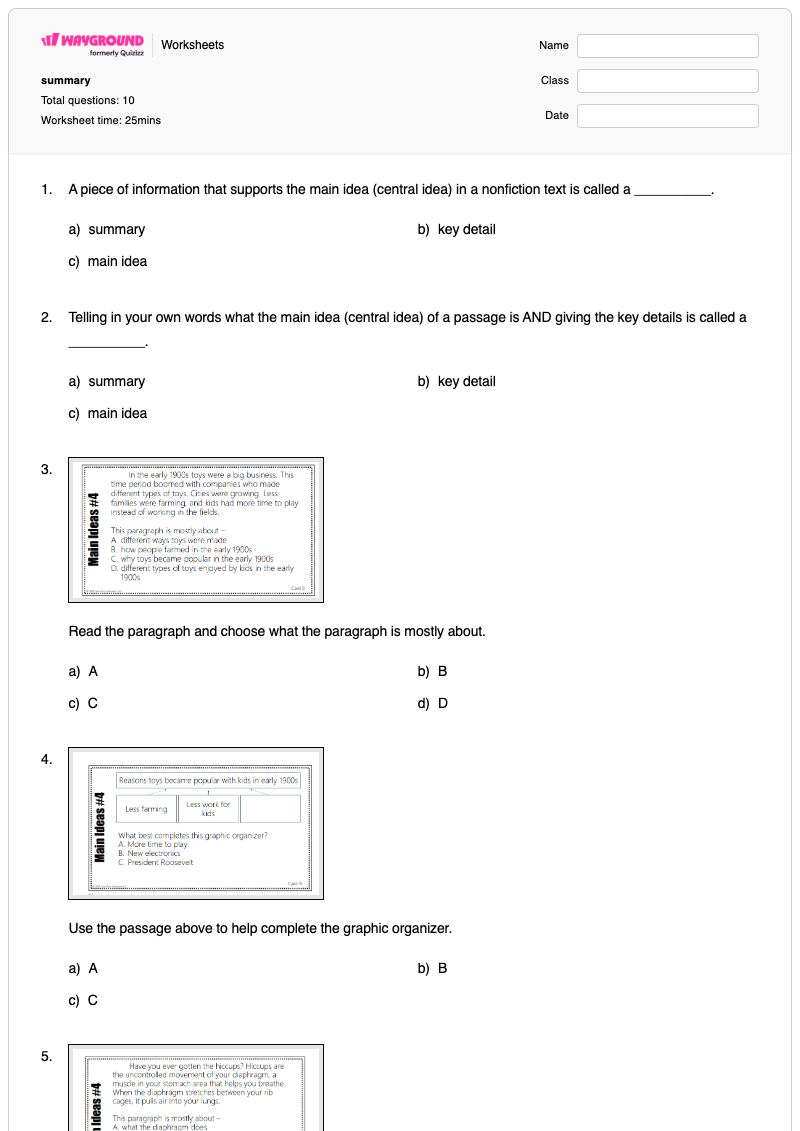
This Grade 5 English worksheet helps students distinguish a nonfiction text’s central idea, key details, and summary. It begins with multiple-choice vocabulary questions that identify a supporting piece of information as a key detail and define a summary as a restatement of the central idea with its key details. Students then read short paragraphs and passages to determine what each is mostly about, select entries to complete related graphic organizers, and choose the best summary. Across 10 multiple-choice questions, the worksheet builds the ability to identify a text’s central idea, connect it to supporting information, organize those ideas, and evaluate whether a summary captures the most important points. This free printable worksheet is designed for Grade 5 English instruction, independent practice, review, or formative assessment, and includes a complete answer key.
Worksheet settings
Font size
WorksheetsAnswer Keykey detail
C
A
B
C
C
A
C
C
This Grade 5 English worksheet covers identifying the central idea of nonfiction paragraphs and passages, recognizing key details, completing graphic organizers, and selecting an accurate summary. Its 10 multiple-choice questions move from defining key detail and summary to applying those concepts while reading, helping students connect a text’s main point with the information that supports it.
Introduce the terms central idea, key detail, and summary, then model how to ask what a paragraph is mostly about before identifying the details that support that idea. Have students use the worksheet’s graphic-organizer items to connect the central idea and supporting information, and then explain why one answer is a complete summary rather than a single detail or unrelated statement. Finish by having students justify their choices for the best-summary questions with evidence from the passage.
Students may confuse a key detail with the central idea or choose “summary” when the question is asking for one supporting fact. When selecting what a paragraph is mostly about, they may focus on an interesting detail instead of the broader central idea. In the graphic-organizer and best-summary items, watch for choices that include only part of the passage or omit the key details needed for a complete summary.
You can assign this worksheet as a printable PDF or use it as a digital quiz on Wayground. It includes a complete answer key for the 10 multiple-choice questions, and printable submissions can be graded by scanning student work with the Wayground for Teachers app. The printable format also gives schools an option for reducing screen time.
In the worksheet’s Advanced Settings, adjust font spacing and font size to make the nonfiction passages, graphic-organizer choices, and multiple-choice items easier to read. You can also select a dyslexia-friendly font or translate the worksheet into another language when that better supports access to the central-idea and summary tasks.
Wayground offers a comprehensive collection of free printable worksheets and practice problems across subjects, with downloadable PDFs and answer keys to help students master essential skills and concepts. Browse more resources at https://wayground.com/en-us/worksheets.