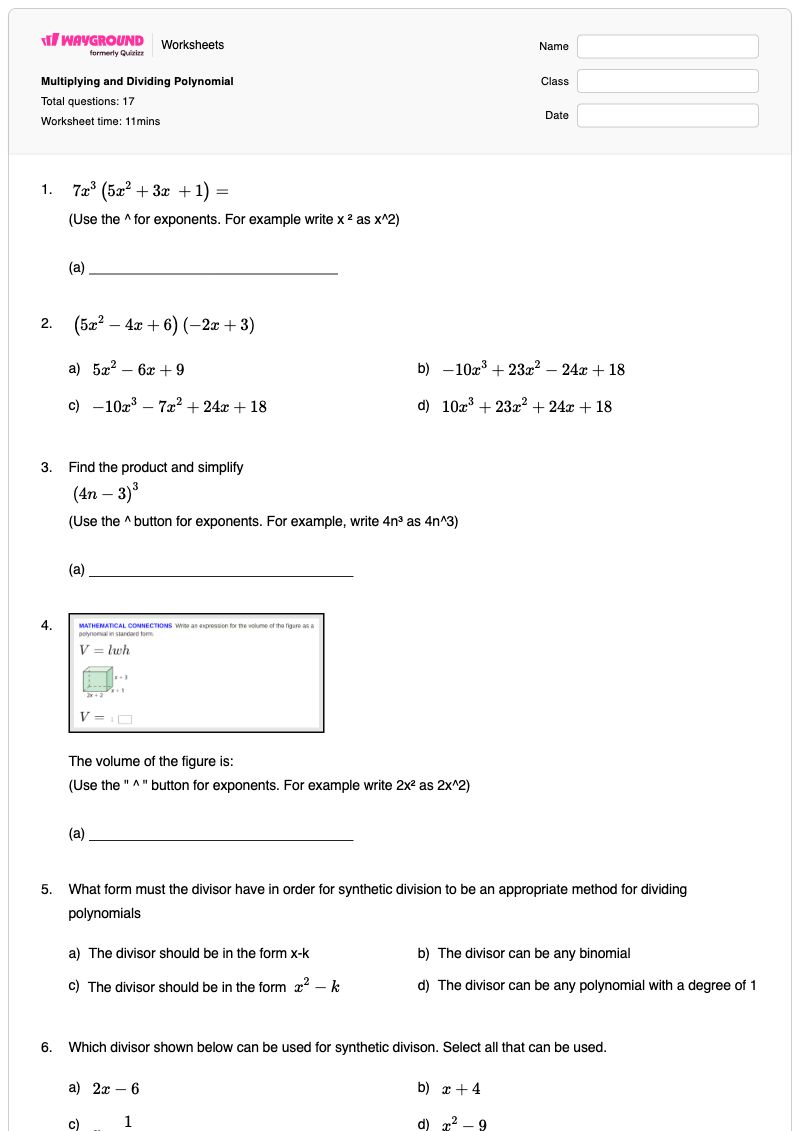
Multiplying and Dividing Polynomial is a Grade 9–12 mathematics worksheet with 17 items that builds fluency with polynomial products, division, and notation. Students simplify products, write polynomial expressions for a volume problem, identify when synthetic division applies, and interpret the divisor, dividend, quotient, coefficients, and remainder shown in synthetic-division setups. The worksheet also includes polynomial-division problems solved with long division and synthetic division.
The mixed format—five fill-in-the-blank items, 11 multiple-choice questions, and one multiple-select question—checks both procedural accuracy and understanding of how division representations connect to polynomial expressions. It is useful for guided practice, independent work, review, or an assessment for students in Algebra and later secondary mathematics courses. This is a free printable worksheet with a complete answer key, helping teachers quickly check simplified products, division results, and students’ interpretation of synthetic-division layouts.
Worksheet settings
Font size
S
M
L
XL
Worksheets
Multiplying and Dividing Polynomial
Total questions: 17
Name
Class
Date
1.
7x3(5x2+3x+1)=
(Use the ^ for exponents. For example write x ² as x^2)
(a)
2.
(5x2−4x+6)(−2x+3)
a)
5x2−6x+9
b)
−10x3+23x2−24x+18
c)
−10x3−7x2+24x+18
d)
10x3+23x2+24x+18
3.
Find the product and simplify
(4n−3)3
(Use the ^ button for exponents. For example, write 4n³ as 4n^3)
(a)
4.
The volume of the figure is:
(Use the " ^ " button for exponents. For example write 2x² as 2x^2)
(a)
5.
What form must the divisor have in order for synthetic division to be an appropriate method for dividing polynomials
a)
The divisor should be in the form x-k
b)
The divisor can be any binomial
c)
The divisor should be in the form x2−k
d)
The divisor can be any polynomial with a degree of 1
6.
Which divisor shown below can be used for synthetic divison. Select all that can be used.
a)
2x−6
b)
x+4
c)
x−21
d)
x2−9
7.
The divisor represented by this synthetic divsion was (a)
8.
The dividend represented by this synthetic division problem was ______________
a)
x4−2x3−9x2+18x
b)
x3−2x2−9x+18
c)
x2−5x+6
d)
x3−5x2+6x
9.
The quotient represented by this synthetic divsion problem is_____________
a)
x4−2x3−9x2+18x
b)
x3−2x2−9x+18
c)
x2−5x+6
d)
x3−5x2+6x
10.
The colored numbers shown in this synthetic divsion problem represent the
a)
Divisor
b)
Quotient
c)
Dividend
d)
Remainder
11.
The blue number to the right in this synthetic divsion problem represents the
a)
Divisor
b)
Constant term of quotient
c)
Leading Coefficient of dividend
d)
Remainder
12.
The red numbers represent the
a)
Exponents of the quotient
b)
Coefficients of the dividend
c)
Coefficients of the quotient
d)
Divisor
13.
Divide using long division
(3x2−14x−5)÷(x−5)
(a)
14.
Divide using synthetic division
(x3−4x+6)÷(x+3)
a)
x2−3x+5−x+39
b)
x2+1x+3
c)
x+1+x+33
d)
x2+3x+5+x+39
15.
Divide using synthetic division
(x4−5x3−8x2+13x−12)÷(x−6)
a)
x3−11x2+58x+35+x−61908
b)
x3+x2−2x+1−x−66
c)
x4+x3−2x2+1x−x−66
d)
x3−x2−2x−1
16.
Select the quotient of
(x2−x+3)÷(x−2)
a)
x+1+x−21
b)
x+3+x−29
c)
x+1+x−25
d)
x+3+x−23
17.
Use synthetic division to evalute
3x2+2x−20;x=3
a)
13
b)
57
c)
4
d)
24
Answer Key
Multiplying and Dividing Polynomial
Total questions: 17
1.
35x^5 + 21x^4 + 7x^3, 35x^5+21x^4+7x^3
2.
b)
−10x3+23x2−24x+18
3.
64n^3-144n^2+108n-27, 64n^3 - 144n^2 + 108n - 27
4.
2x^3+10x^2+14x+6, 2x^3 + 10x^2 + 14x + 6
5.
a)
The divisor should be in the form x-k
6.
b)
x+4
, c)
x−21
7.
x+3, x + 3, (x+3), (x + 3)
8.
b)
x3−2x2−9x+18
9.
c)
x2−5x+6
10.
b)
Quotient
11.
d)
Remainder
12.
c)
Coefficients of the quotient
13.
3x+1, 3x + 1
14.
a)
x2−3x+5−x+39
15.
b)
x3+x2−2x+1−x−66
16.
c)
x+1+x−25
17.
a)
13
140 %
Browse by subjects
Browse by grades
Browse by format
FAQs
What does the Multiplying and Dividing Polynomial worksheet cover?
This Grade 9–12 worksheet uses fill-in-the-blank, multiple-choice, and multiple-select questions to practise simplifying polynomial products, writing a polynomial volume expression, and dividing polynomials. Students also identify when a divisor has the form x − k and interpret synthetic-division entries as the divisor, quotient coefficients, dividend coefficients, and remainder.
How can I use this worksheet to teach polynomial multiplication and division?
Use the product and volume-expression items first to review multiplying terms and combining like terms, then model how a polynomial is represented in long division and synthetic division. Before students complete the synthetic-division questions, have them explain why a divisor must be in x − k form and predict which numbers will represent the quotient and remainder.
What mistakes should I watch for when students complete this polynomial worksheet?
Watch for sign errors when multiplying or simplifying products, especially in expressions with negative terms, and for students entering equivalent expressions without the required exponent notation. In the synthetic-division items, students may confuse the divisor with the dividend, read the colored quotient coefficients as the original coefficients, or treat the final number as part of the quotient instead of the remainder; in long division, they may stop before simplifying the quotient.
How do I assign and grade this polynomial worksheet?
The worksheet is available as a printable PDF and as a digital quiz on Wayground, and it includes a complete answer key for checking the 17 items. For printed submissions, scan student work with the Wayground for Teachers app to help grade responses.
How can I differentiate this polynomial division worksheet for my students?
In the worksheet’s Advanced Settings, adjust font spacing or choose a larger font size to make the synthetic-division layouts, polynomial expressions, and fill-in responses easier to read. You can also enable a dyslexia-friendly font or translate the written directions into another language while keeping the mathematical expressions available for students to interpret.
Where can I find more worksheets like this on Wayground?
Wayground provides a broad collection of free printable worksheets and practice problems across subjects, with downloadable PDFs and answer keys to support essential skills and concepts. Browse more resources at https://wayground.com/en-us/worksheets.


 Worksheets


