
Intro to Systems of Equations is a Grade 9 mathematics worksheet that builds foundational understanding of what systems of equations represent and how their solutions relate to pairs of lines. Across 20 questions—19 multiple choice and 1 multiple-select—students identify ordered pairs that satisfy both equations, classify systems as having one, no, or infinitely many solutions, and connect those outcomes to slopes, y-intercepts, intersecting lines, parallel lines, and coinciding lines. They also identify solution points, recognize equivalent equations, and follow the setup for substitution.
This free printable worksheet with an answer key supports introductory instruction, guided practice, independent review, or a quick formative check. Its application items ask students to use system relationships when comparing phone-plan choices, while substitution questions focus on correctly isolating y and replacing it in a second equation. The varied question formats help teachers see whether students understand both the vocabulary and the first procedural steps involved in solving systems.
Worksheet settings
Font size
S
M
L
XL
Worksheets
Intro to Systems of Equations
Total questions: 20
Name
Class
Date
1.
What is the solution to a system of equations?
a)
It's the ordered pair where both equations equal zero
b)
It's the ordered pair where graphs of both equations cross the y-axis
c)
It's the ordered pair (x, y) that makes both equations true.
d)
It's the ordered pair where graphs of both equations cross the x-axis
2.
A system has ____________ when two lines intersect at one point.
a)
One solution
b)
No solution
c)
Infinitely Many Solution
3.
If a system has one solution that means the equations in the system have:
a)
Same slopes, same y-intercepts
b)
Same slope, different y-intercepts
c)
different slopes
4.
A system has ____________ when the two equations coincide.
a)
One solution
b)
No solution
c)
Infinitely Many Solutions
5.
Coinciding lines have the...
a)
Same slopes, same y-intercepts
b)
Different slopes
c)
Same slope, different y-intercepts
6.
Parallel lines have the:
a)
Same slopes, same y-intercepts
b)
Different slopes
c)
Same slope, different y-intercepts
7.
A system has ____________ when the two lines are parallel.
a)
One solution
b)
No solution
c)
Infinitely Many Solution
8.
How many solutions will this system have?
a)
No Solution
b)
Infinitely Many Solutions
c)
No Clue
d)
One solution
9.
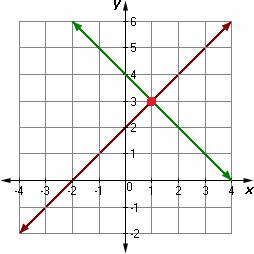
What is the solution to the system?
a)
(0, 3)
b)
(1, -1)
c)
(-3, 1)
d)
(1, 3)
10.
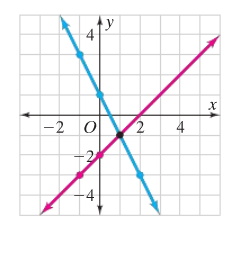
What is the solution?
a)
(1, -1)
b)
(-1, 1)
c)
(0, -2)
d)
(2, 0)
11.
If you plan on owning 5 phones what company should you use?
a)
Spring
b)
AT&R
c)
Horizon
12.
If you plan on owning Less than 2 phones what company should you use?
a)
Spring
b)
AT&R
c)
Horizon
13.
In the system of equations below. What does y equal and therefore can be substituted into the second equation for y?
y = -6 -3x - 6y = 24
a)
y = -6
b)
y = 6
c)
y = -3
d)
y = 24
14.
In the system of equations below, what will substituting y = -6 into the bottom equation look like?
y = -6 -3x - 6y = 24
a)
-3(-6) - 6y = 24
b)
-3x - 6(-6) = 24
c)
-3x +6(-6) = 24
d)
-3x = 24
15.
In the given system of equations, what does y equal? y = 2x + 1 y = 4x - 1
a)
y = 2x + 1
b)
y = 4x - 1
c)
y = 2x
d)
y = -1
16.
Which of the following shows the correct substitution for y? y = 2x + 1 y = 4x - 1
a)
2x + 1 = 4x - 1
b)
2x -1 = 4x + 1
c)
y = 2x
d)
2x = 1
17.
Are the lines parallel, perpendicular, or neither? y = 3x – 7 y = 3x + 1
a)
Parallel
b)
Perpendicular
c)
Neither
18.
what is the variable that willl be "eliminated"?
5x - 4y = 11
5x + 4y = -14
a)
x variable
b)
y variables
c)
both variables
19.
2x - 6y = 20
2x + 5y = -11
What would you need to multiply the top equation by so that the x variables eliminate?
a)
Multiply by -1
b)
Multiply by 1
c)
Multiply by 6
d)
Multiply by -2
20.
2x - 6y = 20
2x + 5y = -11
what would the top equation become when you multiply everything by -1?
a)
2x - 6y = 20
b)
-2x - 6y = -20
c)
-2x + 6y = 20
d)
-2x + 6y = -20
Answer Key
Intro to Systems of Equations
Total questions: 20
1.
c)
It's the ordered pair (x, y) that makes both equations true.
2.
a) One solution
3.
c)
different slopes
4.
c)
Infinitely Many Solutions
5.
a)
Same slopes, same y-intercepts
6.
c)
Same slope, different y-intercepts
7.
b) No solution
8.
b) Infinitely Many Solutions
9.
d) (1, 3)
10.
a) (1, -1)
11.
b)
AT&R
12.
a)
Spring
13.
a)
y = -6
14.
b)
-3x - 6(-6) = 24
15.
a)
y = 2x + 1
, b)
y = 4x - 1
16.
a)
2x + 1 = 4x - 1
17.
a) Parallel
18.
b)
y variables
19.
a)
Multiply by -1
20.
d)
-2x + 6y = -20
140 %
Browse by subjects
Browse by grades
Browse by format
FAQs
What does the Intro to Systems of Equations worksheet cover?
This Grade 9 worksheet uses 19 multiple-choice questions and 1 multiple-select question to practice identifying ordered pairs that make both equations true and classifying systems as having one, no, or infinitely many solutions. Students connect these classifications to intersecting, parallel, and coinciding lines, compare slopes and y-intercepts, identify solution points, and begin substitution by isolating y and replacing it in another equation.
How can I use this worksheet to teach the introduction to systems of equations?
Begin by reviewing the meaning of a system solution as an ordered pair that makes both equations true, then use the line-relationship questions to have students predict the number of solutions from slopes and y-intercepts. After students justify those predictions, model the substitution items by isolating y and carefully replacing y in the second equation. Finish with the solution-point and phone-plan questions so students apply the classifications and interpret their results.
What mistakes should I watch for when students complete this systems of equations worksheet?
Watch for students confusing parallel lines with coinciding lines: parallel lines have the same slope and different y-intercepts, while coinciding lines have the same slope and the same y-intercept. Students may also choose a point that satisfies only one equation, reverse the meaning of one, no, and infinitely many solutions, or lose a negative sign when substituting the isolated value of y. On the multiple-select item, check that they select both equations that give y rather than choosing only one.
How do I assign and grade this systems of equations worksheet?
The worksheet is available as a printable PDF and as a digital quiz on Wayground, and it includes a complete answer key for the classification, solution-point, phone-plan, and substitution items. For printable submissions, you can grade student work by scanning it with the Wayground for Teachers app.
How can I differentiate this systems of equations worksheet for my students?
Use the worksheet’s Advanced Settings to increase font spacing or font size for clearer reading of the equations, answer choices, and ordered pairs, or enable a dyslexia-friendly font. You can also translate the worksheet through Advanced Settings while keeping the system-classification and substitution questions in the same format.
Where can I find more worksheets like this on Wayground?
Wayground offers a comprehensive collection of free printable worksheets and practice problems across all subjects, with downloadable PDFs and answer keys to help students master essential skills and concepts. Browse more resources at https://wayground.com/en-us/worksheets.