Test Review Systems of Equations is a Grade 9 Algebra I mathematics worksheet with 10 multiple-choice questions. It reviews solving systems of linear equations, interpreting their graphs, and translating real-world situations into equations. Students work through scenarios involving business costs and profit, animal feed, item purchases, and service times, then identify solutions such as ordered pairs and determine which system represents a situation.
The worksheet also checks understanding of how line relationships describe system solutions, including why parallel lines have no solution and why intersecting lines have one solution. It is a free printable worksheet with a complete answer key, making it useful for independent review, homework, class practice, or a quick assessment before a systems-of-equations test.
Worksheet settings
Font size
S
M
L
XL
Worksheets
Test Review Systems of Equations
Total questions: 10
Name
Class
Date
1.
Madison is starting a business creating custom websites. She expects her weekly cost can be modeled using y = 50x + 400. She will make $100 for each website designed. How many websites does she need to create to begin making a profit?
a)
9 websites
b)
20 websites
c)
2 weebsite
d)
5 website
2.
Terry needs to feed his chickens and his goats. He purchases 100 pound of feed each month. The chicken feed is $1.00 per pound and the goat feed is $3.50 per pound. He spent a total of $275. How many pounds of goat feed did he purchase?
a)
30 pounds
b)
50 pounds
c)
70 pounds
d)
7 pounds
3.
Robin purchased toys at the toy store. She bought squishies for $3 each and surprise eggs for $2 each. She spent a total of $59 on a total of 22 items. Determine how many squishies and surprise eggs Robin purchased.
a)
15 squishies
7 surprise eggs
b)
7 squishies
15 surprise eggs
c)
11 squishies
11 surprise eggs
d)
18 squishies
4 surprise eggs
4.
Solve the system of equations.
x + y = 7
x + 2y = 11
a)
(3, 4)
b)
(4, 3)
c)
(-2, 1)
d)
(1, -2)
5.
If a system of equations has no solution, what does the graph look like?
a)
intersecting lines
b)
parallel lines
c)
skew lines
d)
intersecting lines
6.
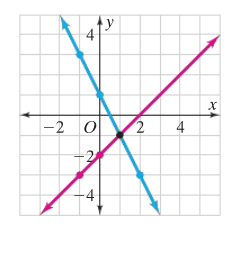
What is the solution?
a)
(1, -1)
b)
(-1, 1)
c)
(0, -2)
d)
(0, 1)
7.
Solve for x and y 3x + 2y = 16 7x + y = 19
a)
(-2,5)
b)
(-2,-5)
c)
(2,-5)
d)
(2,5)
8.
Alexandra finds that she can give 3 haircuts and 2 hair dyes in 315 minutes. Giving 2 haircuts and 4 hair dyes takes 450 minutes. Which system of equations represents the situation?
a)
3x + 2y = 315 2x + 4y = 450
b)
3x + 2y = 450 2x + 4y = 315
c)
2x + 2y = 315 3x + 4y = 450
9.
If a system of linear equations has one solution, what does this mean about the two lines?
a)
Parallel lines
b)
the same line
c)
Intersecting lines
10.
Parallel Lines never intersect because...
a)
they have the same slopes.
b)
they have the same y-intercept.
c)
they have different slopes.
d)
they have different y-intercepts.
Answer Key
Test Review Systems of Equations
Total questions: 10
1.
a)
9 websites
2.
c)
70 pounds
3.
a)
15 squishies
7 surprise eggs
4.
a)
(3, 4)
5.
b) parallel lines
6.
a) (1, -1)
7.
d) (2,5)
8.
a) 3x + 2y = 315 2x + 4y = 450
9.
c) Intersecting lines
10.
a) they have the same slopes.
140 %
Browse by subjects
Browse by grades
Browse by format
FAQs
What does this systems of equations review worksheet help students practice?
This Grade 9 worksheet uses 10 multiple-choice questions to review solving systems of linear equations, identifying ordered-pair solutions, interpreting line intersections, and recognizing parallel lines as a no-solution case. Students also translate contexts such as profit, feed costs, purchases, and service times into equations or systems, connecting algebraic solutions to real-world quantities.
How can I use this worksheet to teach systems of equations?
Use the word-problem items first to model how quantities, costs, and totals become two equations, then have students compare those models with the direct-solving questions. Use the graph-focused items to discuss how intersecting lines represent one solution, while parallel lines represent no solution, and ask students to justify each multiple-choice selection rather than only naming an answer.
What mistakes should I watch for when students complete this worksheet?
Watch for students reversing the quantities in the cost and purchase scenarios, assigning the wrong variable to a quantity, or selecting an ordered pair without checking it in both equations. Students may also confuse parallel lines with lines that have the same y-intercept, or choose a system for the haircut-and-hair-dye situation without matching each coefficient and total to the correct statement.
How do I assign and grade this systems of equations worksheet?
The worksheet is available as a printable PDF and as a digital quiz on Wayground, and it includes a complete answer key for all 10 multiple-choice questions. For printable submissions, you can grade student work by scanning it with the Wayground for Teachers app. The PDF option can also support classrooms that are reducing screen time.
How can I differentiate this systems of equations worksheet for my students?
In the worksheet’s Advanced Settings, adjust font spacing or font size to make the multiple-choice layout and multi-step word problems easier to read. You can also apply a dyslexia-friendly font or translate the worksheet into another language so students can focus on modeling and interpreting the systems.
Where can I find more worksheets like this on Wayground?
Wayground offers a comprehensive collection of free printable worksheets and practice problems across subjects, with downloadable PDFs and answer keys to support essential skills and concepts. Browse more resources at https://wayground.com/en-us/worksheets.

 Worksheets