

Wayground
Using Matrices to Solve Systems of Equations - Printable Mathematics Worksheets - Wayground

Using Matrices to Solve Systems of Equations

9 questions

11th - 11th Grade

Mathematics

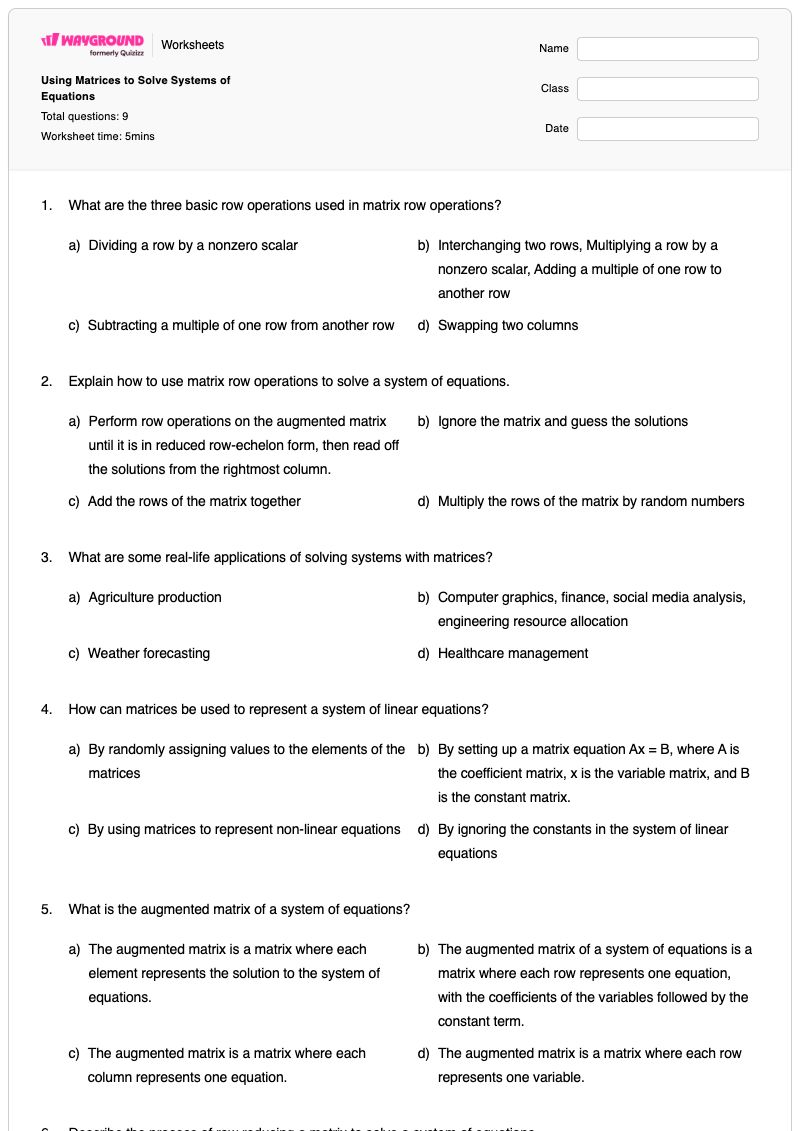
This Grade 11 mathematics worksheet helps students understand how matrices represent and solve systems of linear equations. Across nine multiple-choice questions, students identify the three elementary row operations, recognize an augmented matrix, connect a system to the matrix equation Ax = B, and describe row reduction to row-echelon or reduced row-echelon form. They also review matrix inversion, multiple-variable systems, and the role of consistency and inconsistency. Use this free printable worksheet to check conceptual understanding before students perform extended matrix calculations or after instruction on Gaussian elimination and inverse matrices. The questions ask students to distinguish correct procedures and representations from common misconceptions, while also connecting matrix methods to applications such as computer graphics, finance, social media analysis, and engineering resource allocation. A complete answer key is included for efficient review, feedback, or independent practice.

Worksheet settings

Font size

S
M
L
XL
Worksheets

Using Matrices to Solve Systems of Equations

Total questions: 9

Name
Class
Date
1.

What are the three basic row operations used in matrix row operations?

a)

Dividing a row by a nonzero scalar

b)

Interchanging two rows, Multiplying a row by a nonzero scalar, Adding a multiple of one row to another row

c)

Subtracting a multiple of one row from another row

d)

Swapping two columns

2.

Explain how to use matrix row operations to solve a system of equations.

a)

Perform row operations on the augmented matrix until it is in reduced row-echelon form, then read off the solutions from the rightmost column.

b)

Ignore the matrix and guess the solutions

c)

Add the rows of the matrix together

d)

Multiply the rows of the matrix by random numbers

3.

What are some real-life applications of solving systems with matrices?

a)

Agriculture production

b)

Computer graphics, finance, social media analysis, engineering resource allocation

c)

Weather forecasting

d)

Healthcare management

4.

How can matrices be used to represent a system of linear equations?

a)

By randomly assigning values to the elements of the matrices

b)

By setting up a matrix equation Ax = B, where A is the coefficient matrix, x is the variable matrix, and B is the constant matrix.

c)

By using matrices to represent non-linear equations

d)

By ignoring the constants in the system of linear equations

5.

What is the augmented matrix of a system of equations?

a)

The augmented matrix is a matrix where each element represents the solution to the system of equations.

b)

The augmented matrix of a system of equations is a matrix where each row represents one equation, with the coefficients of the variables followed by the constant term.

c)

The augmented matrix is a matrix where each column represents one equation.

d)

The augmented matrix is a matrix where each row represents one variable.

6.

Describe the process of row reducing a matrix to solve a system of equations.

a)

Perform elementary row operations to transform the matrix into row-echelon form or reduced row-echelon form.

b)

Subtract one row from another row

c)

Multiply the matrix by a scalar value

d)

Add a constant multiple of one row to another row

7.

How can matrices be used to solve problems involving multiple variables?

a)

Matrices are only used for single-variable problems.

b)

Matrices are used to represent non-linear equations.

c)

Matrices can only solve problems with two variables.

d)

Matrices are used to represent systems of linear equations and solve for multiple variables by performing matrix operations.

8.

Explain the concept of matrix inversion and its role in solving systems of equations.

a)

Matrix inversion involves multiplying matrices together to find the solution

b)

Matrix inversion is only used in geometry, not algebra

c)

Matrix inversion is not related to solving systems of equations

d)

Matrix inversion is crucial in solving systems of equations as it simplifies the process of finding the solution by transforming the system into a matrix equation and then using the inverse of the coefficient matrix to find the values of the variables.

9.

Discuss the importance of consistency and inconsistency in matrix systems.

a)

Inconsistency ensures reliability and predictability

b)

Consistency and inconsistency have no impact on matrix systems

c)

Consistency ensures reliability and predictability, while inconsistency can lead to errors and incorrect results.

d)

Consistency leads to errors and incorrect results

Answer Key

Using Matrices to Solve Systems of Equations

Total questions: 9

1.
b)

Interchanging two rows, Multiplying a row by a nonzero scalar, Adding a multiple of one row to another row

2.
a)

Perform row operations on the augmented matrix until it is in reduced row-echelon form, then read off the solutions from the rightmost column.

3.
b)

Computer graphics, finance, social media analysis, engineering resource allocation

4.
b)

By setting up a matrix equation Ax = B, where A is the coefficient matrix, x is the variable matrix, and B is the constant matrix.

5.
b)

The augmented matrix of a system of equations is a matrix where each row represents one equation, with the coefficients of the variables followed by the constant term.

6.
a)

Perform elementary row operations to transform the matrix into row-echelon form or reduced row-echelon form.

7.
d)

Matrices are used to represent systems of linear equations and solve for multiple variables by performing matrix operations.

8.
d)

Matrix inversion is crucial in solving systems of equations as it simplifies the process of finding the solution by transforming the system into a matrix equation and then using the inverse of the coefficient matrix to find the values of the variables.

9.
c)

Consistency ensures reliability and predictability, while inconsistency can lead to errors and incorrect results.

FAQs

What does this worksheet cover about using matrices to solve systems of equations?

This Grade 11 worksheet uses nine multiple-choice questions to assess how students represent systems with an augmented matrix or Ax = B and solve them conceptually through elementary row operations. It also checks understanding of row-echelon and reduced row-echelon form, matrix inversion, consistency, and applications of matrix-based systems.

How can I use this worksheet to teach matrix methods for systems of equations?

Introduce the worksheet after modeling how a system becomes an augmented matrix and how row operations transform that matrix without changing its solution set. Have students explain why each selected operation is valid, then discuss how the rightmost column is used after reduced row-echelon form is reached. The questions on matrix inversion and applications can extend the lesson from procedure to purpose.

What mistakes should I watch for when students complete this matrix systems worksheet?

Watch for students choosing column swaps instead of the three elementary row operations, confusing the coefficient matrix with the augmented matrix, or treating row reduction as adding or scaling rows randomly. Students may also confuse row-echelon form with reduced row-echelon form, overlook the role of the rightmost column in reading solutions, or interpret consistency and inconsistency as interchangeable ideas.

How do I assign and grade this matrix systems worksheet?

The worksheet is available as a printable PDF and as a digital quiz on Wayground, so you can assign the nine multiple-choice questions in the format that fits your lesson. It includes a complete answer key for checking students’ understanding of augmented matrices, row operations, inversion, and consistency. Printable submissions can also be graded by scanning student work with the Wayground for Teachers app.

How can I differentiate this worksheet on matrix systems for my students?

In the worksheet’s Advanced Settings, adjust font spacing or choose a larger font size to make the nine multiple-choice matrix questions easier to read. You can also enable a dyslexia-friendly font or translate the worksheet into another language, while keeping the question structure and matrix terminology intact.

Where can I find more free worksheets like this from Wayground?

Wayground offers a broad collection of free printable worksheets and practice problems across subjects, with downloadable PDFs and answer keys to support mastery of essential skills and concepts. Browse more resources at https://wayground.com/en-us/worksheets.