
Wayground
3.3 Prove Lines Parallel - Printable Math Worksheets 7th Grade - Wayground

3.3 Prove Lines Parallel

Abigail Mitchell

Created by Abigail Mitchell

14 questions

7th Grade

Math

Updated Oct 2026

3.3 Prove Lines Parallel is a Grade 7 mathematics worksheet that builds students’ ability to identify the theorem or postulate that proves two lines are parallel. Across 14 multiple-choice questions, students distinguish direct statements from their converses and select the correct justification involving corresponding, alternate interior, consecutive (same-side) interior, or alternate exterior angles. Several items also ask students to recognize when a relationship, such as vertical angles or a linear pair, cannot prove that lines are parallel. This worksheet is useful for introducing or reviewing how transversals create angle relationships that establish parallel lines. Teachers can use the questions for guided practice, independent review, or a quick check of students’ ability to match a geometric statement with the correct theorem name. It is a free printable worksheet with a complete answer key, and it is also available digitally through Wayground for flexible Grade 7 math practice.

Worksheet settings

Font size

S
M
L
XL
WaygroundWorksheets

3.3 Prove Lines Parallel

Total questions: 14

Name
Class
Date
1.
Which could be used to prove the lines are parallel?

Which could be used to prove the lines are parallel?

a)

Converse of Alternate Interior Angles Theorem

b)

Converse of Same-Side Interior Angles Theorem

c)

Converse of Corresponding Angles Postulate

d)

Cannot be proved parallel

2.
Which could be used to prove the lines are parallel?

Which could be used to prove the lines are parallel?

a)

Converse of Vertical Angles

b)

Converse of Alternate Interior Angles Theorem

c)

Converse of Corresponding Angles Postulate

d)

Cannot be proved parallel

3.
Question Image
a)

No

b)

Yes, Corresponding angles are congruent

c)

Yes, Alternate Interior angles are congruent

d)

Yes, Alternate Exterior angles are congruent

4.
Which could be used to prove the lines are parallel?

Which could be used to prove the lines are parallel?

a)

Converse of Corresponding Angles Postulate

b)

Converse of Alternate Interior Angles Theorem

c)

Converse of Linear Pair

d)

Cannot be proved parallel

5.
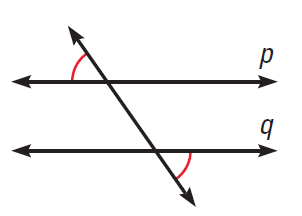
Question Image
a)

No

b)

Yes, Corresponding angles are congruent

c)

Yes, Alternate Interior angles are congruent

d)

Yes, Alternate Exterior angles are congruent

6.
Question Image
a)

No

b)

Yes, Corresponding angles are congruent

c)

Yes, Alternate Interior angles are congruent

d)

Yes, Alternate Exterior angles are congruent

7.
Question Image
a)

No

b)

Yes, corresponding angles are congruent

c)

Yes, consecutive interior angles are congruent

d)

Yes, Alternate exterior angles are congruent

8.
Question Image
a)

Converse of Corresponding Angles Postulate

b)

Corresponding Angles Postulate

c)

Converse of Consecutive Interior Angles Theorem

d)

Converse of Alternate Interior Angles Theorem

9.
Question Image
a)

Consecutive Interior Angles Theorem

b)

Converse of Consecutive Interior Angles Theorem

c)

Converse of Alternate Interior Angles Theorem

d)

Converse of Corresponding Angles Theorem

10.
Which theorem explains why the two lines are parallel?

Which theorem explains why the two lines are parallel?

a)

Alt. Exterior Angles Thm

b)

Same Side Int. Angles Post

c)

Alt. Exterior Angles Converse

d)

Same Side Int. Angles Converse

11.
"If two parallel lines are cut by a transversal then corresponding angles are congruent "

"If two parallel lines are cut by a transversal then corresponding angles are congruent"

a)

Corresponding Angles Postulate

b)

Converse of

Corresponding Angles Postulate

12.
"If alternate interior angles are congruent, then the lines being cut by the transversal are parallel "

"If alternate interior angles are congruent, then the lines being cut by the transversal are parallel"

a)

Alternate Interior Angle Theorem

b)

Converse of Alternate Interior Angle Theorem

13.
"If two parallel lines are intersected by a transversal, then same side interior angles are supplementary "

"If two parallel lines are intersected by a transversal, then same side interior angles are supplementary"

a)

Consecutive Interior Angles Theorem

b)

Converse of

Consecutive Interior Angles Theorem

14.
"If alternate exterior angles are congruent , then the lines are parallel"

"If alternate exterior angles are congruent,

then the lines are parallel"

a)

Alternate Exterior Angles Theorem

b)

Converse of

Alternate Exterior Angles Theorem

WaygroundAnswer Key

3.3 Prove Lines Parallel

Total questions: 14

1.
a)

Converse of Alternate Interior Angles Theorem

2.
d)

Cannot be proved parallel

3.
c)

Yes, Alternate Interior angles are congruent

4.
d)

Cannot be proved parallel

5.
d)

Yes, Alternate Exterior angles are congruent

6.
a)

No

7.
b)

Yes, corresponding angles are congruent

8.
a)

Converse of Corresponding Angles Postulate

9.
b)

Converse of Consecutive Interior Angles Theorem

10.
c)

Alt. Exterior Angles Converse

11.
a)

Corresponding Angles Postulate

12.
b)

Converse of Alternate Interior Angle Theorem

13.
a)

Consecutive Interior Angles Theorem

14.
b)

Converse of

Alternate Exterior Angles Theorem

FAQs

What does the 3.3 Prove Lines Parallel worksheet cover?

This Grade 7 worksheet uses 14 multiple-choice questions to assess whether students can identify the theorem or postulate that proves two lines are parallel. Students distinguish statements from their converses and match angle relationships—including corresponding, alternate interior, consecutive interior, and alternate exterior angles—to the correct justification.

How can I use this worksheet to teach proving lines parallel?

Introduce the worksheet by reviewing how a transversal creates corresponding, alternate interior, same-side interior, and alternate exterior angle pairs. Then have students explain why a statement uses a theorem or postulate, while its reverse requires the converse; discuss why relationships such as vertical angles or a linear pair alone cannot prove the lines are parallel. Use the multiple-choice options to prompt students to compare closely related theorem names.

What mistakes should I watch for on this parallel-lines worksheet?

Watch for students selecting a theorem instead of its converse when the question starts with congruent or supplementary angles and asks them to prove the lines are parallel. Students may also confuse alternate interior with alternate exterior angles, or assume that any true angle relationship—such as vertical angles—proves parallel lines. Ask them to identify both the angle pair and the direction of the statement before choosing an answer.

How do I assign and grade the 3.3 Prove Lines Parallel worksheet?

The worksheet is available as a printable PDF and as a digital quiz on Wayground, with a complete answer key for all 14 multiple-choice questions. Printable submissions can be graded by scanning student work with the Wayground for Teachers app, while the digital version supports online assignment and grading.

How can I differentiate this prove-parallel-lines worksheet for my students?

In the worksheet’s Advanced Settings, adjust font spacing or font size to make the theorem-and-converse choices easier to read. You can also apply a dyslexia-friendly font or translate the multiple-choice worksheet into another language when those options better support access to the angle vocabulary.

Where can I find more worksheets like this on Wayground?

Wayground offers a broad collection of free printable worksheets and practice problems across subjects, including downloadable PDFs and answer keys to help students master essential skills and concepts. Browse more resources at https://wayground.com/en-us/worksheets.