This Grade 8 mathematics worksheet helps students build vocabulary for parallel lines cut by a transversal. It contains 15 multiple-choice questions that ask students to identify and define parallel, perpendicular, and transversal lines; distinguish complementary from supplementary angles; and recognize vertical, corresponding, alternate interior, alternate exterior, same-side interior, and same-side exterior angle pairs. Several items use visual angle-pair diagrams, requiring students to connect the terminology to the positions of angles in a figure.
Use this free printable worksheet as a vocabulary introduction, guided practice, or a quick check before students solve angle-measure problems involving parallel lines. The true-or-false and definition-based items reinforce the relationships between angle position and properties such as congruence, 90-degree sums, and 180-degree sums. The worksheet includes a complete answer key, making it practical for independent practice, review, or formative assessment.
Worksheet settings
Font size
S
M
L
XL
Worksheets
Parallel Lines Cut by a Transversal - Vocabulary
Total questions: 15
Name
Class
Date
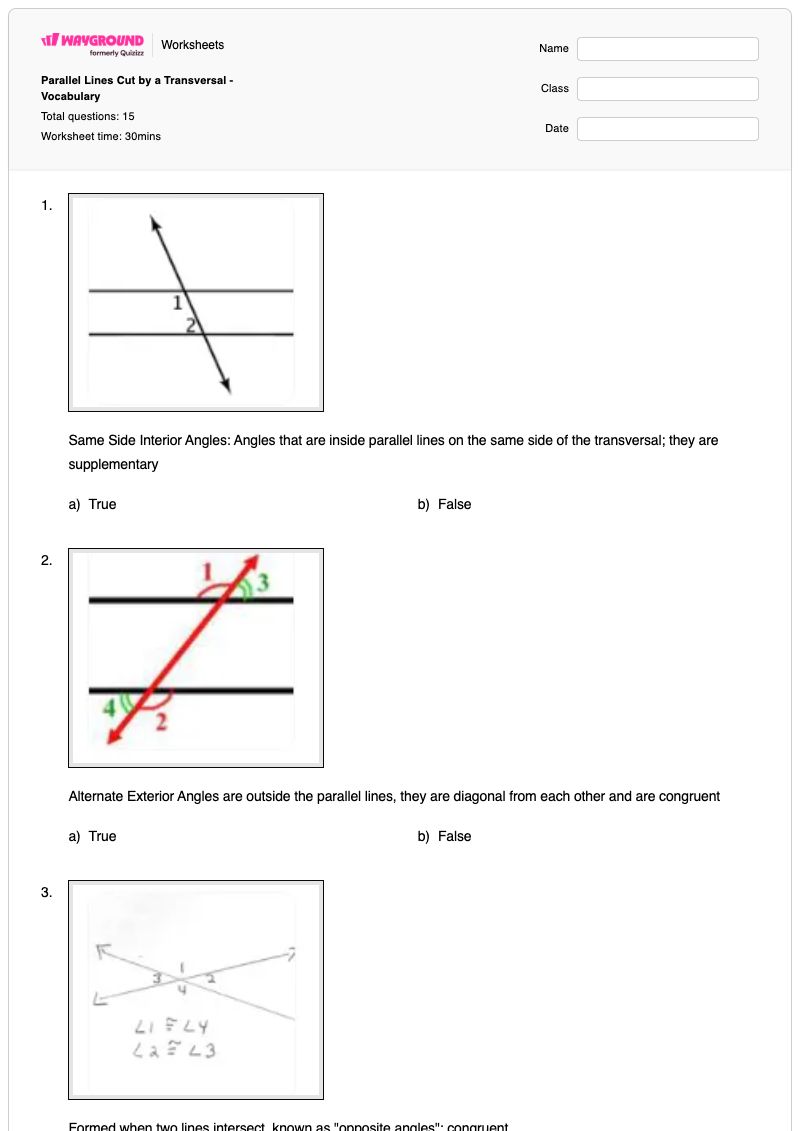
1.
Same Side Interior Angles: Angles that are inside parallel lines on the same side of the transversal; they are supplementary
a)
True
b)
False
2.
Alternate Exterior Angles are outside the parallel lines, they are diagonal from each other and are congruent
a)
True
b)
False
3.
Formed when two lines intersect, known as "opposite angles"; congruent
a)
Same Side Interior Angles
b)
Vertical Angles
c)
Perpendicular Lines
d)
Parallel Lines
4.
Same position on the parallel lines in relation to the transversal; Same position on the figure; congruent
a)
Corresponding Angles
b)
Alternate Interior Angles
c)
Perpendicular Lines
d)
Same Side Interior Angles
5.
Inside the parallel lines; Opposite sides of the transversal; they are diagonal (non adjacent) from each other; congruent
a)
alternate interior angles
b)
alternate exterior angles
c)
same side exterior angles
d)
same side interior angles
6.
Two lines in the same place that never intersect
a)
Transversal
b)
Parallel
c)
Perpendicular
7.
A line that intersects two or more lines
a)
Parallel
b)
Transversal
c)
Perpendicular
8.
Two lines that intersect to form four right angles
a)
Parallel
b)
Transversal
c)
Perpendicular
9.
Outside the parallel lines; same side of the transversal; supplementary
a)
Alternate Exterior Angles
b)
Same Side Exterior Angles
c)
Corresponding Angles
d)
Same Side Interior Angles
10.
Two angles whose sum is 180 degrees
a)
Complementary
b)
Supplementary
c)
Parallel
d)
Right
11.
Two angles whose sum is 90 degrees
a)
Complementary
b)
Supplementary
c)
Perpendicular
d)
Transversal
12.
What type of angles are labeled in the picture?
a)
Same Side Exterior
b)
Corresponding
c)
Complementary
d)
Alternate Interior Angles
13.
Which angle pair is shown in the picture?
a)
Corresponding
b)
Alternate Interior Angles
c)
Alternate Exterior Angles
d)
Same Side Interior Angels
14.
Which type of angles are shown in the picture?
a)
Alternate Interior Angles
b)
Alternate Exterior Angles
c)
Same Side Interior Angles
d)
Same Side Exterior Angles
15.
Which special angle pairs are shown in the picture?
a)
Alternate Interior Angles
b)
Alternate Exterior Angles
c)
Same Side Exterior Angles
d)
Corresponding Angles
Answer Key
Parallel Lines Cut by a Transversal - Vocabulary
Total questions: 15
1.
a)
True
2.
a)
True
3.
b)
Vertical Angles
4.
a)
Corresponding Angles
5.
a)
alternate interior angles
6.
b)
Parallel
7.
b)
Transversal
8.
c)
Perpendicular
9.
b)
Same Side Exterior Angles
10.
b)
Supplementary
11.
a)
Complementary
12.
b)
Corresponding
13.
d)
Same Side Interior Angels
14.
a)
Alternate Interior Angles
15.
b)
Alternate Exterior Angles
140 %
Browse by subjects
Browse by grades
Browse by format
FAQs
What does the Parallel Lines Cut by a Transversal - Vocabulary worksheet cover?
This Grade 8 worksheet develops vocabulary for identifying relationships formed when a transversal intersects parallel lines. Its 15 multiple-choice items ask students to match definitions and diagrams with terms such as corresponding, alternate interior, alternate exterior, same-side interior, same-side exterior, and vertical angles, while also distinguishing complementary and supplementary angles.
How can I use this worksheet to teach angle relationships formed by a transversal?
Introduce the worksheet by having students mark the interior and exterior regions and trace the transversal on a parallel-lines diagram. Then model one angle-pair category at a time, asking students to explain whether the angles are in the same or opposite positions and whether the relationship indicates congruence or a supplementary sum. Use the definition and picture-based multiple-choice items for guided practice before assigning the remaining questions independently.
What mistakes should I watch for when students complete this angle vocabulary worksheet?
Watch for students confusing corresponding angles with alternate interior angles: corresponding angles occupy the same relative position, while alternate interior angles lie inside the parallel lines on opposite sides of the transversal. Students may also reverse same-side interior and same-side exterior pairs, or confuse supplementary angles, which total 180 degrees, with complementary angles, which total 90 degrees. The diagram questions are useful for checking whether students are classifying position rather than choosing a term from memory.
How do I assign and grade this Parallel Lines Cut by a Transversal worksheet?
On Wayground, assign this worksheet either as a printable PDF or as a digital quiz containing the 15 multiple-choice questions. It includes a complete answer key for checking the vocabulary definitions and diagram-based angle-pair identifications. For printable submissions, teachers can scan student work with the Wayground for Teachers app to support grading.
How can I differentiate this angle-pair vocabulary worksheet for my students?
Use the worksheet’s Advanced Settings to increase font size or adjust font spacing so the definition-based choices and angle-pair diagrams are easier to read. You can also select a dyslexia-friendly font or translate the worksheet into another language, helping students access terms such as corresponding, alternate interior, and supplementary while working through the multiple-choice items.
Where can I find more worksheets like this on Wayground?
Wayground offers a comprehensive collection of free printable worksheets and practice problems across all subjects, with downloadable PDFs and answer keys to help students master essential skills and concepts. Browse more resources at https://wayground.com/en-us/worksheets.


 Worksheets


