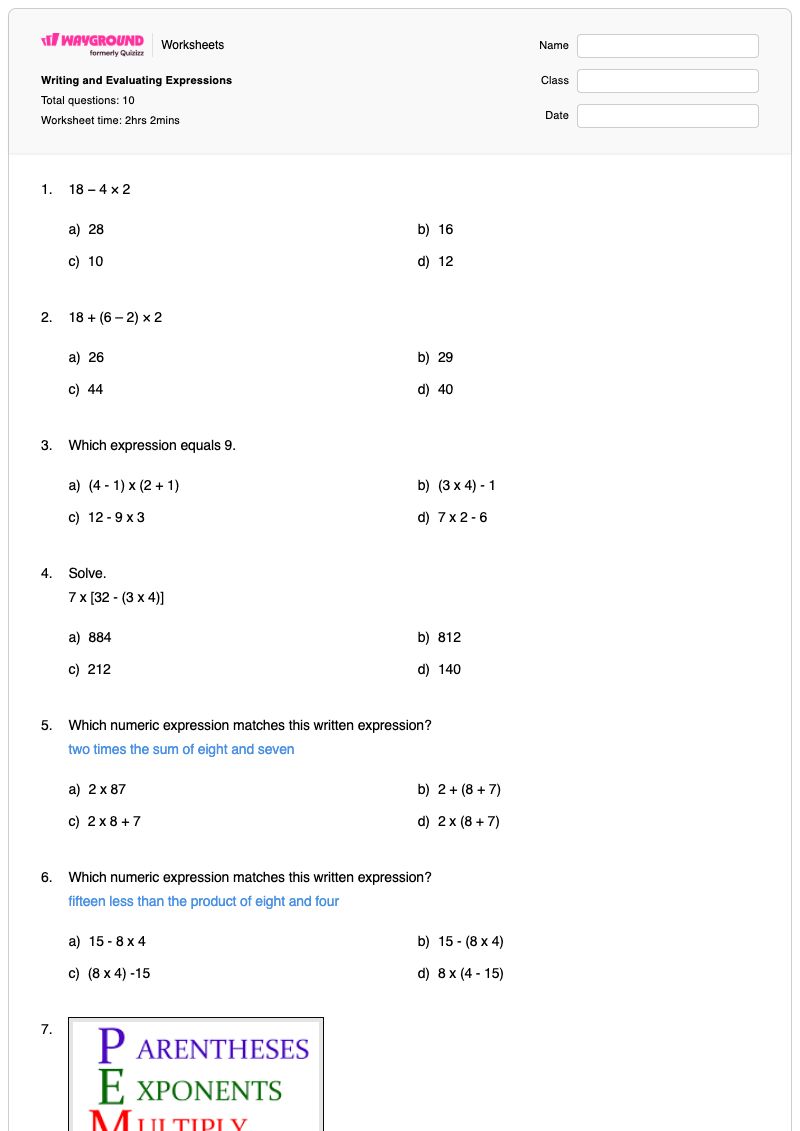
This Grade 5 mathematics worksheet helps students write and evaluate numerical expressions using the order of operations. Across 10 multiple-choice questions, students solve expressions with parentheses, multiplication, division, addition, and subtraction; identify the first operation to complete; interpret the “E” in PEMDAS as exponents; and select numerical expressions that match verbal descriptions such as “two times the sum” or “fifteen less than the product.”
The worksheet gives teachers a focused way to check whether students understand both the structure and value of an expression. Items include evaluating expressions such as 18 − 4 × 2 and 7 × [32 − (3 × 4)], recognizing equivalent expressions, and sequencing operations in a multi-step problem. Designed for Grade 5 math instruction, this free printable worksheet includes a complete answer key for independent practice, classwork, homework, or quick assessment.
Worksheet settings
Font size
S
M
L
XL
Worksheets
Writing and Evaluating Expressions
Total questions: 10
Name
Class
Date
1.
18 − 4 × 2
a)
28
b)
16
c)
10
d)
12
2.
18 + (6 – 2) × 2
a)
26
b)
29
c)
44
d)
40
3.
Which expression equals 9.
a)
(4 - 1) x (2 + 1)
b)
(3 x 4) - 1
c)
12 - 9 x 3
d)
7 x 2 - 6
4.
Solve. 7 x [32 - (3 x 4)]
a)
884
b)
812
c)
212
d)
140
5.
Which numeric expression matches this written expression? two times the sum of eight and seven
a)
2 x 87
b)
2 + (8 + 7)
c)
2 x 8 + 7
d)
2 x (8 + 7)
6.
Which numeric expression matches this written expression? fifteen less than the product of eight and four
a)
15 - 8 x 4
b)
15 - (8 x 4)
c)
(8 x 4) -15
d)
8 x (4 - 15)
7.
What would be my first step? 3 + 4 x 6 - 4 =
a)
addition
b)
multiplication
c)
subtraction
d)
exponents
8.
(10 + 33 - 3) ÷ 8
a)
13
b)
3
c)
5
d)
11
9.
What does the ( E )in PEMDAS mean?
a)
experience
b)
exponents
c)
examples
d)
evidence
10.
What are the steps to solve the following expression? 50 − 16 ÷ 2 ∗ (12 + 4)
a)
parentheses multiplication subtraction division
b)
parentheses multiplication division subtraction
c)
parentheses division multiplication subtraction
d)
parentheses subtraction multiplication division
Answer Key
Writing and Evaluating Expressions
Total questions: 10
1.
c) 10
2.
a) 26
3.
a) (4 - 1) x (2 + 1)
4.
d) 140
5.
d) 2 x (8 + 7)
6.
c) (8 x 4) -15
7.
b) multiplication
8.
c) 5
9.
b) exponents
10.
c) parentheses division multiplication subtraction
140 %
Browse by subjects
Browse by grades
Browse by format
FAQs
What does the Writing and Evaluating Expressions worksheet cover?
This Grade 5 worksheet covers writing and evaluating numerical expressions with parentheses and the order of operations. Its 10 multiple-choice questions ask students to calculate expressions, identify the first operation in an expression, interpret PEMDAS, and match verbal phrases such as “two times the sum of eight and seven” to the correct numerical expression.
How can I use this worksheet to teach writing and evaluating expressions?
Introduce the worksheet by modeling how parentheses and operation priority determine the structure and value of an expression. Think aloud with an item such as 18 + (6 − 2) × 2, then have students explain why the grouped subtraction is completed before multiplication and addition. Use the verbal-expression items to connect phrases such as “the product of” and “less than” to mathematical symbols before students complete the remaining questions.
What mistakes should I watch for on this expressions worksheet?
Watch for students performing operations strictly from left to right instead of following PEMDAS, especially in items such as 18 − 4 × 2 and 50 − 16 ÷ 2 × (12 + 4). Students may also omit parentheses when translating phrases, reverse the meaning of “fifteen less than the product,” or choose the wrong first step when multiplication and addition appear together. Check that they recognize the E in PEMDAS as exponents, even though the practice expressions primarily emphasize grouping and the other operations.
How do I assign and grade the Writing and Evaluating Expressions worksheet?
Assign it as a printable PDF or as a digital quiz on Wayground, depending on whether students should complete the 10 multiple-choice items on paper or online. The worksheet includes a complete answer key, and printable submissions can be graded by scanning student work with the Wayground for Teachers app. The PDF option can also support classrooms or schools that are reducing screen time.
How can I differentiate this expressions worksheet for my students?
Use the worksheet’s Advanced Settings to adjust font spacing or increase the font size so the multi-step expressions, brackets, and answer choices are easier to read. You can also enable a dyslexia-friendly font or translate the worksheet into another language when those options support access to the numerical-expression and PEMDAS practice.
Where can I find more free worksheets like this on Wayground?
Wayground provides a comprehensive collection of free printable worksheets and practice problems across all subjects, with downloadable PDFs and answer keys to help students master essential skills and concepts. Browse more resources at https://wayground.com/en-us/worksheets.


 Worksheets
