

Wayground
Lab Safety/Measurement 2020 - Printable Science Worksheets kindergarten - Wayground

Lab Safety/Measurement 2020

David Hohenadel

Created by David Hohenadel

16 questions

6th Grade

Science

Updated Aug 2026

Lab Safety/Measurement 2020 is a free printable Grade 6 science worksheet that combines introductory measurement with essential laboratory safety. Across 16 items, students read a mass value and a graduated-cylinder volume, identify metric base units for mass, volume, and length, and distinguish mass from weight. They also apply Celsius and Fahrenheit reference points for water’s freezing and boiling temperatures and identify the metric system. The worksheet uses multiple-choice, fill-in-the-blank, and multiple-select questions to check both vocabulary and practical decision-making. Students select appropriate precautions for lab work involving fire and chemicals, including wearing goggles, checking chemical labels, securing long hair, and avoiding loose clothing. A complete answer key is included, making this free worksheet useful for classroom practice, review, or an introductory assessment.

Worksheet settings

Font size

S
M
L
XL
WaygroundWorksheets

Lab Safety/Measurement 2020

Total questions: 16

Name
Class
Date
1.
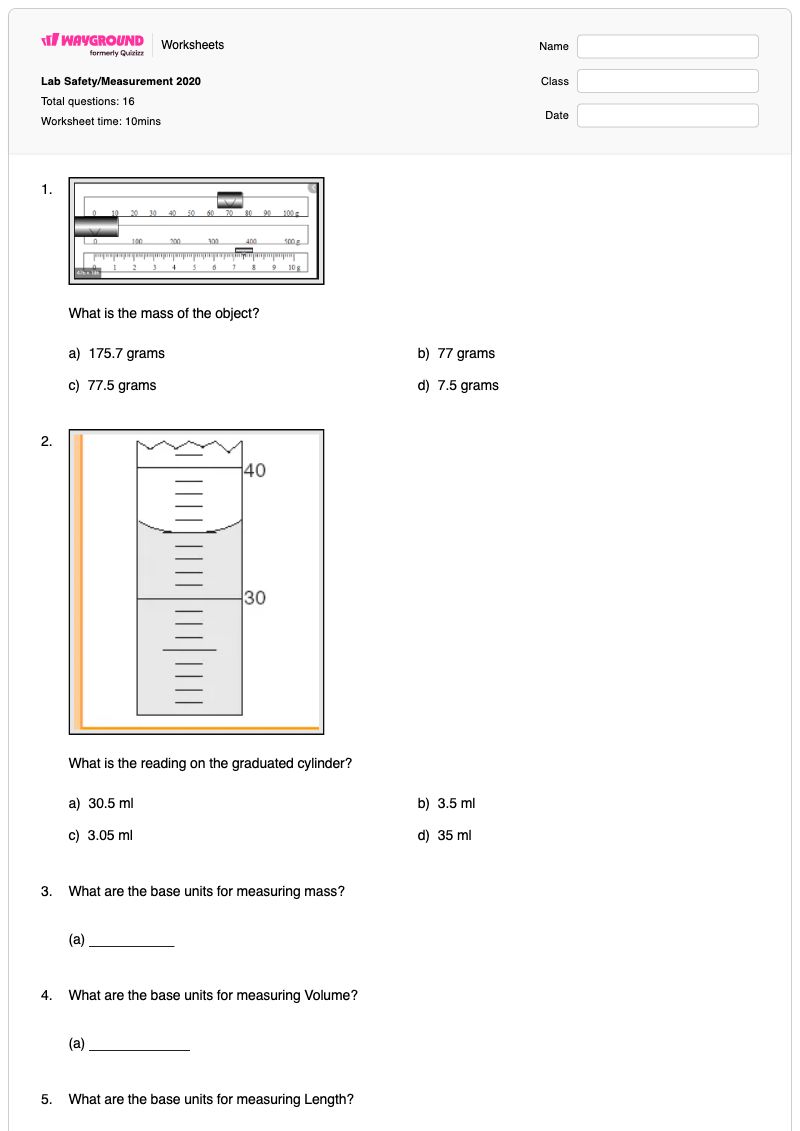
What is the mass of the object?

What is the mass of the object?

a)

175.7 grams

b)

77 grams

c)

77.5 grams

d)

7.5 grams

2.
What is the reading on the graduated cylinder?

What is the reading on the graduated cylinder?

a)

30.5 ml

b)

3.5 ml

c)

3.05 ml

d)

35 ml

3.

What are the base units for measuring mass?

(a)  

4.

What are the base units for measuring Volume?

(a)  

5.

What are the base units for measuring Length?

(a)  

6.

Which of the following are the temperature that water boils? (SELECT ALL THAT APPLY)

a)

212 Fahrenheit

b)

100 Fahrenheit

c)

212 Celcius

d)

100 Celcius

7.

Which of the following are the temperature that water freezes? (SELECT ALL THAT APPLY)

a)

32 Fahrenheit

b)

0 Fahrenheit

c)

0 Celcius

d)

32 Celcius

8.

Mass is....

a)

The amount of space in an object

b)

The amount of matter in an object

c)

The point at which water freezes

d)

The pull of Earth's gravity on an object

9.

Weight is....

a)

The amount of space in an object

b)

The amount of matter in an object

c)

The point at which water freezes

d)

The pull of Earth's gravity on an object

10.

What is the system of measurement that all scientist us around the world? (gram, meter, liter)

a)

American System

b)

Standard System

c)

Metric System

d)

Imperial System

11.

When should goggles be worn in the lab?

a)

At all times during a lab

b)

Only when you are close to fire

c)

When you forget your glasses

d)

Only when it matches your outfit

12.

There is a lab that utilizes fire for an experiment, what lab safety precautions should you take? (Select all that apply)

a)

Make sure clothes are not baggy

b)

Wear your goggles

c)

If you have long hair, tie it back

13.

Which word means a safety measure you take to protect you from something dangerous?

a)

Precaution

b)

Warning

c)

Hazard

d)

Checklist

14.

Which word means something that could be dangerous

a)

Precaution

b)

Warning

c)

Hazard

d)

Checklist

15.

When working with chemicals what precautions should we take? (Select all that apply)

a)

Make sure to sniff each chemical, to make sure they are correct

b)

Wear safety goggles

c)

Check labels of chemicals, to make sure they are correct

d)

Put your pencil in the solution to see if there is a reaction

16.

What tool would we use to measure the mass of a tennis ball?

a)

Spring Scale

b)

Graduated Cylinder

c)

Meter stick

d)

Triple Beam Balance

WaygroundAnswer Key

Lab Safety/Measurement 2020

Total questions: 16

1.
c)

77.5 grams

2.
d)

35 ml

3.
gram, grams
4.
Liter, Liters
5.
meter, meters
6.
a)

212 Fahrenheit

, d)

100 Celcius

7.
a)

32 Fahrenheit

, c)

0 Celcius

8.
b)

The amount of matter in an object

9.
d)

The pull of Earth's gravity on an object

10.
c)

Metric System

11.
a)

At all times during a lab

12.
a)

Make sure clothes are not baggy

, b)

Wear your goggles

, c)

If you have long hair, tie it back

13.
a)

Precaution

14.
c)

Hazard

15.
b)

Wear safety goggles

, c)

Check labels of chemicals, to make sure they are correct

16.
d)

Triple Beam Balance

FAQs

What does the Lab Safety/Measurement 2020 worksheet cover?

This Grade 6 science worksheet builds skill in reading mass and graduated-cylinder volume measurements, identifying metric units for mass, volume, and length, and distinguishing mass from weight. Its 16 questions use multiple choice, fill-in-the-blank, and multiple-select formats to reinforce Celsius and Fahrenheit water temperatures, metric-system vocabulary, and safe practices for labs involving fire and chemicals.

How can I use this worksheet to teach measurement and lab safety?

Begin by modeling how to read the displayed mass and graduated-cylinder measurements, then review grams, liters, and meters and contrast mass with weight. Use the temperature and metric-system items to connect measurement vocabulary to familiar reference points before discussing why goggles, labeled chemicals, tied-back hair, and non-baggy clothing matter in the worksheet’s fire and chemical-lab scenarios. Finish with the multiple-select questions so students explain why more than one precaution may be correct.

What mistakes should I watch for when students complete this worksheet?

Students may confuse mass with weight, select the wrong metric unit, or misread the graduated-cylinder value by overlooking the decimal or the unit. Watch for confusion between Celsius and Fahrenheit when identifying water’s freezing and boiling temperatures. In the multiple-select safety items, students may choose only one correct precaution or select unsafe actions such as sniffing chemicals or testing a solution with a pencil.

How do I assign and grade this Lab Safety/Measurement worksheet?

The worksheet is available as a printable PDF and as a digital quiz on Wayground, and it includes a complete answer key for the measurement, temperature, vocabulary, and safety items. Printable submissions can be graded by scanning student work with the Wayground for Teachers app. The printable format also gives schools an option for reducing screen time.

How can I differentiate this worksheet for my students?

Use the worksheet’s Advanced Settings to adjust font spacing and font size so the measurement, vocabulary, and safety questions are easier to navigate. You can also enable a dyslexia-friendly font or translate the worksheet into another language, while keeping its multiple-choice, fill-in-the-blank, and multiple-select formats intact.

Where can I find more worksheets like this on Wayground?

Wayground offers a comprehensive collection of free printable worksheets and practice problems across subjects, with downloadable PDFs and answer keys to help students master essential skills and concepts. Browse more resources at https://wayground.com/en-us/worksheets.