This Grade 7 science worksheet helps students distinguish metric and imperial measurement systems and match units to the quantities they measure. Across 15 questions—12 multiple-choice and 3 multiple-select—students identify units for length, mass or weight, liquid volume, dry volume, and temperature. They also select suitable units for real-world measurements, such as using an inch to measure a child’s thumb, and compare relative length units such as inch, foot, yard, and mile.
The worksheet reinforces precise classification of units, including recognizing meters, centimeters, and kilometers as length units; grams as a metric mass unit; Celsius and Fahrenheit as temperature units; and pints, gallons, quarts, bushels, and pecks as volume units. It is a free printable worksheet with an answer key for Grade 7 science instruction, independent practice, review, or assessment. The mix of single-answer and multiple-select items lets teachers check whether students can identify every correct unit in a category rather than relying on partial recognition.
Worksheet settings
Font size
S
M
L
XL
Worksheets
Metric/Imperial Units
Total questions: 15
Name
Class
Date
1.
A centimeter is part of which system of measurement?
a)
Metric
b)
Imperial
2.
An inch is part of which system of measurement?
a)
Metric
b)
Imperial
3.
What is the metric unit for mass/weight?
a)
liter
b)
pound
c)
gram
d)
ounce
4.
Which of these are used to measure length.
a)
cm
b)
mm
c)
km
d)
all of them
5.
Which one(s) are the imperial unit(s) for measuring liquid volume?
a)
pint
b)
centimeter
c)
liter
d)
celsius
6.
Celsius is a metric unit for measuring ______________.
a)
length
b)
mass
c)
volume
d)
temperature
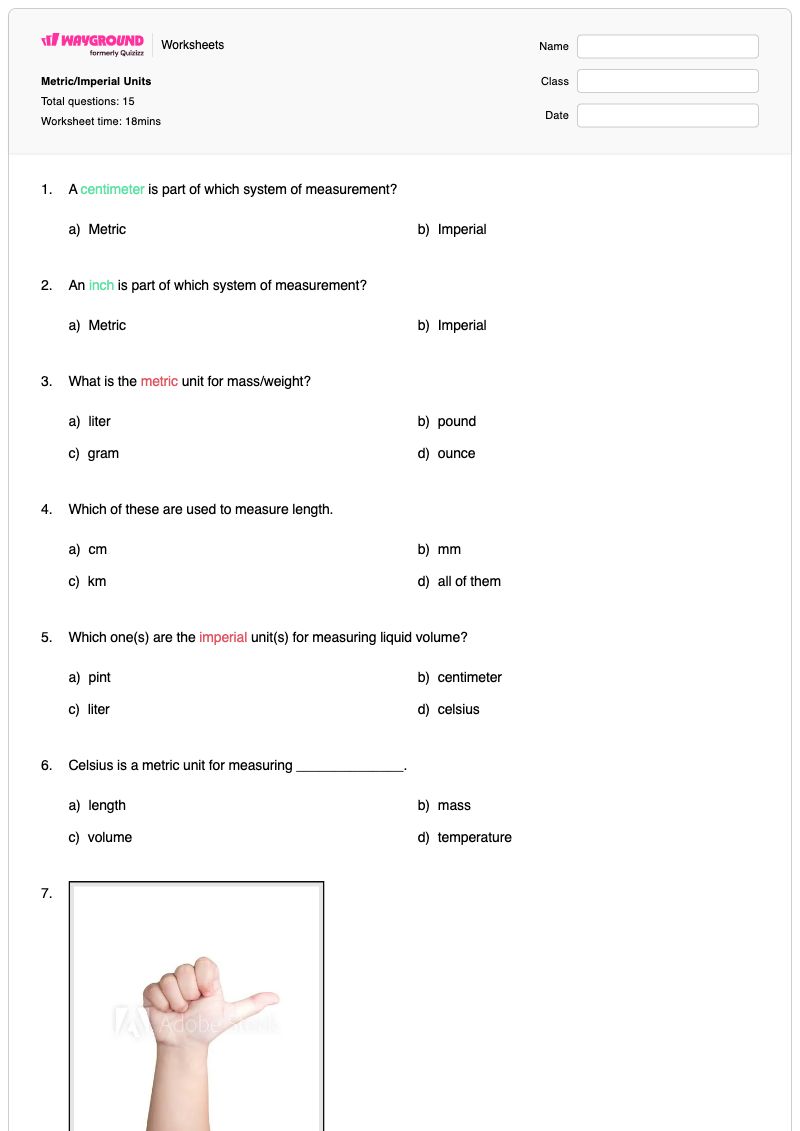
7.
Which is the suitable imperial unit to measure the length of a child's thumb?
a)
inch
b)
mile
c)
pound
d)
pint
8.
What is the metric unit for measuring length?
a)
meter
b)
mile
c)
yard
9.
Gallon, pints, and quarts are imperial units for measuring _______________
a)
dry volume
b)
mass/weight
c)
liquid volume
d)
length
10.
Which is the largest imperial unit of measure for length?
a)
inch (in.)
b)
foot (ft)
c)
yard (yd)
d)
mile (mi)
11.
Which of these is an imperial unit for measuring dry volume?
a)
bushel
b)
peck
c)
liter
d)
quart
12.
What is the imperial unit for measuring temperature?
a)
Fahrenheit
b)
liter
c)
celsius
d)
centimeter
13.
Which of these is NOT a metric unit?
a)
celsius
b)
centimeter
c)
gram
d)
peck
14.
Which of these are imperial units for measuring length?
a)
foot
b)
mile
c)
meter
d)
centimeter
15.
What measurement do the following units measure?
liter, bushel, peck
a)
liquid volume
b)
temperature
c)
length
d)
dry volume
Answer Key
Metric/Imperial Units
Total questions: 15
1.
a) Metric
2.
b) Imperial
3.
c)
gram
4.
d)
all of them
5.
a)
pint
6.
d)
temperature
7.
a)
inch
8.
a)
meter
9.
c)
liquid volume
10.
d)
mile (mi)
11.
a)
bushel
, b)
peck
, d)
quart
12.
a)
Fahrenheit
13.
d)
peck
14.
a)
foot
, b)
mile
15.
d)
dry volume
140 %
Browse by subjects
Browse by grades
Browse by format
FAQs
What does the Metric/Imperial Units worksheet cover?
This Grade 7 science worksheet asks students to classify metric and imperial units by what they measure: length, mass or weight, liquid volume, dry volume, or temperature. Its 12 multiple-choice and 3 multiple-select questions build accuracy by having students identify units such as meter, gram, pint, bushel, Celsius, and Fahrenheit, choose an appropriate unit for a familiar length, and distinguish the largest listed imperial length unit.
How can I use this worksheet to teach metric and imperial units?
Introduce the worksheet by organizing the units on the page into two systems and five measurement categories, then model one comparison such as meter versus mile or liter versus gallon. Have students explain why an inch fits the child’s-thumb question, and pause on the multiple-select items so they justify every selected dry-volume or imperial-length unit before completing the remaining questions independently.
What mistakes should I watch for when students complete this worksheet?
Watch for students who identify a unit correctly but place it in the wrong system, such as treating an inch as metric or a gram as imperial. They may also confuse liquid volume with dry volume, select Celsius for an imperial-temperature question, or choose only one option on a multiple-select item when several units—such as bushel, peck, and quart—are correct.
How do I assign and grade this Metric/Imperial Units worksheet?
On Wayground, assign it as a digital quiz or download the printable PDF; the worksheet includes a complete answer key for all 15 questions. Printable submissions can be graded by scanning student work with the Wayground for Teachers app, while the digital version records student responses for online review.
How can I differentiate this metric and imperial units worksheet for my students?
In the worksheet’s Advanced Settings, adjust font spacing or choose a larger font size to make the unit names and answer choices easier to read. You can also enable a dyslexia-friendly font or translate the worksheet into another language, which may help students process measurement vocabulary across the multiple-choice and multiple-select items.
Where can I find more worksheets like this on Wayground?
Wayground offers a comprehensive collection of free printable worksheets and practice problems across subjects, with downloadable PDFs and answer keys to support essential skills and concepts. Browse more resources at https://wayground.com/en-us/worksheets.


 Worksheets
