

Wayground
Lesson 5.17 - Review Electric and Magnetic Forces - Printable Science Worksheets grade 3 - Wayground

Lesson 5.17 - Review Electric and Magnetic Forces

Danica Rosales

Created by Danica Rosales

10 questions

3rd Grade

Science

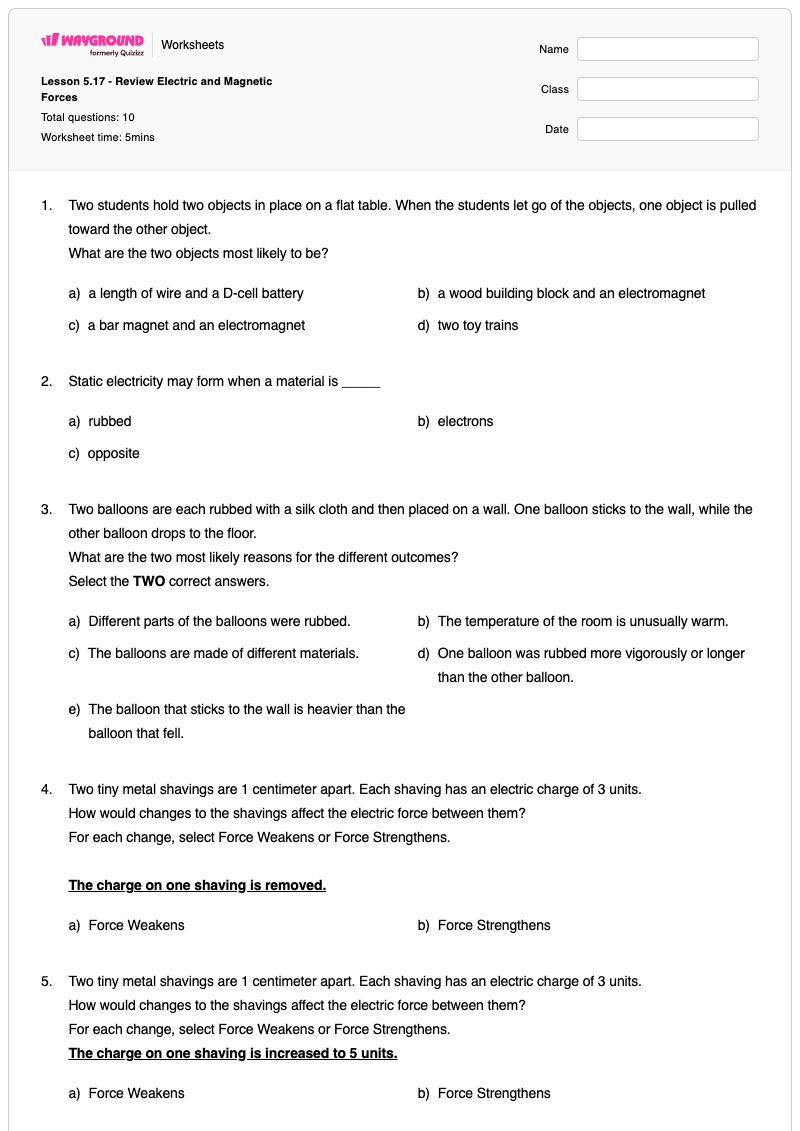
Lesson 5.17 - Review Electric and Magnetic Forces is a Grade 3 science worksheet that reviews how electric and magnetic forces change in familiar situations. Across 10 questions—9 multiple choice and 1 multiple-select—students identify objects that attract, recognize that rubbing can produce static electricity, and determine how changing charge or distance makes electric force weaken or strengthen. They also compare materials for magnetic attraction and consider how a powerful electromagnet can affect a magnetic compass. This free printable worksheet helps students apply force concepts to scenarios involving balloons, metal shavings, magnets, spoons, and a drone rather than simply recall definitions. It is suitable for independent practice, a review lesson, or a quick check of understanding after instruction on electric and magnetic forces. A complete answer key is included for efficient checking and feedback.

Worksheet settings

Font size

S
M
L
XL
WaygroundWorksheets

Lesson 5.17 - Review Electric and Magnetic Forces

Total questions: 10

Name
Class
Date
1.

Two students hold two objects in place on a flat table. When the students let go of the objects, one object is pulled toward the other object. 

What are the two objects most likely to be?

a)

a length of wire and a D-cell battery

b)

a wood building block and an electromagnet

c)

a bar magnet and an electromagnet

d)

two toy trains

2.

Static electricity may form when a material is _____​

a)

rubbed

b)

electrons

c)

opposite

3.

Two balloons are each rubbed with a silk cloth and then placed on a wall. One balloon sticks to the wall, while the other balloon drops to the floor.

What are the two most likely reasons for the different outcomes?

Select the TWO correct answers.

a)

Different parts of the balloons were rubbed.

b)

The temperature of the room is unusually warm.

c)

The balloons are made of different materials.

d)

One balloon was rubbed more vigorously or longer than the other balloon.

e)

The balloon that sticks to the wall is heavier than the balloon that fell.

4.

Two tiny metal shavings are 1 centimeter apart. Each shaving has an electric charge of 3 units.

How would changes to the shavings affect the electric force between them?

For each change, select Force Weakens or Force Strengthens.


The charge on one shaving is removed.

a)

Force Weakens

b)

Force Strengthens

5.

Two tiny metal shavings are 1 centimeter apart. Each shaving has an electric charge of 3 units.

How would changes to the shavings affect the electric force between them?

For each change, select Force Weakens or Force Strengthens.

The charge on one shaving is increased to 5 units.

a)

Force Weakens

b)

Force Strengthens

6.

Two tiny metal shavings are 1 centimeter apart. Each shaving has an electric charge of 3 units.

How would changes to the shavings affect the electric force between them?

For each change, select Force Weakens or Force Strengthens.

The charge on each shaving is increased to 5 units.

a)

Force Weakens

b)

Force Strengthens

7.

Two tiny metal shavings are 1 centimeter apart. Each shaving has an electric charge of 3 units.

How would changes to the shavings affect the electric force between them?

For each change, select Force Weakens or Force Strengthens.

The distance between the shavings is increased to 2 centimeters.

a)

Force Weakens

b)

Force Strengthens

8.

Two tiny metal shavings are 1 centimeter apart. Each shaving has an electric charge of 3 units.

How would changes to the shavings affect the electric force between them?

For each change, select Force Weakens or Force Strengthens.

The distance between the shavings decreased to one half a centimeter.

a)

Force Weakens

b)

Force Strengthens

9.

Two small spoons are placed at the same distance from the poles of a bar magnet. One spoon is attracted to the magnet, while the other spoon experiences no magnetic force.

What property must differ between the two spoons?


a)

  • size

b)

texture

c)

type of material

d)

mass

10.

A drone uses a magnetic compass to find its way. The drone flies near a powerful electromagnet, such as a magnet that lifts scrap metal at a junkyard.

How would the drone most likely be affected?

a)

The drone would fly faster and more accurately.

b)

The drone would stop flying and drop to the ground.

c)

The drone would fly in the wrong direction, and soon crash.

d)

The drone would be pushed away from the electromagnet.

WaygroundAnswer Key

Lesson 5.17 - Review Electric and Magnetic Forces

Total questions: 10

1.
c)

a bar magnet and an electromagnet

2.
a)

rubbed

3.
c)

The balloons are made of different materials.

, d)

One balloon was rubbed more vigorously or longer than the other balloon.

4.
a)

Force Weakens

5.
b)

Force Strengthens

6.
b)

Force Strengthens

7.
a)

Force Weakens

8.
b)

Force Strengthens

9.
c)

type of material

10.
c)

The drone would fly in the wrong direction, and soon crash.

FAQs

What does this electric and magnetic forces worksheet cover?

This Grade 3 worksheet uses 9 multiple-choice questions and 1 multiple-select question to review static electricity, electric force, magnetic materials, electromagnets, and compass interference. Students determine how removing or increasing charge and changing the distance between charged objects affects force, then apply magnetic-force ideas to objects such as spoons, balloons, and a drone near an electromagnet.

How can I use this worksheet to teach electric and magnetic forces?

Use the worksheet after demonstrations such as rubbing balloons with cloth, testing which materials respond to a magnet, or discussing how a compass responds near a powerful electromagnet. Before students answer, ask them to predict whether each change to the metal shavings—more charge, less charge, greater distance, or smaller distance—will strengthen or weaken electric force, then have them explain their choices using the scenarios in the worksheet.

What mistakes should I watch for when students complete this worksheet?

Watch for students choosing answers based on an object's size, weight, or appearance instead of its material or charge-related conditions. In the balloon multiple-select item, students may select only one reason or overlook that both the balloon materials and how vigorously or how long they were rubbed can account for different outcomes. Students may also reverse the effects of changing charge and distance on electric force or assume a nearby electromagnet improves a compass-guided drone's direction.

How do I assign and grade this electric and magnetic forces worksheet?

The worksheet is available as a printable PDF and as a digital quiz on Wayground, with a complete answer key for all 10 questions. You can grade printed student submissions by scanning their work with the Wayground for Teachers app, while the digital quiz supports online response collection and review.

How can I differentiate this worksheet for my students?

In the worksheet's Advanced Settings, adjust font spacing or choose a larger font size to make the force-change scenarios and answer choices easier to follow. You can also enable a dyslexia-friendly font or translate the worksheet into another language, while keeping the multiple-choice and multiple-select format intact.

Where can I find more free worksheets like this on Wayground?

Wayground offers a comprehensive collection of free printable worksheets and practice problems across subjects, with downloadable PDFs and answer keys to help students master essential skills and concepts. Browse more resources at https://wayground.com/en-us/worksheets.