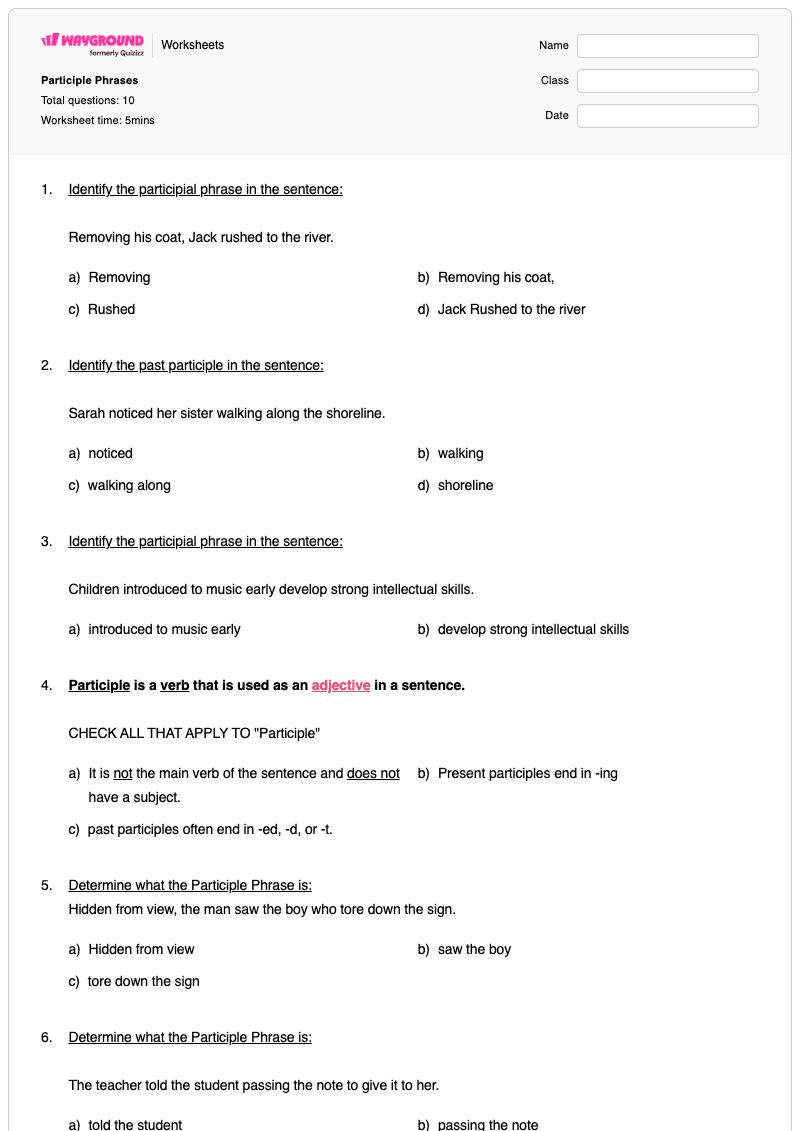
Participle Phrases is a free printable English worksheet for students in Grades 7–12. It provides 10 questions—9 multiple-choice and 1 multiple-select—that ask learners to identify participles and participial phrases in complete sentences, distinguish a participle from the sentence’s main verb, and recognize present and past participle forms. The examples include phrases such as “Removing his coat,” “introduced to music early,” and “Having played sports,” helping students examine how verb forms function as adjectives.
Use this worksheet to reinforce grammar instruction, provide independent practice, or check whether students can locate a participle or the full participial phrase within a sentence. The multiple-select item also checks students’ understanding that participles are not main verbs and reviews common endings, including -ing and -ed, -d, or -t. A complete answer key is included for efficient review and grading.
Worksheet settings
Font size
S
M
L
XL
Worksheets
Participle Phrases
Total questions: 10
Name
Class
Date
1.
Identify the participial phrase in the sentence:
Removing his coat, Jack rushed to the river.
a)
Removing
b)
Removing his coat,
c)
Rushed
d)
Jack Rushed to the river
2.
Identify the past participle in the sentence:
Sarah noticed her sister walking along the shoreline.
a)
noticed
b)
walking
c)
walking along
d)
shoreline
3.
Identify the participial phrase in the sentence:
Children introduced to music early develop strong intellectual skills.
a)
introduced to music early
b)
develop strong intellectual skills
4.
Participle is a verbthat is used as an adjective in a sentence.
CHECK ALL THAT APPLY TO "Participle"
a)
It is not the main verb of the sentence and does not have a subject.
b)
Present participles end in -ing
c)
past participles often end in -ed, -d, or -t.
5.
Determine what the Participle Phrase is:
Hidden from view, the man saw the boy who tore down the sign.
a)
Hidden from view
b)
saw the boy
c)
tore down the sign
6.
Determine what the Participle Phrase is:
The teacher told the student passing the note to give it to her.
a)
told the student
b)
passing the note
c)
to give it to her
7.
Determine what the Participle is:
I watched the dog charging toward me.
a)
watched
b)
charging
8.
Determine what the Participle is:
Sighing happily, she folded and put away the letter.
a)
sighing
b)
folded and put
9.
Determine what the Participle is:
Having played sports in the past, Jim knew the importance of stretching first.
a)
Having played sports
b)
knew the importance of stretching
10.
Determine what the Participle is:
The jacket was covered by dragons flying through the night sky.
a)
covered by dragons
b)
flying through the night sky
Answer Key
Participle Phrases
Total questions: 10
1.
b)
Removing his coat,
2.
a)
noticed
3.
a)
introduced to music early
4.
a)
It is not the main verb of the sentence and does not have a subject.
, b)
Present participles end in -ing
, c)
past participles often end in -ed, -d, or -t.
5.
a)
Hidden from view
6.
b)
passing the note
7.
b)
charging
8.
a)
sighing
9.
a)
Having played sports
10.
a)
covered by dragons
140 %
Browse by subjects
Browse by grades
Browse by format
FAQs
What does the Participle Phrases worksheet cover?
This worksheet helps students identify individual participles and complete participial phrases in sentences, including phrases placed at the beginning or later in a sentence. Its 9 multiple-choice questions and 1 multiple-select question also reinforce that a participle functions as an adjective rather than as the sentence’s main verb, while reviewing common present and past participle forms.
How can I use this worksheet to teach participles and participial phrases?
Introduce the idea by having students locate the sentence’s main verb first, then ask which remaining verb form describes a noun. Use the worksheet examples to model the difference between a single participle, such as “charging,” and a longer participial phrase, such as “passing the note,” before students complete the identification questions independently. Review the multiple-select item afterward to consolidate the definition and common endings.
What mistakes should I watch for when students complete this worksheet?
Students may choose only one word when the question asks for the full participial phrase, as in “Removing his coat” or “Having played sports.” They may also confuse the participle with the main verb, such as selecting “knew” instead of “Having played sports,” or overlook that the multiple-select question requires all three correct statements to be selected.
How do I assign and grade this Participle Phrases worksheet?
The worksheet is available as a printable PDF and as a digital quiz on Wayground, and it includes a complete answer key for checking the 10 responses. For printable submissions, you can scan student work with the Wayground for Teachers app to streamline grading.
How can I differentiate this participle and participial phrase worksheet for my students?
In the worksheet’s Advanced Settings, adjust font spacing or choose a larger font size to make the sentence-identification items easier to read. You can also apply a dyslexia-friendly font or translate the worksheet into another language while students work with the participle and participial phrase examples.
Where can I find more worksheets like this on Wayground?
Wayground offers a broad collection of free printable worksheets and practice problems across subjects, with downloadable PDFs and answer keys to support essential skills and concepts. Browse more resources at https://wayground.com/en-us/worksheets.

 Worksheets