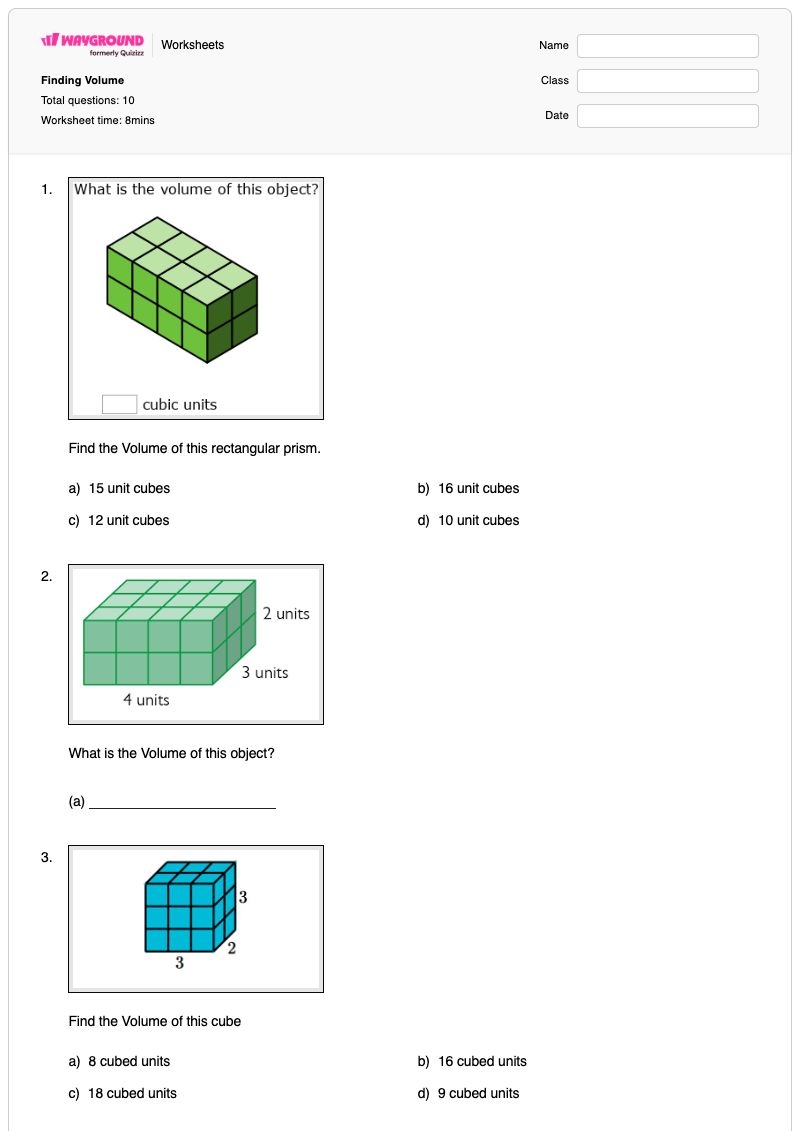
Finding Volume is a free printable Grade 5 mathematics worksheet that helps students calculate the volume of rectangular prisms and cubes using visual models and volume formulas. Across 10 questions, students work through seven multiple-choice items, one fill-in-the-blank item, one open-ended problem, and one multiple-select question. They identify volume in unit cubes and cubic units, apply length × width × height and base × height, and interpret measurements in units such as centimeters and feet.
The varied question types give teachers several ways to check whether students can select an appropriate formula, perform the calculation, and express a volume with the correct unit. The open-ended item provides an opportunity for students to show their reasoning using two formulas, while the multiple-select item checks understanding of more than one valid volume relationship. This worksheet is designed for Grade 5 math practice, review, or assessment and includes a complete answer key.
Worksheet settings
Font size
S
M
L
XL
Worksheets
Finding Volume
Total questions: 10
Name
Class
Date
1.
Find the Volume of this rectangular prism.
a)
15 unit cubes
b)
16 unit cubes
c)
12 unit cubes
d)
10 unit cubes
2.
What is the Volume of this object?
(a)
3.
Find the Volume of this cube
a)
8 cubed units
b)
16 cubed units
c)
18 cubed units
d)
9 cubed units
4.
What is the volume of this rectangular prism?
a)
11 cubed units
b)
12 cubed units
c)
13 cubed units
d)
14 cubed units
5.
Use the two formulas to find volume to solve and find the volume of this rectangular prism.
4 lines
6.
Find the Volume of this rectangular prism.
a)
120 cubed units
b)
40 cubed units
c)
30 cubed units
d)
70 cubed units
7.
Find the Volume.
a)
75 cubed units
b)
72 cubed units
c)
70 cubed units
d)
80 cubed units
8.
What is a formula for volume? Choose 2!
a)
L x W x H = Volume
b)
Base x Height = Volume
c)
L x W = Volume
d)
2L + 2W = Volume
9.
Solve this problem to find the area of the rectangular prism.
This Grade 5 worksheet focuses on finding the volume of rectangular prisms and cubes from visual models and measurements. Its 10 items combine multiple choice, fill-in-the-blank, open-ended, and multiple-select formats so students calculate volume, choose valid formulas, identify cubic units, and explain a solution using two formulas.
How can I use this worksheet to teach volume formulas?
Introduce the worksheet by modeling how length × width × height and base × height represent the volume of a rectangular prism. Then have students solve the visual multiple-choice items, pause to discuss why an answer is expressed in unit cubes or cubic units, and use the open-ended problem to require written reasoning. Finish with the multiple-select formula question as a quick check that students recognize both valid relationships.
What mistakes should I watch for when students complete this volume worksheet?
Watch for students multiplying only two dimensions, confusing an area calculation with a volume calculation, or choosing a formula that does not find volume. Students may also select only one answer on the multiple-select formula item, omit cubic units in the fill-in response, or choose a numerical distractor without checking the dimensions. The open-ended item makes it easier to identify whether an error comes from the formula, multiplication, or unit notation.
How do I assign and grade this Finding Volume worksheet?
On Wayground, you can assign Finding Volume as a printable PDF or use it as a digital quiz. It includes a complete answer key, and printable submissions can be graded by scanning student work with the Wayground for Teachers app. The printable format also gives schools an option for practicing volume with less screen time.
How can I differentiate this volume worksheet for my students?
Use the worksheet’s Advanced Settings to create an alternate version with normal, medium, or wide font spacing and a font size from S through XL. You can also enable a dyslexia-friendly font or translate the volume questions and formula prompts into another language. These options can make the visual models, answer choices, and open-ended directions easier to access without changing the volume skill being practiced.
Where can I find more free worksheets like this on Wayground?
Wayground offers a broad collection of free printable worksheets and practice problems across subjects, with downloadable PDFs and answer keys to support essential skills and concepts. Browse more resources at https://wayground.com/en-us/worksheets.

 Worksheets


