Finding Volume Using unit cubes is a free printable mathematics worksheet for students in Grades 4–5. It focuses on finding the volume of rectangular prisms by counting or interpreting unit cubes, selecting the correct multiplication equation, applying the formula L × W × H, and recording answers with appropriate cubic units.
The worksheet includes 12 questions: 7 fill-in-the-blank volume calculations and 5 multiple-choice items about equations, formulas, numerical volume, and unit notation. Students work with measurements in feet, inches, and centimeters, building accuracy in both computation and mathematical communication. Use it for guided practice, independent work, review, or a quick check of understanding. A complete answer key is included with this free printable worksheet.
Worksheet settings
Font size
S
M
L
XL
Worksheets
Finding Volume Using unit cubes
Total questions: 12
Name
Class
Date
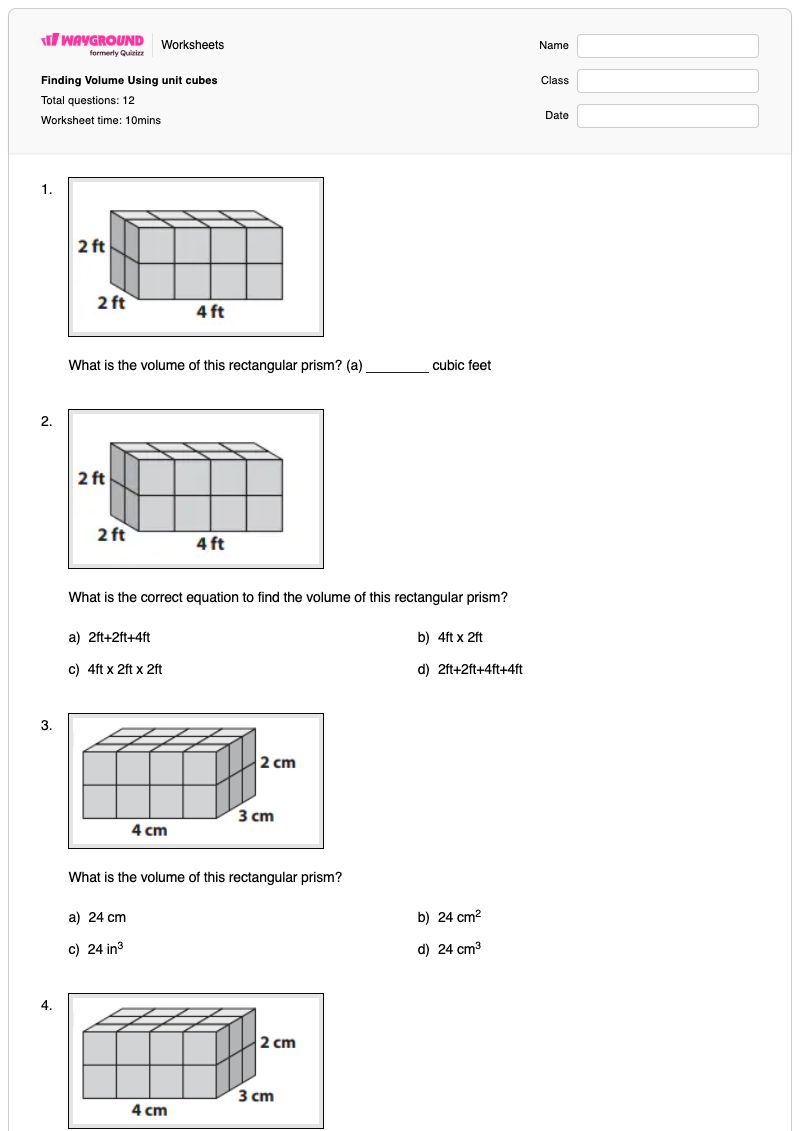
1.
What is the volume of this rectangular prism? (a) cubic feet
2.
What is the correct equation to find the volume of this rectangular prism?
a)
2ft+2ft+4ft
b)
4ft x 2ft
c)
4ft x 2ft x 2ft
d)
2ft+2ft+4ft+4ft
3.
What is the volume of this rectangular prism?
a)
24 cm
b)
24 cm2
c)
24 in3
d)
24 cm3
4.
What formula can I use to find the volume?
a)
L x W
b)
L + W + H
c)
L x W x H
d)
L x W + H
5.
What is the volume of this rectangular prism? (a) cubic inches
6.
Which is the correct equation to find the volume?
a)
2 x 1 x 4
b)
2 x 4
c)
1 x 4
d)
2 + 1 + 4
7.
What is the correct volume?
a)
8 in
b)
8 in2
c)
8 cubic
d)
8 in3
8.
What is the volume of the rectangular prism? (a) cubic ft
9.
What is the volume of the rectangular prism? (a) cubic cm
10.
What is the volume of the rectangular prism? (a) cubic cm
11.
What is the volume of the rectangular prism? (a) cubic ft
12.
What is the volume of the rectangular prism? (a) cubic in
Answer Key
Finding Volume Using unit cubes
Total questions: 12
1.
16
2.
c)
4ft x 2ft x 2ft
3.
d)
24 cm3
4.
c)
L x W x H
5.
8
6.
a)
2 x 1 x 4
7.
d)
8 in3
8.
12
9.
18
10.
40
11.
36
12.
45
140 %
Browse by subjects
Browse by grades
Browse by format
FAQs
What does the Finding Volume Using unit cubes worksheet cover?
This Grade 4–5 math worksheet helps students find the volume of rectangular prisms using unit-cube representations and the formula L × W × H. Across 12 items, students complete seven volume calculations and answer five multiple-choice questions about choosing multiplication equations, applying the formula, and labeling answers in cubic feet, inches, or centimeters.
How can I use this worksheet to teach rectangular-prism volume?
Begin by having students identify the length, width, and height represented by each rectangular prism, then model how multiplying those three dimensions counts the unit cubes. Use the multiple-choice equation and formula questions to discuss why multiplication is appropriate instead of addition, followed by the fill-in-the-blank items for independent practice. Ask students to explain how the selected unit determines whether the answer is in cubic feet, cubic inches, or cubic centimeters.
What mistakes should I watch for when students complete this volume worksheet?
Watch for students adding the three dimensions or multiplying only two of them instead of using L × W × H. Students may also choose a correct numerical value with the wrong unit, such as square units or a linear unit rather than cubic units. In the fill-in-the-blank items, check that students enter the volume value that matches the requested unit, including feet, inches, or centimeters.
How do I assign and grade this volume worksheet?
You can assign Finding Volume Using unit cubes as a printable PDF or use it as a digital quiz on Wayground. The worksheet includes a complete answer key for the seven fill-in-the-blank and five multiple-choice questions, and printable submissions can be graded by scanning student work with the Wayground for Teachers app. The printable format can also support schools that are reducing screen time.
How can I differentiate this rectangular-prism volume worksheet for my students?
In the worksheet’s Advanced Settings, adjust font spacing or choose a larger font size to make the volume prompts, equations, and unit labels easier to read. You can also enable a dyslexia-friendly font or translate the worksheet into another language. These options can support access to the worksheet’s fill-in-the-blank calculations and multiple-choice formula questions without changing the volume skill being assessed.
Where can I find more free worksheets like this on Wayground?
Wayground offers a comprehensive collection of free printable worksheets and practice problems across all subjects, with downloadable PDFs and answer keys to help students master essential skills and concepts. Browse more resources at https://wayground.com/en-us/worksheets.


 Worksheets


