

Wayground
Seasons & Constellations  - Printable Science Worksheets grade 5 - Wayground

Seasons & Constellations

Tanya Fortenberry

Created by Tanya Fortenberry

10 questions

5th Grade

Science

Updated Sep 2026

Seasons & Constellations is a Grade 5 science worksheet that examines why seasonal changes occur and why different constellations are visible at different times of year. Through 10 questions—including multiple-choice, multiple-select, hotspot, and matching items—students connect Earth’s revolution and axial tilt to seasonal sunlight, day length, and the changing position of constellations in the night sky. They also identify Polaris as a guide to north and locate Earth’s position during northern-hemisphere summer. This worksheet gives students practice distinguishing Earth’s rotation from its revolution, explaining how axial tilt affects direct sunlight, and interpreting sky observations without assuming that stars change their patterns. The hotspot and matching tasks add opportunities to apply these ideas beyond selecting written answers. It is a free printable worksheet with a complete answer key for Grade 5 science instruction, review, or assessment.

Worksheet settings

Font size

S
M
L
XL
WaygroundWorksheets

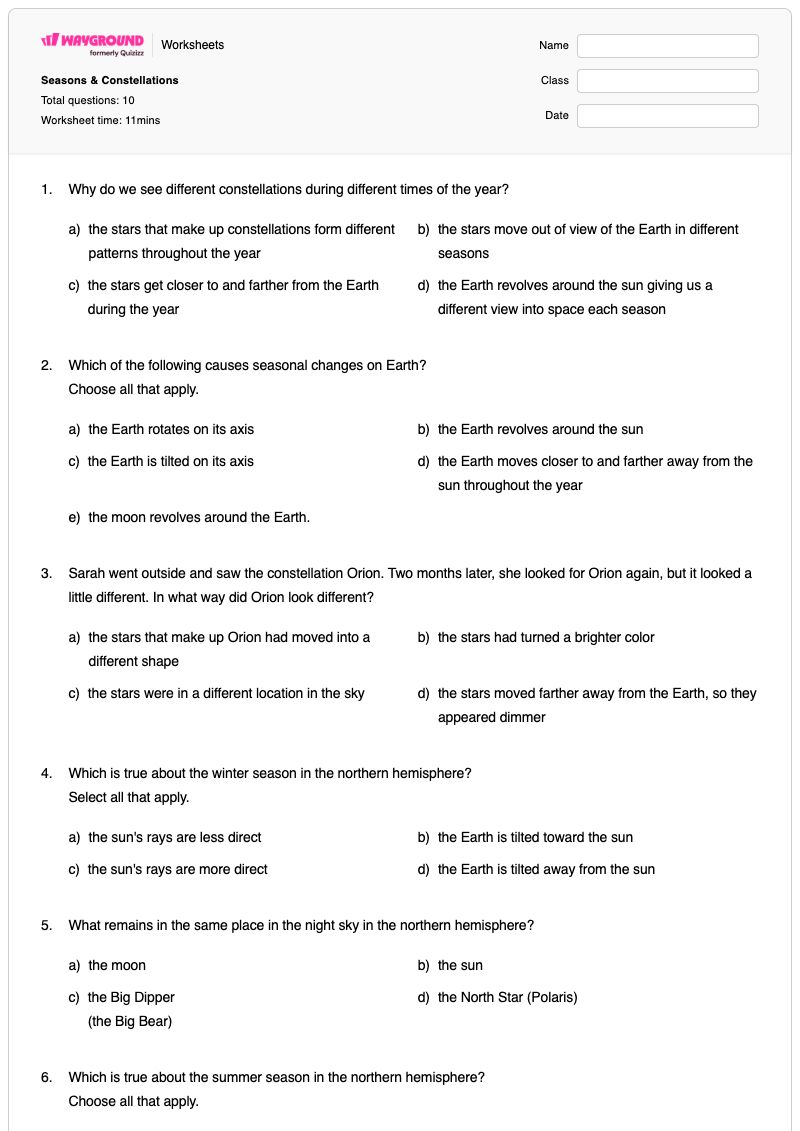
Seasons & Constellations

Total questions: 10

Name
Class
Date
1.

Why do we see different constellations during different times of the year?

a)

the stars that make up constellations form different patterns throughout the year

b)

the stars move out of view of the Earth in different seasons

c)

the stars get closer to and farther from the Earth during the year

d)

the Earth revolves around the sun giving us a different view into space each season

2.

Which of the following causes seasonal changes on Earth?

Choose all that apply.

a)

the Earth rotates on its axis

b)

the Earth revolves around the sun

c)

the Earth is tilted on its axis

d)

the Earth moves closer to and farther away from the sun throughout the year

e)

the moon revolves around the Earth.

3.

Sarah went outside and saw the constellation Orion. Two months later, she looked for Orion again, but it looked a little different. In what way did Orion look different?

a)

the stars that make up Orion had moved into a different shape

b)

the stars had turned a brighter color

c)

the stars were in a different location in the sky

d)

the stars moved farther away from the Earth, so they appeared dimmer

4.

Which is true about the winter season in the northern hemisphere?

Select all that apply.

a)

the sun's rays are less direct

b)

the Earth is tilted toward the sun

c)

the sun's rays are more direct

d)

the Earth is tilted away from the sun

5.

What remains in the same place in the night sky in the northern hemisphere?

a)

the moon

b)

the sun

c)

the Big Dipper

(the Big Bear)

d)

the North Star (Polaris)

6.

Which is true about the summer season in the northern hemisphere?

Choose all that apply.

a)

the sun's rays are more direct

b)

the days are shorter

c)

the Earth is tilted toward the sun

d)

the days are longer

e)

the sun's rays are more spread out on the face of the Earth

7.

What is Polaris, and what is special about it?

a)

it is one of Mars' moons and it stays in the same location in the sky each night

b)

it is the name of Earth's nearest star and it can be used to find the direction north

c)

it is a star that is always located in the same place in the night sky and can be used to find north

d)

it is Earth's moon and can be used to find Earth's nearest star

8.

The constellation Leo is visible in the northern hemisphere in the summer, but not the winter. Which explains why we can't see Leo in the winter?

a)

the constellation Leo moves to another solar system during the winter

b)

the stars that make up Leo change positions and form a new pattern in the winter

c)

during the winter, Leo is located on the daytime side of the Earth, so we can't see it

d)

during the winter, Mars blocks the constellation Leo so we can't see it

9.

Click on the position of the Earth when the northern hemisphere is experiencing the summer season

10.

Match the following

the Earth is tilted on its axis

seasons

the Earth rotates on its axis

day & night

the moon revolves around the Earth

moon phases

WaygroundAnswer Key

Seasons & Constellations

Total questions: 10

1.
d)

the Earth revolves around the sun giving us a different view into space each season

2.
b)

the Earth revolves around the sun

, c)

the Earth is tilted on its axis

3.
c)

the stars were in a different location in the sky

4.
a)

the sun's rays are less direct

, d)

the Earth is tilted away from the sun

5.
d)

the North Star (Polaris)

6.
a)

the sun's rays are more direct

, c)

the Earth is tilted toward the sun

, d)

the days are longer

7.
c)

it is a star that is always located in the same place in the night sky and can be used to find north

8.
c)

during the winter, Leo is located on the daytime side of the Earth, so we can't see it

9.
10.

the Earth is tilted on its axis

 - 

seasons

, 

the Earth rotates on its axis

 - 

day & night

, 

the moon revolves around the Earth

 - 

moon phases

FAQs

What does the Seasons & Constellations worksheet cover?

This Grade 5 science worksheet asks students to explain seasonal changes through Earth’s revolution and axial tilt, including differences in sunlight direction and day length. Its 10 items use multiple-choice, multiple-select, hotspot, and matching formats to assess seasonal constellation visibility, Orion’s changing position in the sky, and Polaris’s role in locating north.

How can I use this worksheet to teach seasons and constellations?

Begin by modeling Earth’s orbit and axial tilt, then have students predict how sunlight and day length differ in northern-hemisphere summer and winter. Use the constellation questions to discuss why Earth’s changing position gives observers a different view of space, while Polaris remains a reference point for north. Assign the multiple-choice and multiple-select items after discussion, then use the hotspot and matching items as application checks.

What mistakes should I watch for on this Seasons & Constellations worksheet?

Watch for students choosing Earth’s rotation instead of its revolution and axial tilt as the causes of seasons, or incorrectly attributing seasonal changes to Earth moving closer to the Sun. Students may also think constellations change shape or that their stars move closer and farther away, rather than recognizing a change in their apparent location. In the hotspot item, check that students locate Earth’s position for northern-hemisphere summer, and in the Polaris items, look for confusion between Polaris, the Moon, and other sky objects.

How do I assign and grade this Seasons & Constellations worksheet?

Wayground provides this worksheet as a printable PDF and as a digital quiz, so you can print the 10 questions or assign them online. It includes a complete answer key for the multiple-choice, multiple-select, hotspot, and matching items. Printable student work can be graded by scanning it with the Wayground for Teachers app.

How can I differentiate this Seasons & Constellations worksheet for my students?

Use the worksheet’s Advanced Settings to adjust font spacing and font size so the multiple-choice and multiple-select answer choices are easier to scan. You can also enable a dyslexia-friendly font or translate the worksheet into another language, while keeping the seasonal diagrams, hotspot task, and science concepts intact.

Where can I find more worksheets like this on Wayground?

Wayground offers a broad collection of free printable worksheets and practice problems across subjects, with downloadable PDFs and answer keys to support essential skills and concepts. Browse more resources at https://wayground.com/en-us/worksheets.