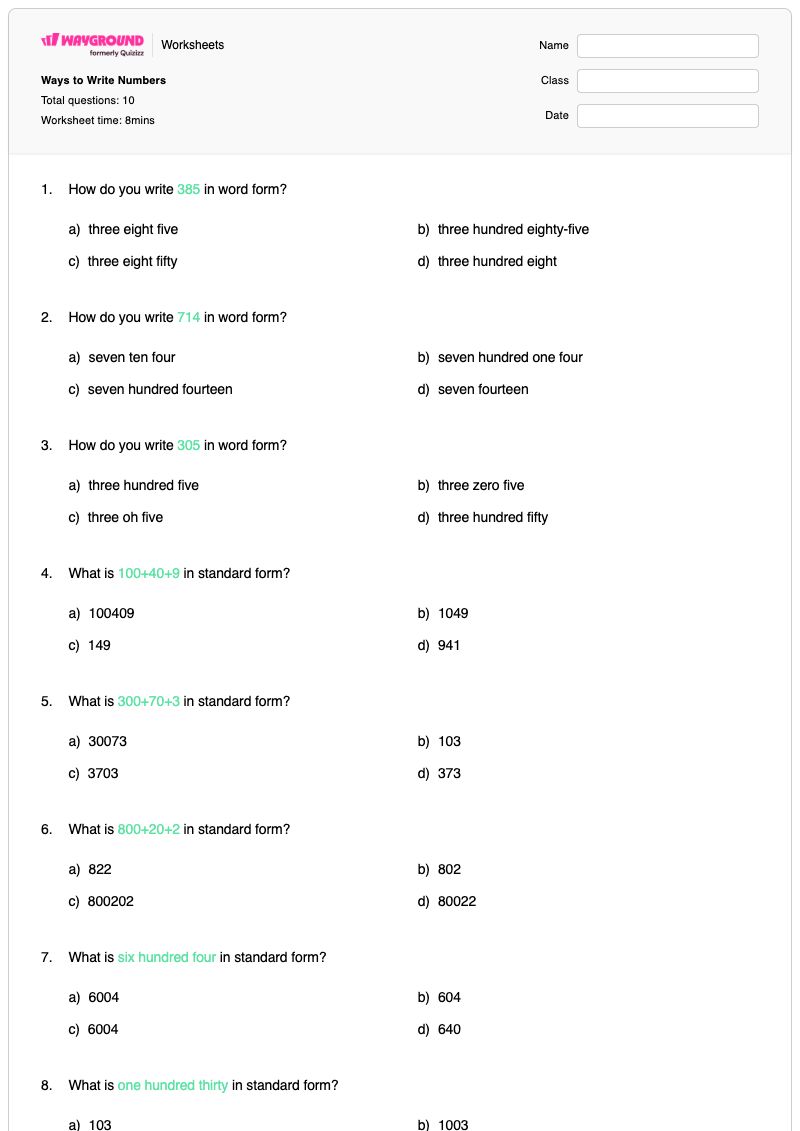
Ways to Write Numbers is a Grade 2 mathematics worksheet that helps students connect three-digit numbers with their word, standard, and expanded forms. Across 10 multiple-choice questions, students write numbers such as 385, 714, and 305 in word form; convert expanded expressions such as 100 + 40 + 9 into standard form; and convert number names such as “six hundred four” into numerals. One item also asks students to identify a representation that does not show 413, reinforcing careful comparison of equivalent forms.
This free printable worksheet gives teachers a focused way to check students’ understanding of hundreds, tens, and ones while they select among plausible answer choices. The choices include common place-value errors, making the set useful for identifying whether students are combining parts correctly or confusing digit order. An answer key is included for efficient review, reteaching, or independent practice.
Worksheet settings
Font size
S
M
L
XL
Worksheets
Ways to Write Numbers
Total questions: 10
Name
Class
Date
1.
How do you write 385 in word form?
a)
three eight five
b)
three hundred eighty-five
c)
three eight fifty
d)
three hundred eight
2.
How do you write 714 in word form?
a)
seven ten four
b)
seven hundred one four
c)
seven hundred fourteen
d)
seven fourteen
3.
How do you write 305 in word form?
a)
three hundred five
b)
three zero five
c)
three oh five
d)
three hundred fifty
4.
What is 100+40+9 in standard form?
a)
100409
b)
1049
c)
149
d)
941
5.
What is 300+70+3 in standard form?
a)
30073
b)
103
c)
3703
d)
373
6.
What is 800+20+2 in standard form?
a)
822
b)
802
c)
800202
d)
80022
7.
What is six hundred four in standard form?
a)
6004
b)
604
c)
6004
d)
640
8.
What is one hundred thirty in standard form?
a)
103
b)
1003
c)
1030
d)
130
9.
What is two hundred seventy four in standard form?
a)
200704
b)
20074
c)
274
d)
247
10.
Which choice does NOT show a way to write 413?
a)
four hundred thirteen
b)
400 + 10 + 13
c)
4 hundreds + 1 ten + 3 ones
d)
431
Answer Key
Ways to Write Numbers
Total questions: 10
1.
b)
three hundred eighty-five
2.
c)
seven hundred fourteen
3.
a)
three hundred five
4.
c)
149
5.
d)
373
6.
a)
822
7.
b)
604
8.
d)
130
9.
c)
274
10.
d)
431
140 %
Browse by subjects
Browse by grades
Browse by format
FAQs
What does the Ways to Write Numbers worksheet cover?
This Grade 2 worksheet covers translating three-digit numbers among word form, standard form, and expanded form. Its 10 multiple-choice items ask students to write numbers such as 385 and 714 in words, combine expanded expressions such as 300 + 70 + 3 into 373, and recognize which representation does not show 413. Completing these varied items builds place-value understanding across hundreds, tens, and ones.
How can I use this worksheet to teach word, standard, and expanded forms?
Introduce one three-digit number at a time with a place-value chart, then model how its digits, number name, and expanded expression represent the same value. Before students complete the multiple-choice items, have them explain why 100 + 40 + 9 becomes 149 and why “six hundred four” is written as 604. Use the final “does not show 413” item as a discussion prompt about checking each representation rather than choosing by appearance.
What mistakes should I watch for on this number-forms worksheet?
Watch for students treating each digit as a separate word, as in “three eight five,” instead of naming the hundreds and tens; this is especially relevant to the word-form items. Students may also insert extra zeros or combine expanded addends incorrectly, choosing options such as 100409 instead of 149. In the item about 413, check whether students recognize that 431 reverses the tens and ones rather than showing an equivalent form.
How do I assign and grade this Ways to Write Numbers worksheet?
You can assign this worksheet as a printable PDF or use it as a digital quiz on Wayground. The complete answer key supports quick grading of all 10 multiple-choice questions, and printable submissions can be graded by scanning student work with the Wayground for Teachers app. The printable format also gives schools an option for reducing screen time.
How can I differentiate this worksheet for students who need support with number forms?
Use the worksheet’s Advanced Settings to adjust font spacing or increase the font size so the multiple-choice options and three-digit representations are easier to compare. You can also select a dyslexia-friendly font or translate the worksheet into another language when those changes support access to the number-form vocabulary. These options apply to the worksheet itself, including items that ask students to read number names such as “two hundred seventy four.”
Where can I find more worksheets like this on Wayground?
Wayground offers a comprehensive collection of free printable worksheets and practice problems across subjects, with downloadable PDFs and answer keys to help students master essential skills and concepts. Browse more resources at https://wayground.com/en-us/worksheets.

 Worksheets