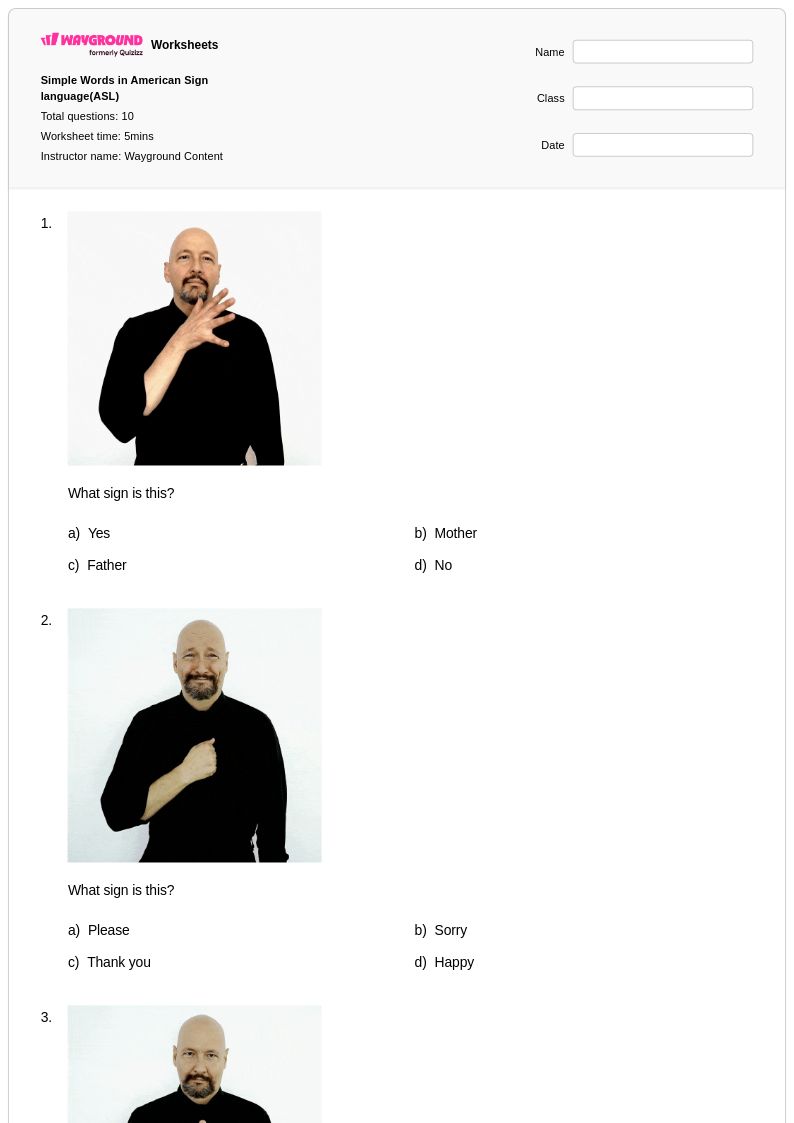
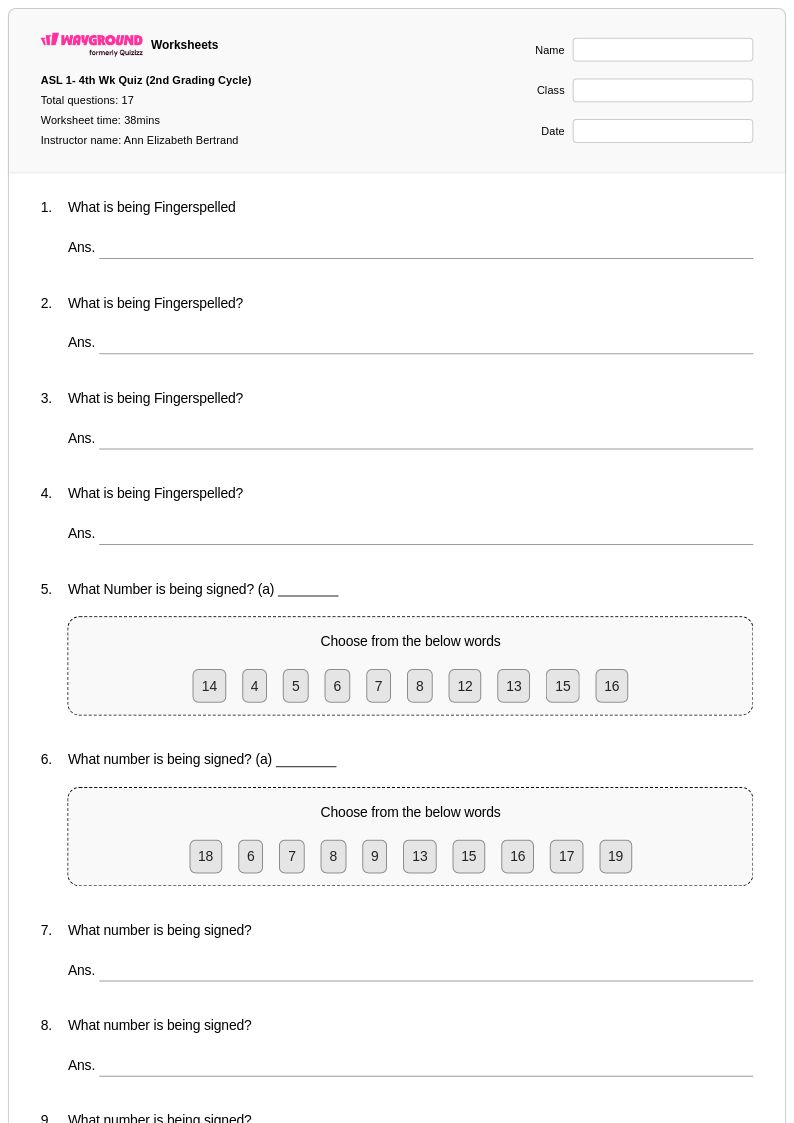
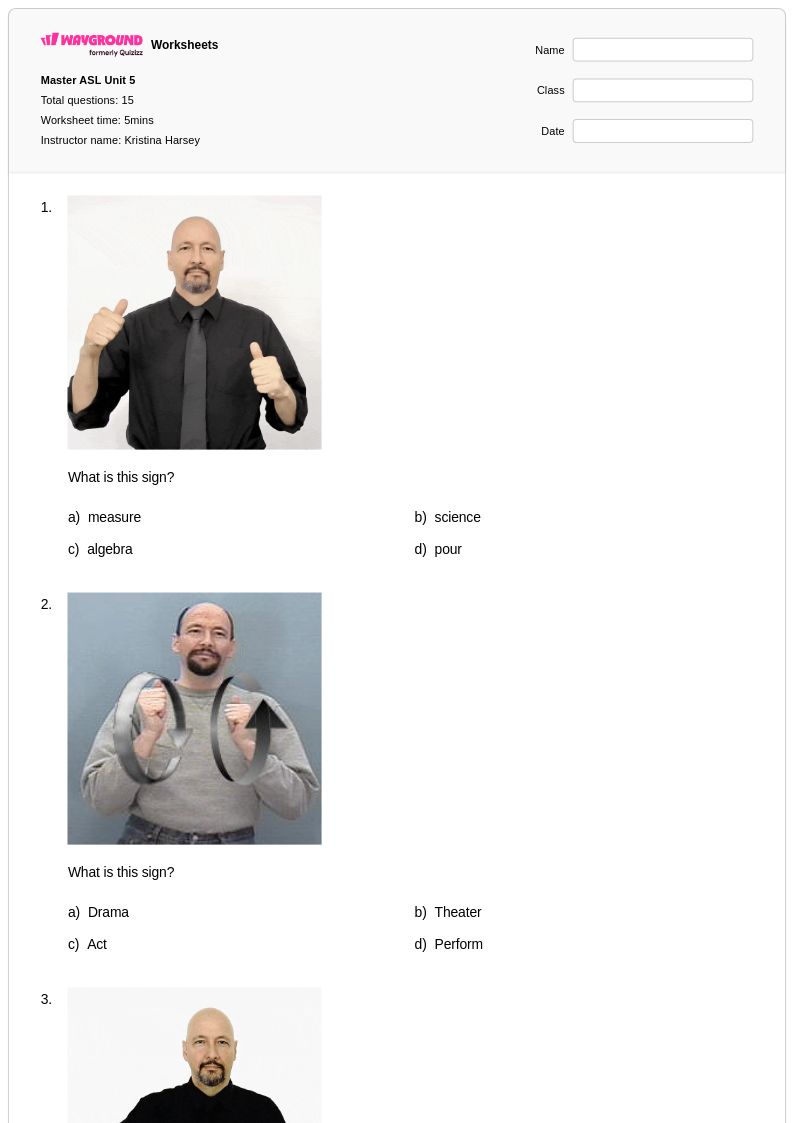
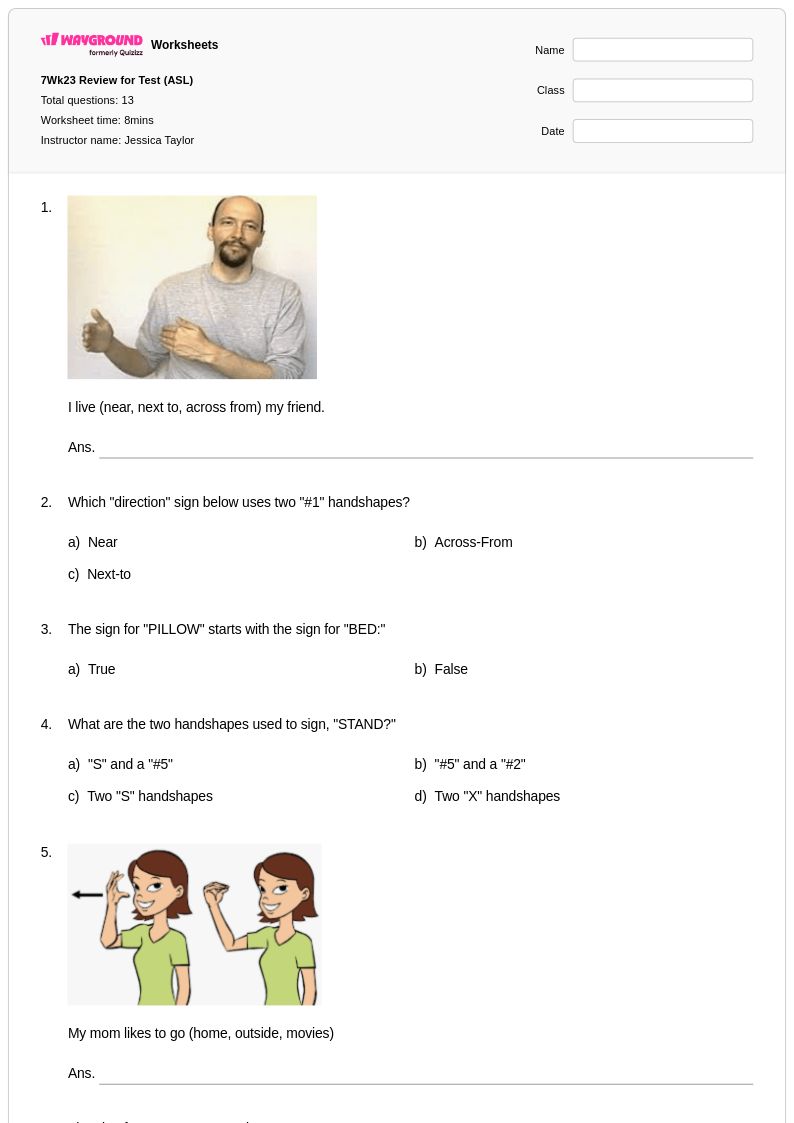
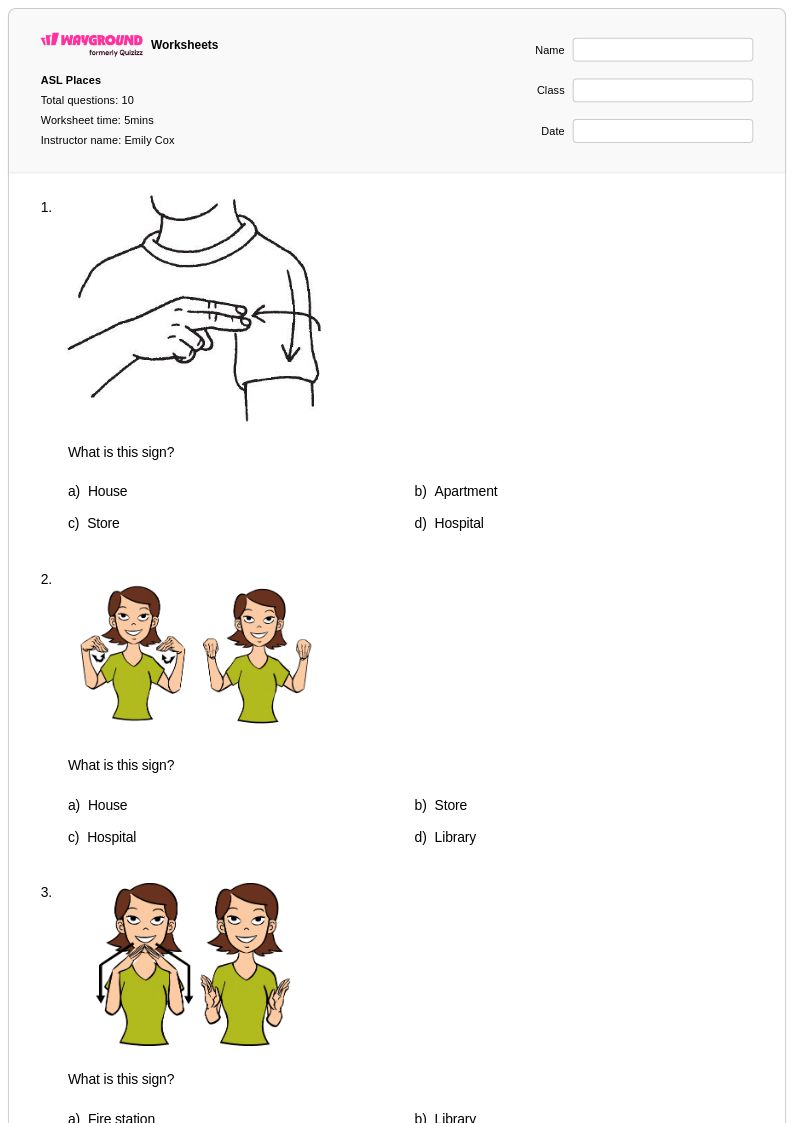
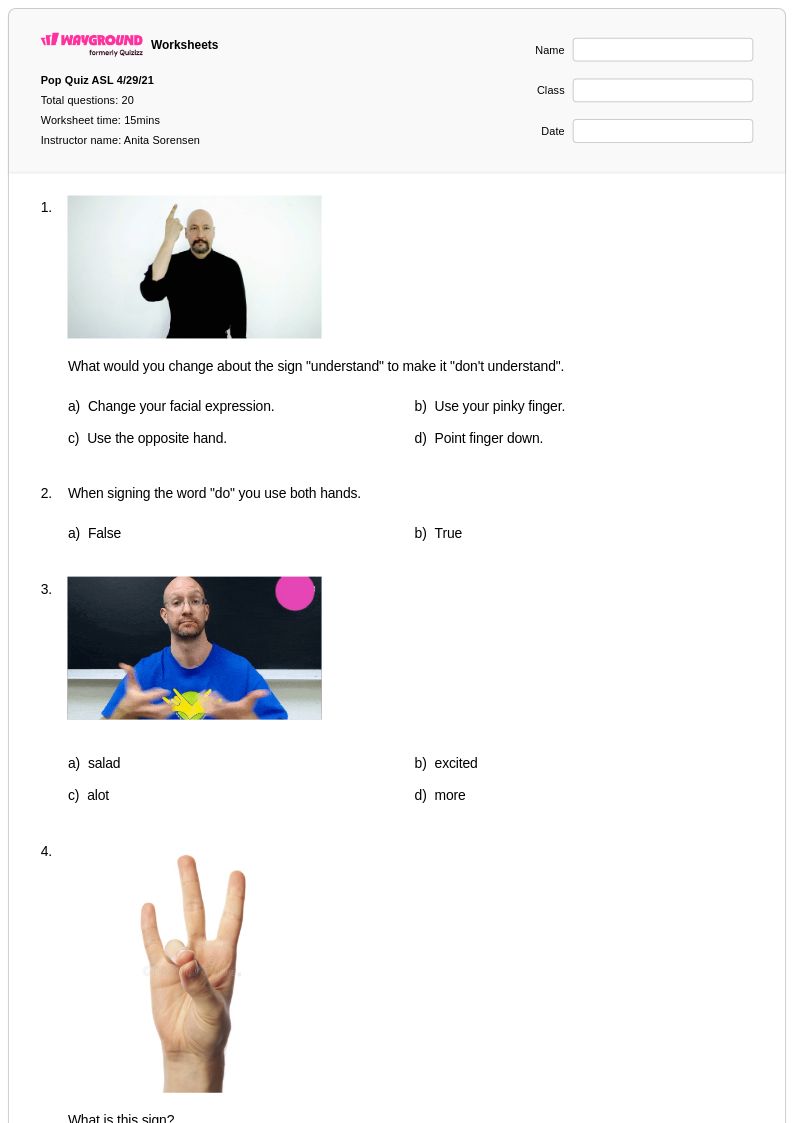
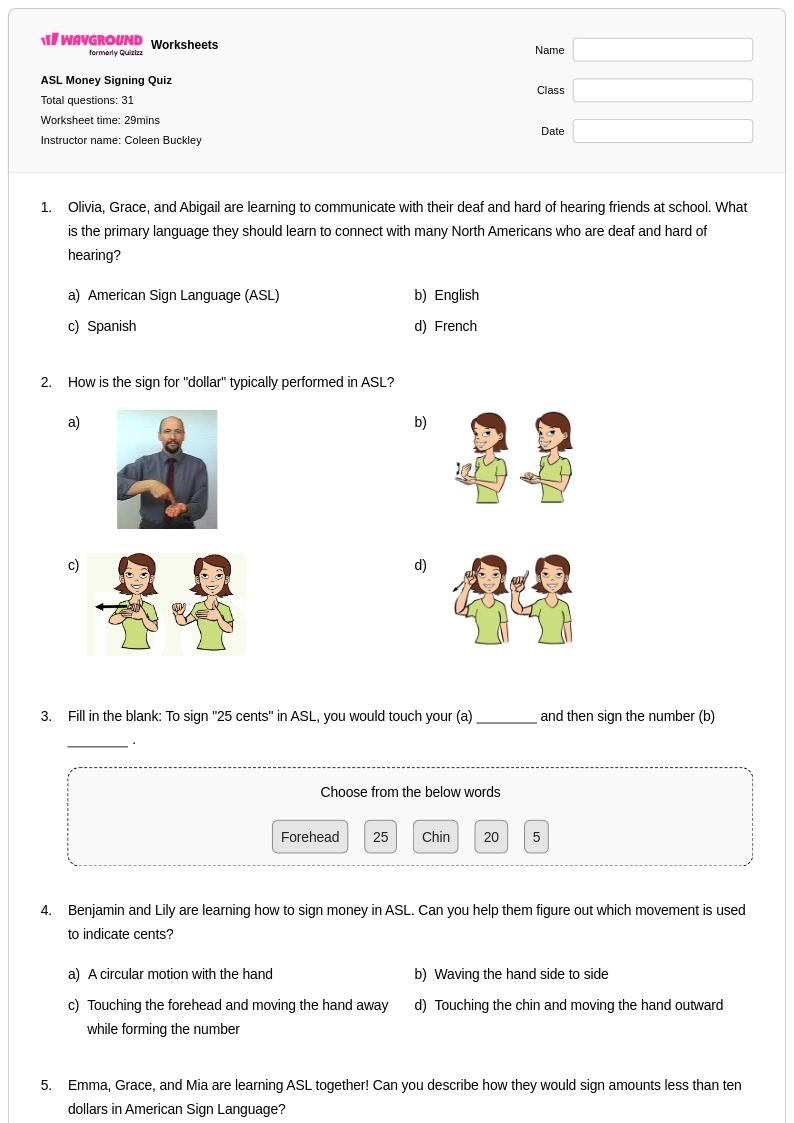
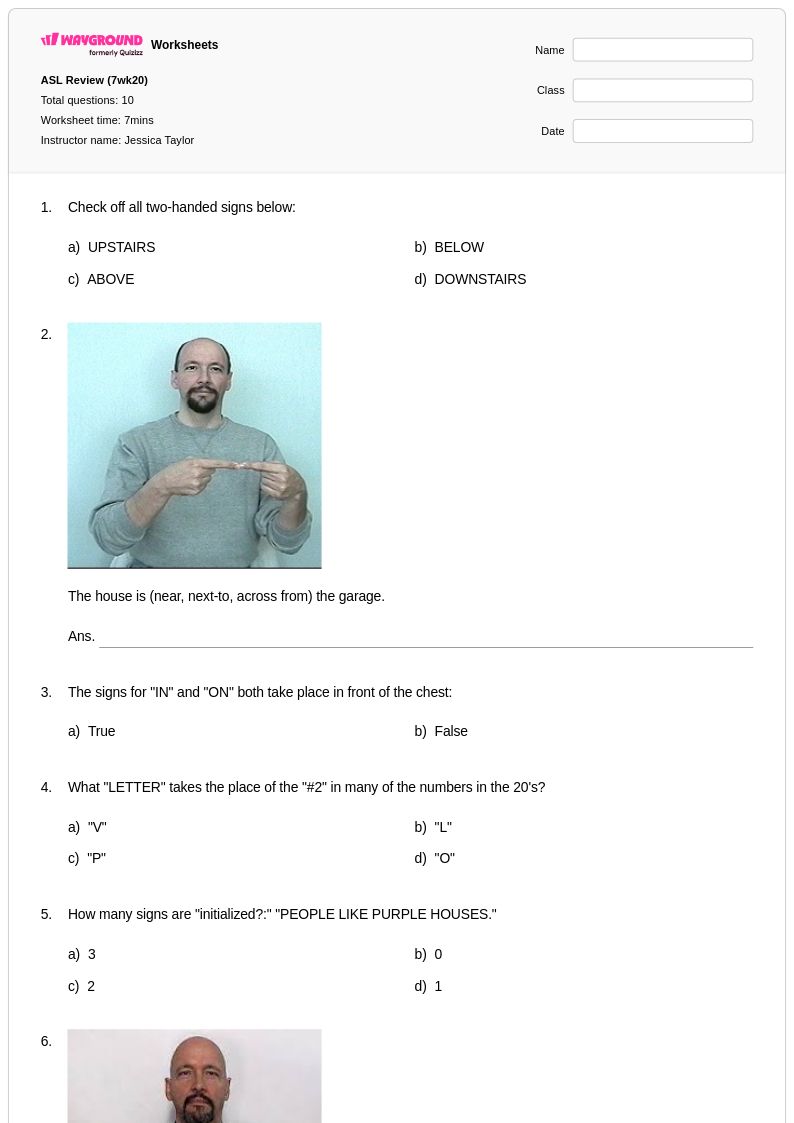
Free Printable American Sign Language (ASL) worksheets
Explore Wayground's comprehensive collection of American Sign Language (ASL) worksheets and printables that help students master essential signing skills through engaging practice problems, free PDF resources, and detailed answer keys.
Explore printable American Sign Language (ASL) worksheets
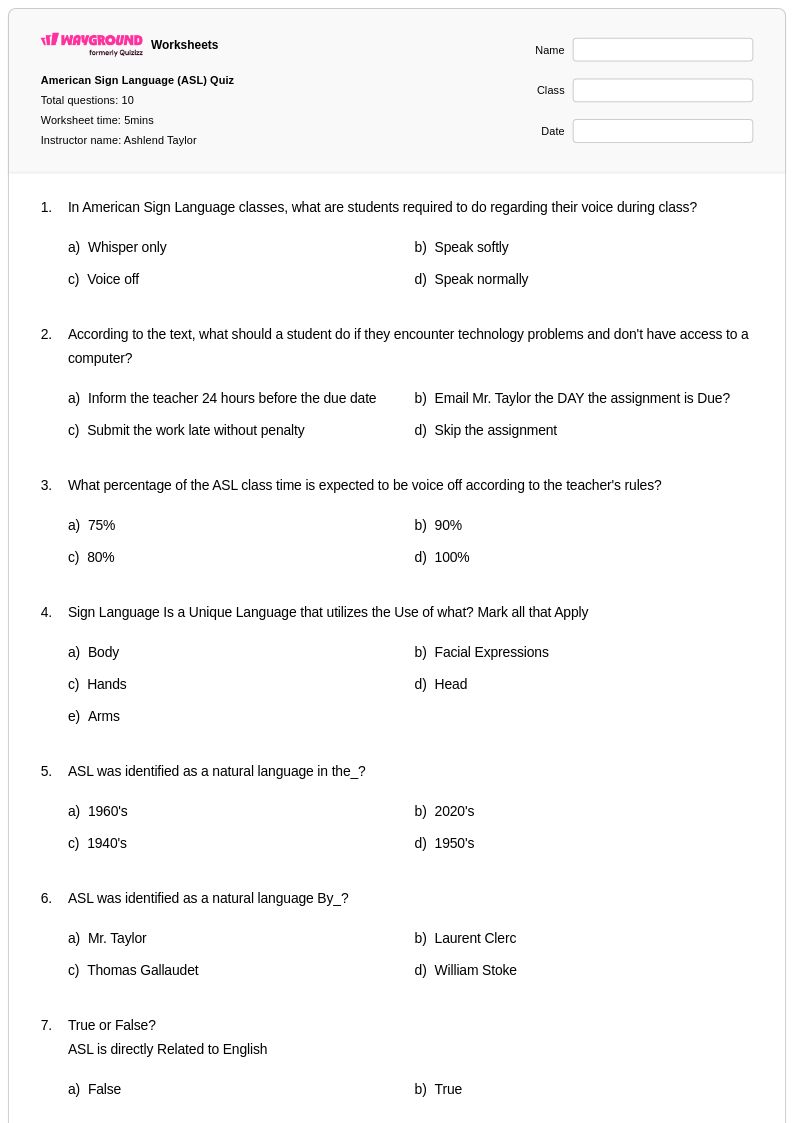
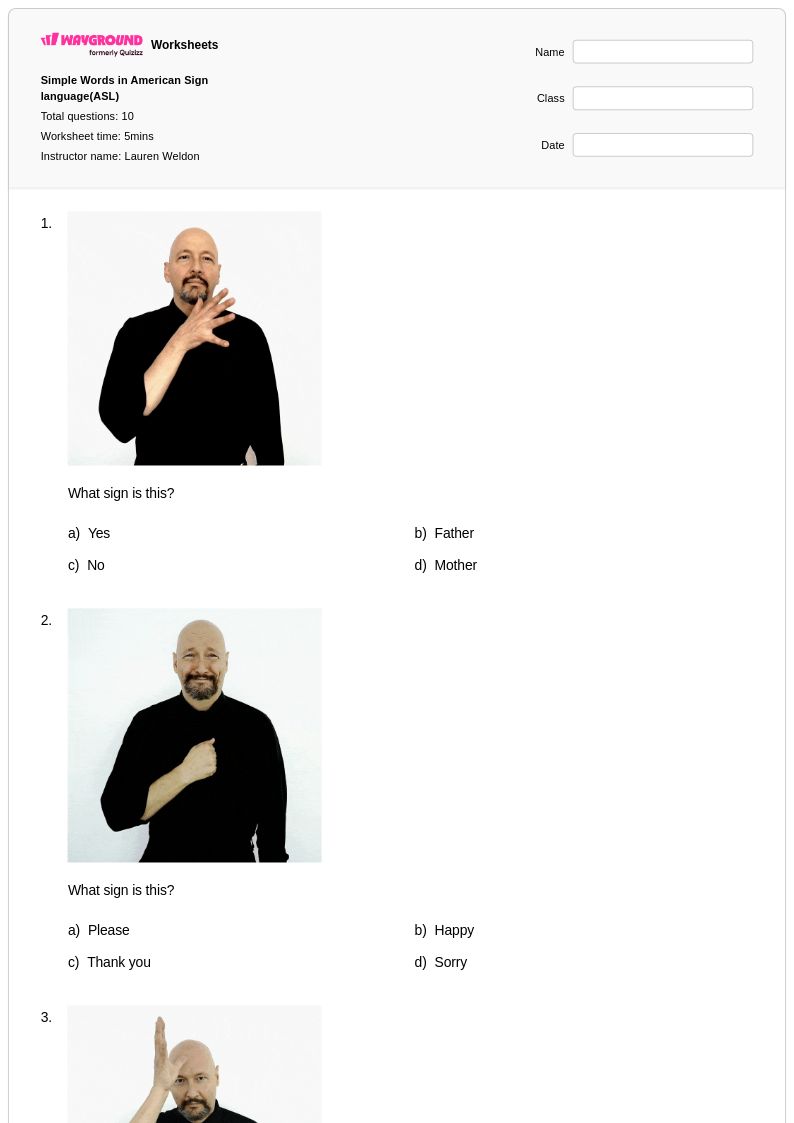
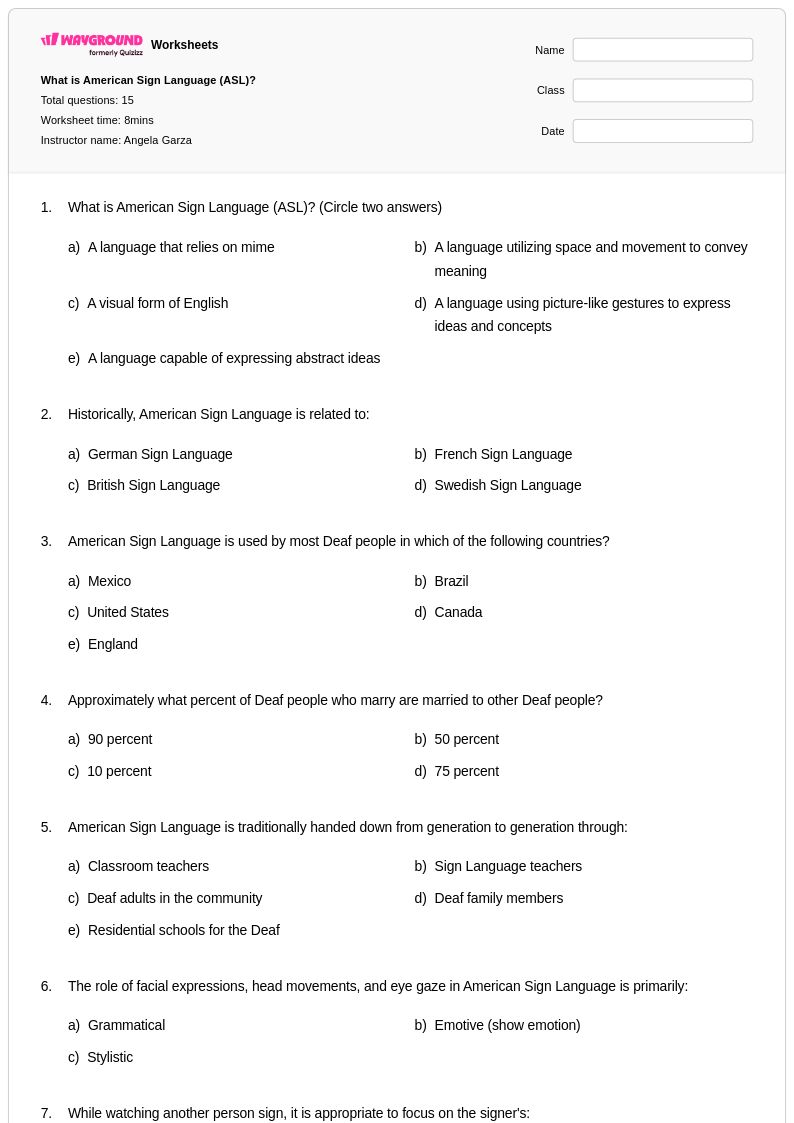
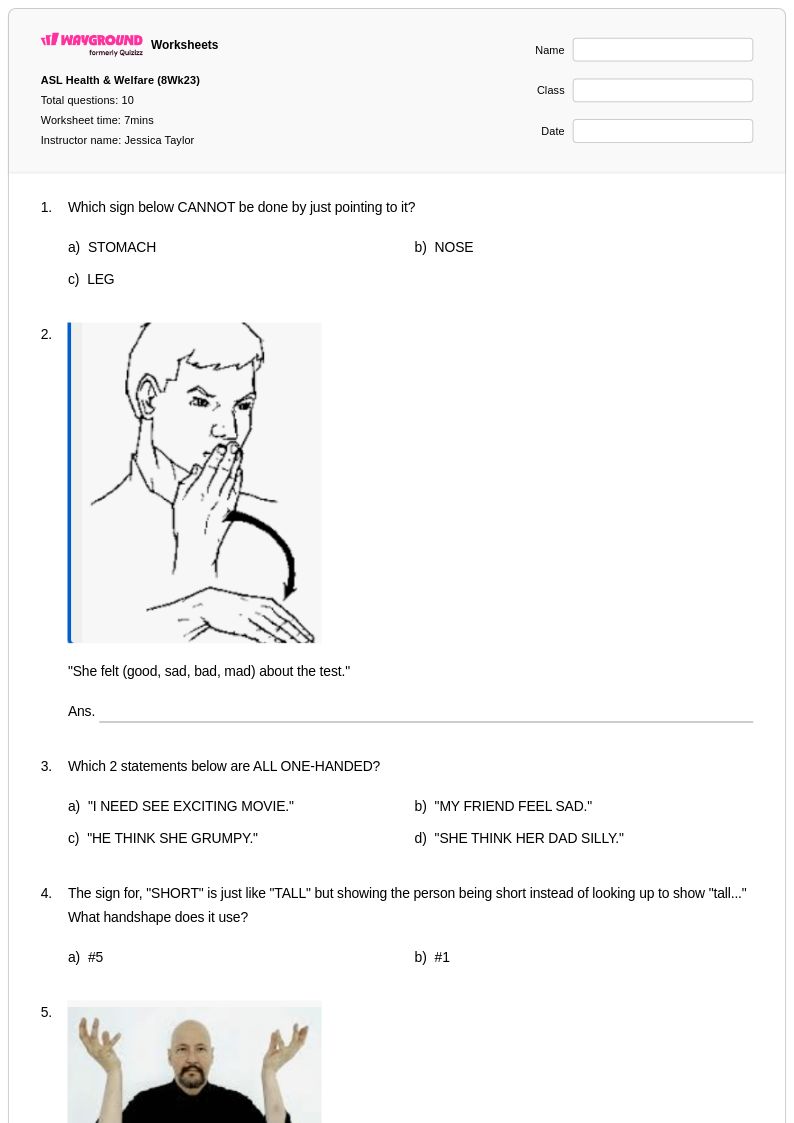
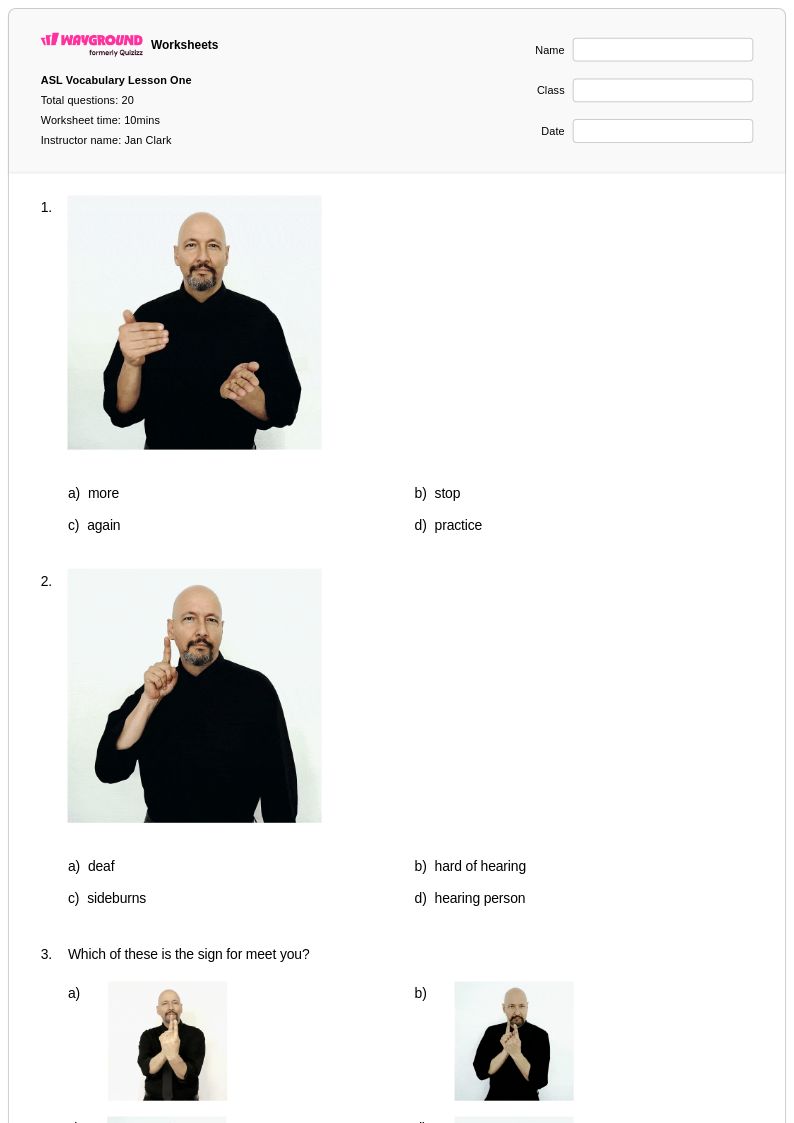
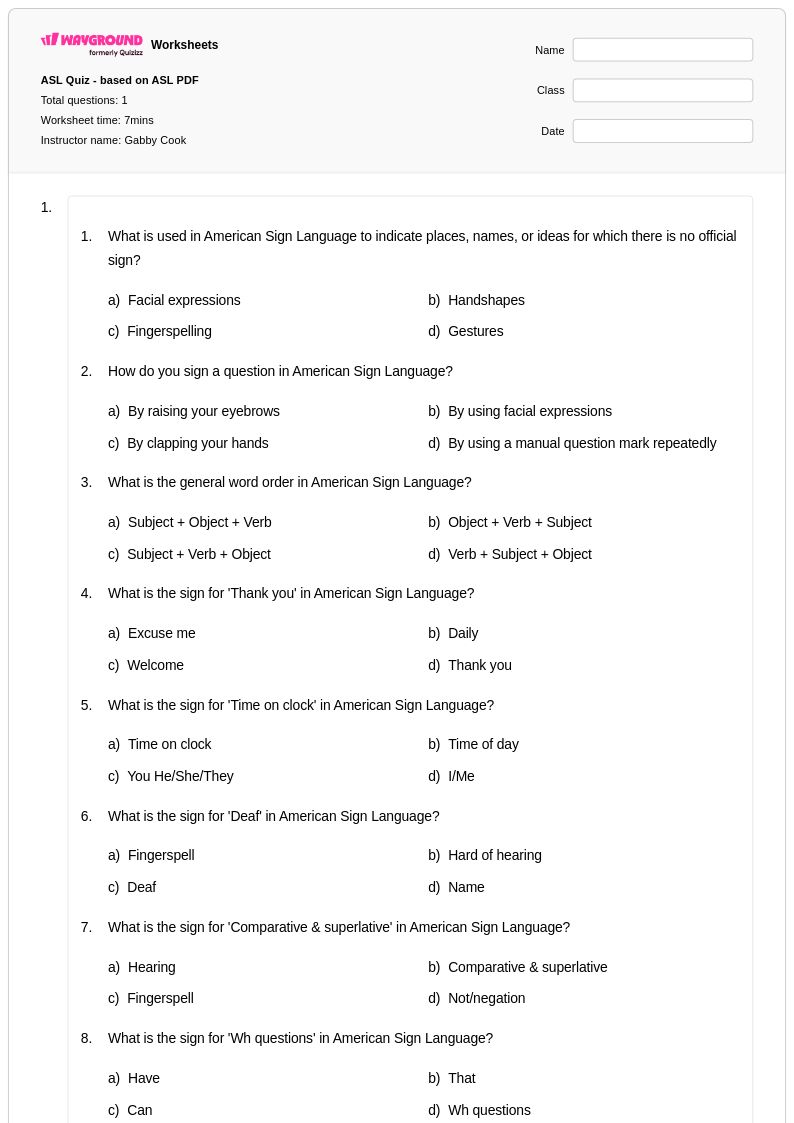
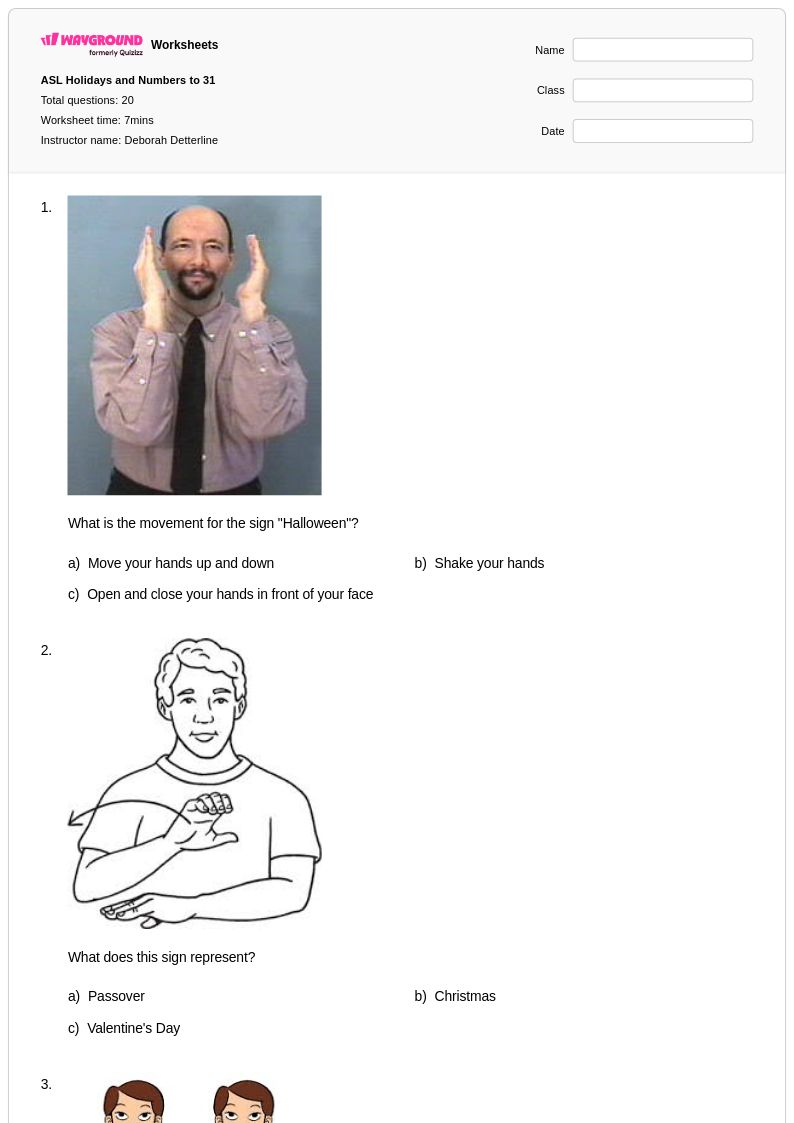
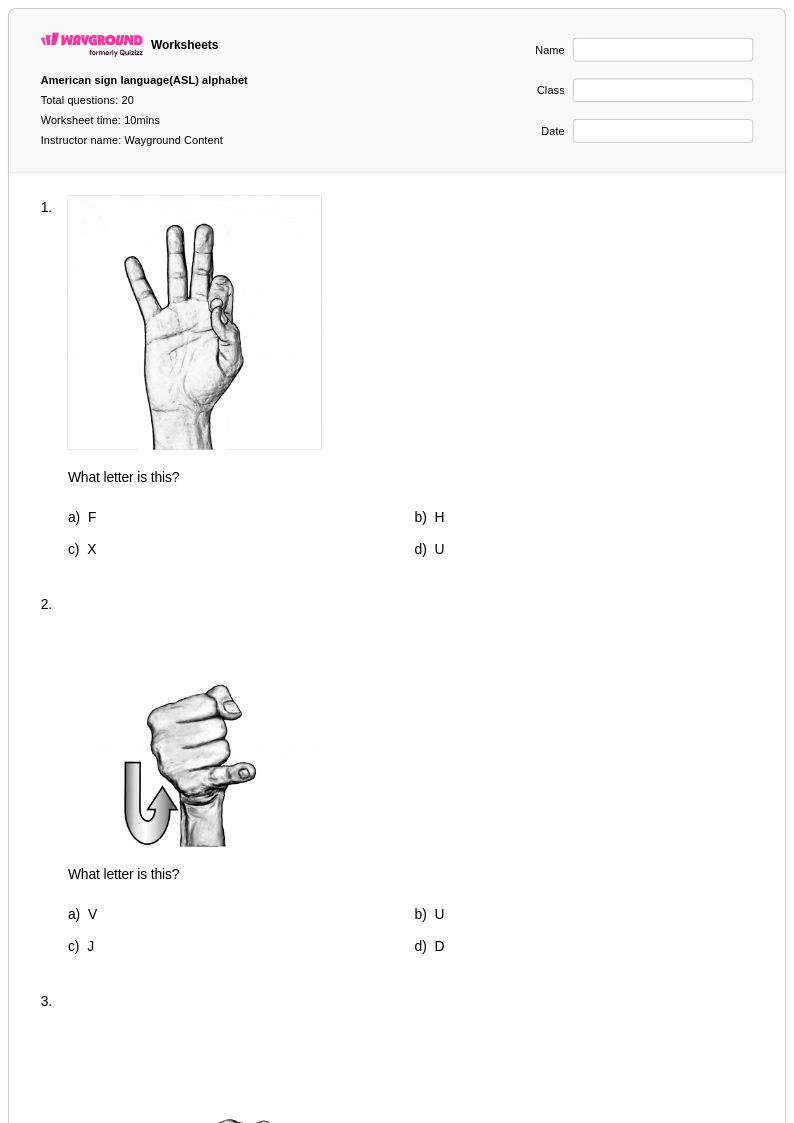
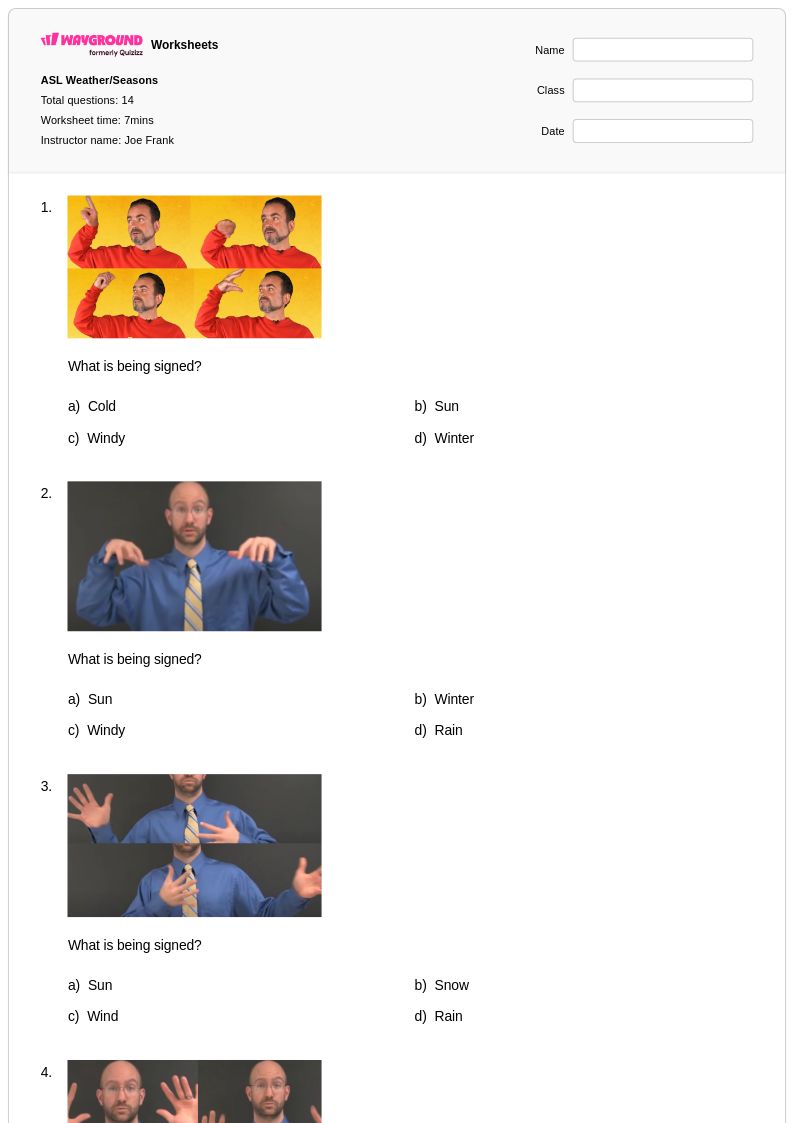
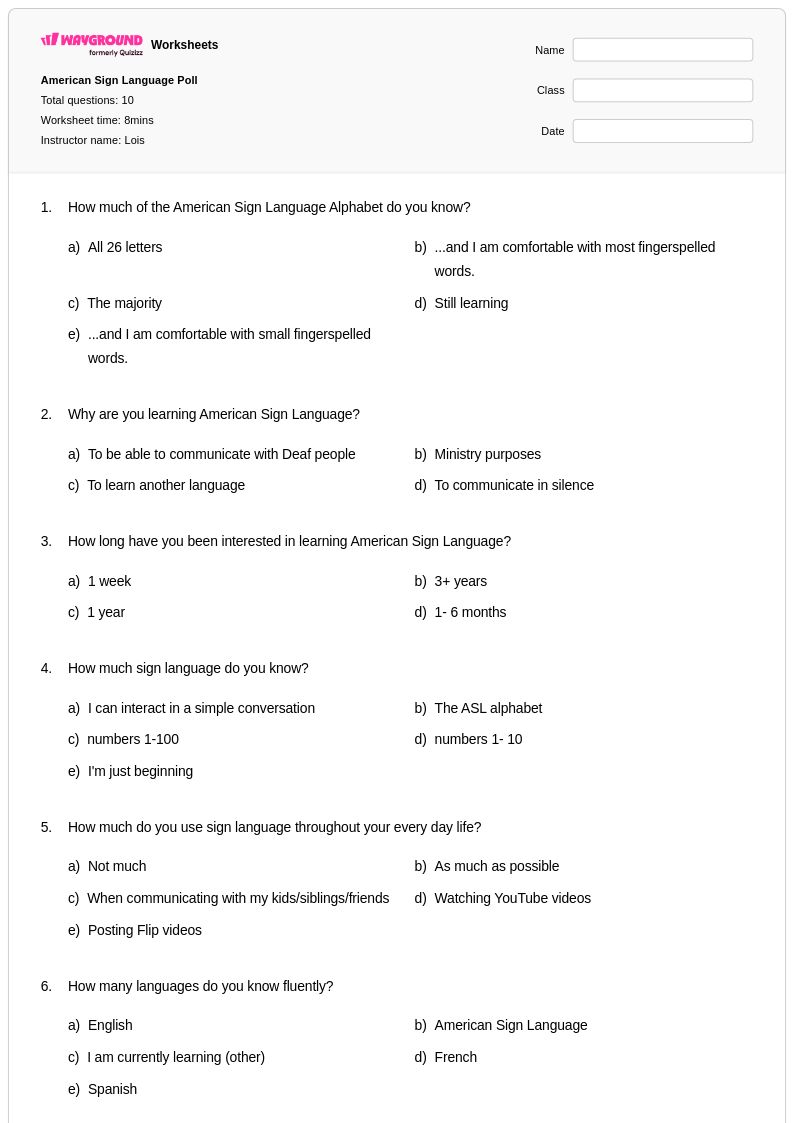
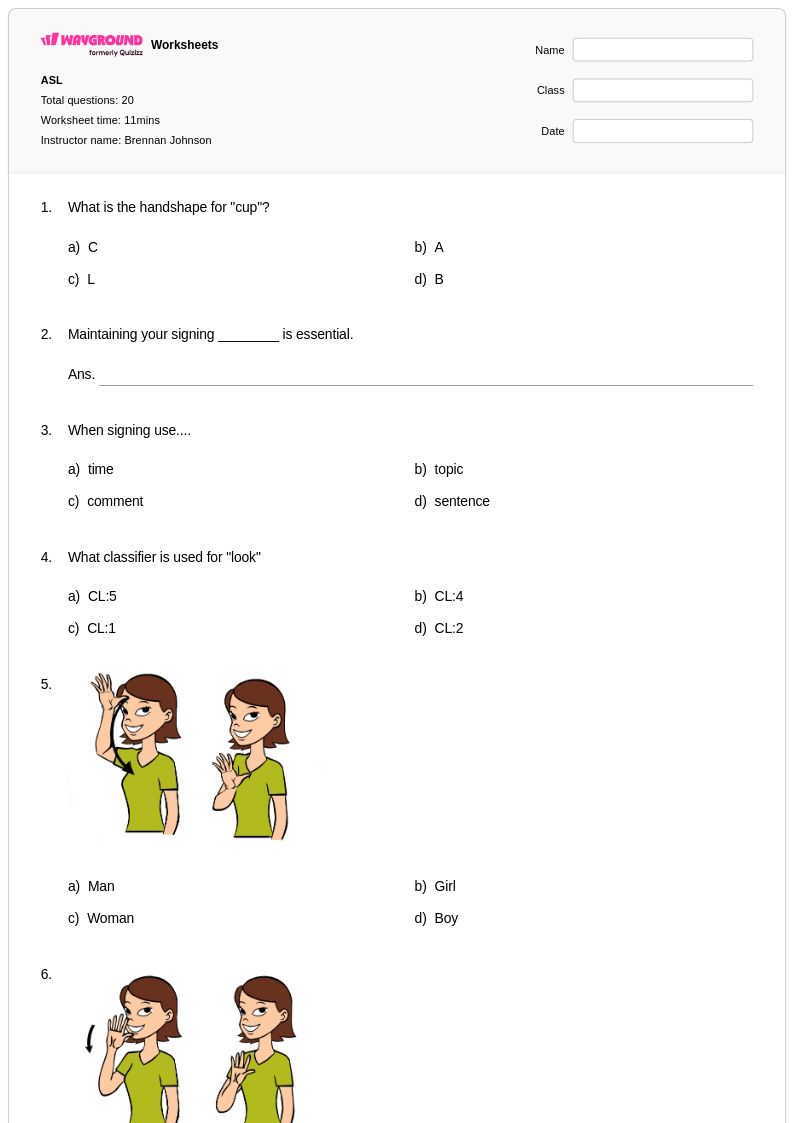
American Sign Language (ASL) worksheets available through Wayground (formerly Quizizz) provide comprehensive resources for developing visual-spatial communication skills and deaf culture awareness. These educational materials focus on essential ASL components including handshape recognition, fingerspelling proficiency, facial expression comprehension, and basic conversational vocabulary. The worksheets strengthen students' ability to understand ASL grammar structures, practice receptive and expressive signing skills, and build cultural competency within the deaf community. Each resource includes detailed answer keys and is available as free printable pdf downloads, featuring practice problems that range from alphabet drills and number recognition to complex sentence construction and storytelling exercises that reinforce proper ASL syntax and non-manual markers.
Wayground (formerly Quizizz) supports educators with millions of teacher-created ASL worksheet collections that streamline lesson planning and accommodate diverse learning needs in world language classrooms. The platform's robust search and filtering capabilities enable teachers to locate age-appropriate materials aligned with world language learning standards, while differentiation tools allow for customized instruction that meets individual student proficiency levels. These flexible resources are available in both printable and digital pdf formats, making them ideal for in-person instruction, remote learning environments, and hybrid classroom settings. Teachers can effectively use these worksheets for targeted skill practice, remediation of challenging concepts like directional verbs and classifiers, and enrichment activities that deepen students' understanding of deaf culture and ASL linguistic principles.
FAQs
How do I teach American Sign Language to students who have no prior signing experience?
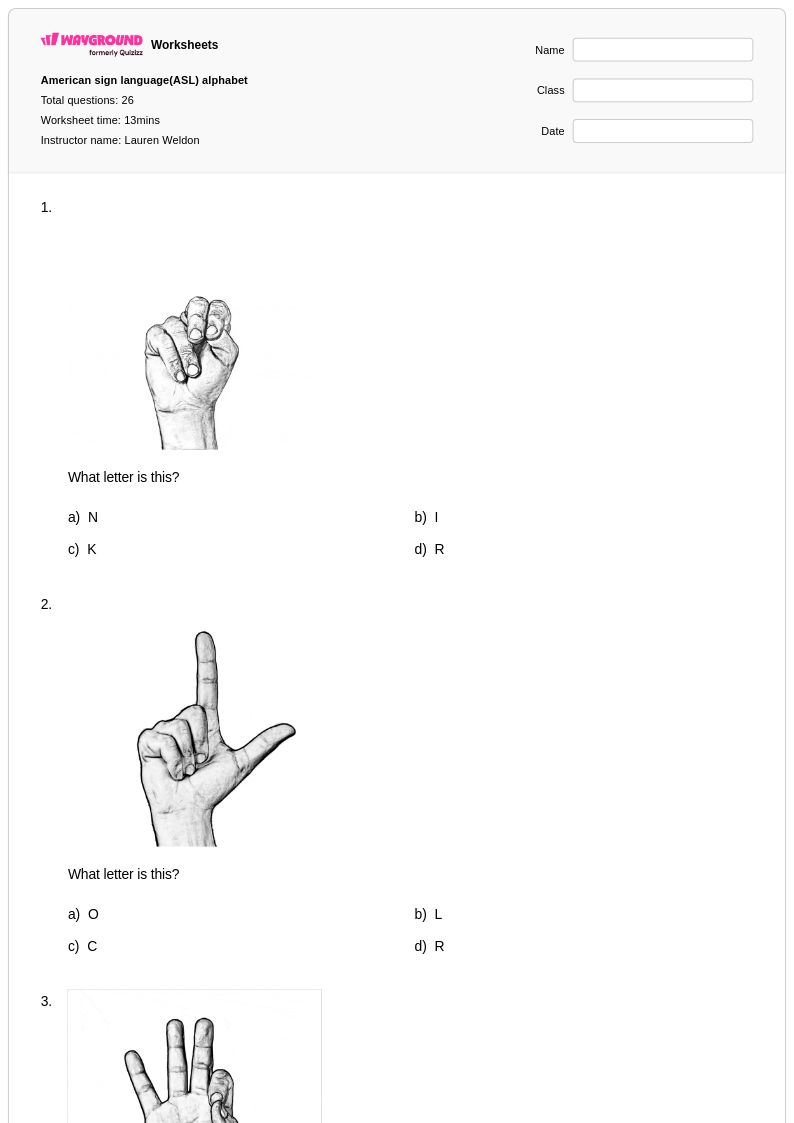
Start with handshape recognition and the ASL alphabet before introducing vocabulary, since fingerspelling forms the foundation of expressive and receptive signing. Introduce common conversational signs in thematic groups such as family, numbers, and greetings so students build functional vocabulary quickly. Pairing visual drills with practice worksheets helps reinforce handshape accuracy and correct non-manual markers like facial expressions, which are grammatically essential in ASL.
What exercises help students practice ASL fingerspelling?
Alphabet drills and timed fingerspelling recognition exercises are the most effective tools for building fluency, as they train both expressive production and receptive reading of fingerspelled words. Worksheets that present fingerspelled sequences for students to decode reinforce letter-to-sign mapping and improve reading speed. Progressing from individual letters to short words and then to names or vocabulary terms mirrors how fingerspelling is used in authentic ASL conversation.
What mistakes do students commonly make when learning ASL signs?
The most frequent errors involve ignoring non-manual markers — students often produce a sign with correct handshape but omit the facial expression or mouth movement that modifies its meaning. Students also tend to transliterate English word-for-word rather than applying ASL grammar structures, such as topic-comment sentence order and spatial referencing. Directional verbs and classifiers are particularly challenging because they encode spatial relationships that have no direct English equivalent, and students often default to signing each element separately instead.
How do I help students understand ASL grammar, which is so different from English?
ASL grammar should be taught explicitly as a separate linguistic system rather than a visual form of English, starting with topic-comment sentence structure and spatial grammar. Practice activities that ask students to identify the subject, object, and verb placement in ASL sentences help break the habit of English word-order thinking. Worksheets focused on sentence construction and storytelling exercises reinforce proper ASL syntax alongside non-manual markers, giving students repeated exposure to grammatically correct signing patterns.
How can I use ASL worksheets to build deaf culture awareness alongside signing skills?
Effective ASL instruction integrates cultural competency with language practice, so worksheets that address deaf community values, history, and etiquette reinforce both linguistic and cultural knowledge. Incorporating deaf culture content into vocabulary units — for example, teaching signs related to community and identity alongside cultural context — makes the learning more meaningful and respectful. Building cultural awareness from the beginning helps students understand ASL as a complete, living language rather than a communication workaround.
How do I use Wayground's ASL worksheets in my classroom?
Wayground's ASL worksheets are available as free printable PDF downloads for traditional classroom use and in digital formats for technology-integrated or remote learning environments, making them flexible across a range of instructional settings. Each worksheet includes a detailed answer key, so teachers can use them for independent practice, guided review, or homework without additional preparation. Teachers can also host worksheets as a quiz directly on Wayground, enabling real-time student responses and streamlined grading.