This Grade 7 mathematics worksheet gives students structured practice adding and subtracting rational numbers in decimal, fraction, and integer forms. Across 25 questions, students find sums and differences, simplify expressions, convert values to decimals, identify additive inverses, complete missing-number equations, and recognize that a number and its opposite have a sum of zero. It also includes absolute-value reasoning for finding distance between numbers and a multi-step money word problem.
The worksheet uses 21 multiple-choice questions, 3 multiple-select questions, and 1 dropdown item, giving students varied practice with selecting, comparing, and applying operations. It is useful for introducing or reviewing rational-number operations, checking understanding of sign rules and common denominators, and identifying students who need additional support with expressions or real-world applications. This free printable worksheet includes a complete answer key for efficient review and grading.
Worksheet settings
Font size
S
M
L
XL
Worksheets
Adding & Subtracting Rational Numbers
Total questions: 25
Name
Class
Date
1.
Find the sum.
0.5 + 0.25
a)
0.75
b)
1.25
c)
- 0.75
d)
12.5
2.
Find the sum.
32+54
a)
1522
b)
86
c)
158
d)
156
3.
Find the difference.
32−96
a)
2712
b)
94
c)
128
d)
0
4.
Find the difference.
54−32
a)
146
b)
56
c)
152
d)
−3610
5.
Write 43 as a decimal.
a)
0.5
b)
21
c)
0.75
d)
0.3
6.
Simplify the expression.
4.56−(−0.04)
a)
4.6
b)
-4.6
c)
4.52
d)
-4.52
7.
Find the difference.
21−0.5
a)
1
b)
-1
c)
0
d)
32
8.
Which number is the additive inverse of 5?
a)
51
b)
-5
c)
0.5
d)
- 0.5
9.
To add two fractions, I need to...
a)
have a common denominator
b)
multiply by the reciprocal
c)
keep, change, flip
d)
ask for extra help
10.
Find the sum.
21+25
a)
54
b)
- 3
c)
3
d)
45
11.
Find the missing number.
13 + ( ) = 0
a)
13
b)
- 13
c)
131
d)
−131
12.
Which expression can be used to find the distance between - 2 and 6?
Look back in your notes.
a)
-2 - 6
b)
|-2 - 6|
c)
|-2| - |6|
d)
|6 - 2|
13.
What is the sum of a number and its opposite?
a)
negative number
b)
positive number
c)
zero
14.
Simplify the expression.
−361+553
a)
23013
b)
−23013
c)
13013
d)
−13013
15.
At the beginning of the week, Jimmy has $20 dollars. He spends $13 on Monday. He receives $2 on Tuesday. Then he spends $4 on Wednesday and spends $5 on Thursday. How much money does Jimmy have at the beginning of the day on Friday?
a)
- 4 dollars
b)
0 dollars
c)
44 dollars
d)
3 dollars
16.
What is the absolute value of a number?
a)
0
b)
the opposite of the number
c)
the distance between that number and zero
d)
a positive number
17.
Find the difference.
7−4−(21−2)
a)
21−10
b)
21−14
c)
−14−2
d)
−14−6
18.
Find the sum.
331+(−132)
a)
132
b)
−132
c)
5
d)
−315
19.
Simplify the expression.
-4.7 + 18.5
a)
23.2
b)
13.8
c)
-13.8
d)
-23.2
20.
Which of the following a considered integers?
Select all that apply.
a)
24
b)
0
c)
-3.5
d)
98
e)
-3
21.
When written as a decimal, the fraction 517 is a (a) decimal.
Choose from the below words
repeating
terminating
non-terminating
22.
When converted to decimal form, which of the following are repeated decimals?
Select all that apply.
a)
6513
b)
113
c)
97
d)
31
e)
85
23.
Find the sum of52 and −93 .
a)
−151
b)
151
c)
−1511
d)
1511
24.
Which could be used as the common denominator for 41 and 62 ?
a)
4
b)
12
c)
6
d)
16
25.
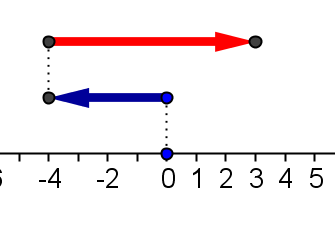
Which addition expression is shown on the number line?
a)
3 + (-4)
b)
-4 + 3
c)
7 + (-4)
d)
-4 + 7
Answer Key
Adding & Subtracting Rational Numbers
Total questions: 25
1.
a)
0.75
2.
a)
1522
3.
d)
0
4.
c)
152
5.
c)
0.75
6.
a)
4.6
7.
c)
0
8.
b)
-5
9.
a)
have a common denominator
10.
c)
3
11.
b)
- 13
12.
b)
|-2 - 6|
13.
c)
zero
14.
a)
23013
15.
b)
0 dollars
16.
c)
the distance between that number and zero
17.
a)
21−10
18.
a)
132
19.
b) 13.8
20.
a)
24
, b)
0
, e)
-3
21.
terminating
22.
b)
113
, c)
97
, d)
31
23.
b)
151
24.
b)
12
25.
d) -4 + 7
140 %
Browse by subjects
Browse by grades
Browse by format
FAQs
What does the Adding & Subtracting Rational Numbers worksheet cover?
This Grade 7 worksheet covers adding and subtracting rational numbers represented as decimals, fractions, and integers. Its 25 items ask students to find sums and differences, simplify expressions, identify additive inverses, solve missing-number equations, use absolute value to represent distance, and apply signed-number operations in a money word problem. The mix of multiple-choice, multiple-select, and dropdown questions checks both computation and concept recognition.
How can I use this worksheet to teach adding and subtracting rational numbers?
Use the worksheet after modeling how to align decimal places, find common denominators for fractions, and track signs when operating with integers. Pause before the additive-inverse, absolute-value distance, and missing-number items to have students explain why opposite numbers sum to zero and why distance is nonnegative. Then use the multi-step money problem as an application task, asking students to represent each transaction as a signed change before calculating the final balance.
What mistakes should I watch for on this rational numbers worksheet?
Watch for students reversing the sign when subtracting, treating an additive inverse as a reciprocal, or adding fractions without first using a common denominator. In the distance item, students may choose a signed difference instead of the absolute value, and in the money problem they may treat expenses as positive amounts or skip one transaction. Multiple-select questions also require students to choose every correct difference, not just one option.
How do I assign and grade this Adding & Subtracting Rational Numbers worksheet?
Wayground provides this worksheet as a printable PDF and as a digital quiz, so you can use the same rational-number practice for paper-based work or online assignment. It includes a complete answer key for the decimal, fraction, integer, absolute-value, and word-problem items. Printable submissions can be graded by scanning student work with the Wayground for Teachers app.
How can I differentiate this rational numbers worksheet for my students?
In the worksheet’s Advanced Settings, adjust font spacing and font size to make the 25 computation and application items easier to scan. You can also enable a dyslexia-friendly font or translate the worksheet into another language when that better supports access to the decimal, fraction, integer, and word-problem questions.
Where can I find more worksheets like this on Wayground?
Wayground offers a broad collection of free printable worksheets and practice problems across subjects, with downloadable PDFs and answer keys to help students master essential skills and concepts. Browse more resources at https://wayground.com/en-us/worksheets.

 Worksheets