Living in Groups Help Some Animals Survive is a Grade 3 science worksheet about how social behavior helps animals meet survival needs. Students examine why animals live in groups, including sharing food and caring for young; identify animals that live alone or in groups; and recognize how elephants, chickens, lions, honeybees, vampire bats, and killer whales benefit from group living. The worksheet also introduces the term prey and connects animal behavior to human health through a fact about vampire bat saliva.
The 10-item worksheet combines four multiple-select questions, three multiple-choice questions, and three fill-in-the-blank items. Students select more than one reason or example when required, identify details such as elephants protecting smaller group members and vampire bats living in colonies, and supply terms such as group, prey, and rooster. This free printable worksheet includes a complete answer key and is designed to reinforce Grade 3 understanding of how living in groups can help animals survive.
Worksheet settings
Font size
S
M
L
XL
Worksheets
Living in Groups Help Some Animals Survive
Total questions: 10
Name
Class
Date
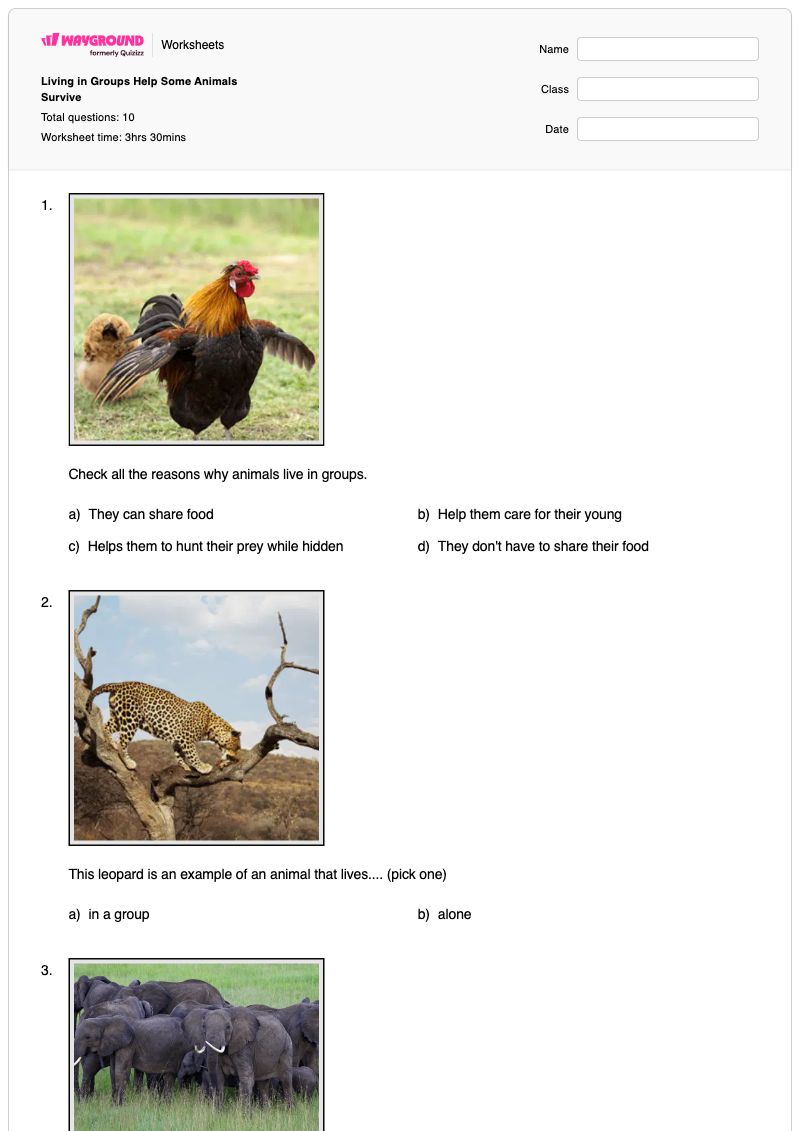
1.
Check all the reasons why animals live in groups.
a)
They can share food
b)
Help them care for their young
c)
Helps them to hunt their prey while hidden
d)
They don't have to share their food
2.
This leopard is an example of an animal that lives.... (pick one)
a)
in a group
b)
alone
3.
Larger elephants in this group form a ring on the outside to __________________ elephants on the inside.
a)
lean on each other
b)
keep watch for enemies
c)
protect the small
d)
block the sun from hitting the hot
4.
Elephants, Chickens, and Killer whales are examples of animals that live in (a) ?
5.
Lions and honeybees live in very_________________ groups.
a)
large
b)
small
6.
An animal that is hunted and eaten is called __________.
a)
pride
b)
prey
7.
Vampire bats live in ________________ to keep warm and to share food.
a)
pride
b)
swarm
c)
colonies
d)
school
8.
Killer whales hunt together to catch _____________?
a)
seals
b)
porpoises
c)
larger whales
d)
all the above
9.
A male (a) is read to protect the female hen looking for food in the grass.
10.
True or False?
A medicine made from Vampire Bat saliva may help people who've had a stroke?
(a)
Answer Key
Living in Groups Help Some Animals Survive
Total questions: 10
1.
a)
They can share food
, b)
Help them care for their young
2.
b)
alone
3.
c)
protect the small
4.
Groups, a group
5.
a)
large
6.
b)
prey
7.
c)
colonies
8.
d)
all the above
9.
rooster
10.
true
140 %
Browse by subjects
Browse by grades
Browse by format
FAQs
What does the Living in Groups Help Some Animals Survive worksheet cover?
This Grade 3 science worksheet teaches how living in groups helps animals survive through shared food, care of young, protection, warmth, and cooperative hunting. Its 10 questions use multiple-select, multiple-choice, and fill-in-the-blank formats to have students identify group-living behaviors, distinguish animals such as leopards that live alone, define prey, and recall examples such as vampire bats living in colonies.
How can I use this worksheet to teach how group living helps animals survive?
Introduce the worksheet by asking students what animals can do together that may be difficult alone, then discuss the examples before students work independently. Use the elephant, chicken, vampire bat, lion, honeybee, and killer whale items as evidence: students can explain how protection, warmth, food sharing, caring for young, and cooperative hunting support survival. Review the multiple-select questions carefully so students justify every option they choose.
What mistakes should I watch for when students complete this animal groups worksheet?
Students may choose the incorrect statement that animals in groups do not have to share food, or select only one answer when a multiple-select item has several correct responses. Watch for confusion between prey and a group name such as pride, and between vampire bats living in colonies and other listed group terms. Students may also miss that the leopard represents an animal that lives alone or that elephants form an outer ring to protect smaller elephants.
How do I assign and grade this Living in Groups Help Some Animals Survive worksheet?
Wayground provides this worksheet as a printable PDF and as a digital quiz, and it includes a complete answer key for the multiple-select, multiple-choice, and fill-in-the-blank items. You can grade printable submissions by scanning student work with the Wayground for Teachers app, while the digital quiz can be assigned and scored through Wayground.
How can I differentiate this worksheet for my students?
Use the worksheet’s Advanced Settings to adjust font spacing and font size so the animal-behavior questions and answer choices are easier to read. You can also enable a dyslexia-friendly font or translate the worksheet into another language, helping students access the multiple-select, multiple-choice, and fill-in-the-blank items.
Where can I find more worksheets like this on Wayground?
Wayground offers a broad collection of free printable worksheets and practice problems across subjects, with downloadable PDFs and answer keys to help students master essential skills and concepts. Browse more resources at https://wayground.com/en-us/worksheets.


 Worksheets


