

Wayground
Apple Tree Life Cycle - Printable Science Worksheets kindergarten - Wayground

Apple Tree Life Cycle

1 questions

3rd - 3rd Grade

Science

This Grade 3 science worksheet helps students explain the life cycle of an apple tree from seed germination through blossom and pollination to fruit development. Students read a short informational passage and use it to identify the first and final stages, recall the conditions needed for germination, and explain how blossoms support pollination and fruit production. The free printable worksheet includes eight varied items: one comprehension passage, two fill-in-the-blank questions, four multiple-choice questions, and one open-ended response. This combination checks both factual understanding and students’ ability to describe a stage’s role in the cycle. An answer key is included to support efficient review, feedback, and assessment in a Grade 3 science lesson.

Worksheet settings

Font size

S
M
L
XL
Worksheets

Apple Tree Life Cycle

Total questions: 1

Name
Class
Date
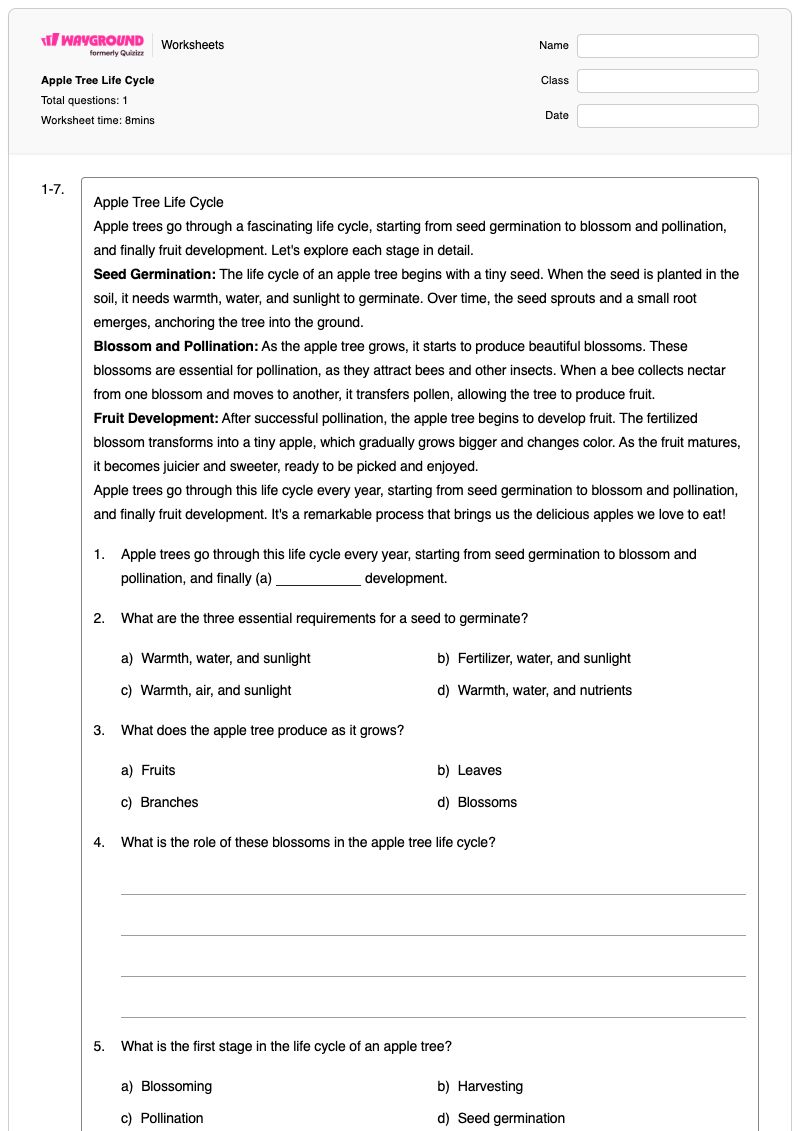
1-7.

Apple Tree Life Cycle

Apple trees go through a fascinating life cycle, starting from seed germination to blossom and pollination, and finally fruit development. Let's explore each stage in detail.

Seed Germination: The life cycle of an apple tree begins with a tiny seed. When the seed is planted in the soil, it needs warmth, water, and sunlight to germinate. Over time, the seed sprouts and a small root emerges, anchoring the tree into the ground.

Blossom and Pollination: As the apple tree grows, it starts to produce beautiful blossoms. These blossoms are essential for pollination, as they attract bees and other insects. When a bee collects nectar from one blossom and moves to another, it transfers pollen, allowing the tree to produce fruit.

Fruit Development: After successful pollination, the apple tree begins to develop fruit. The fertilized blossom transforms into a tiny apple, which gradually grows bigger and changes color. As the fruit matures, it becomes juicier and sweeter, ready to be picked and enjoyed.

Apple trees go through this life cycle every year, starting from seed germination to blossom and pollination, and finally fruit development. It's a remarkable process that brings us the delicious apples we love to eat!

1.

Apple trees go through this life cycle every year, starting from seed germination to blossom and pollination, and finally (a)   development.

2.

What are the three essential requirements for a seed to germinate?

a)

Warmth, water, and sunlight

b)

Fertilizer, water, and sunlight

c)

Warmth, air, and sunlight

d)

Warmth, water, and nutrients

3.

What does the apple tree produce as it grows?

a)

Fruits

b)

Leaves

c)

Branches

d)

Blossoms

4.

What is the role of these blossoms in the apple tree life cycle?

4 lines
5.

What is the first stage in the life cycle of an apple tree?

a)

Blossoming

b)

Harvesting

c)

Pollination

d)

Seed germination

6.

What is the final stage in the life cycle of an apple tree?

a)

Seed germination

b)

Blossom and pollination

c)

Fruit development

d)

Root growth

7.

After successful pollination, the apple tree begins to develop (a)   .

Answer Key

Apple Tree Life Cycle

Total questions: 1

1-7.
1.
fruit
2.
a)

Warmth, water, and sunlight

3.
d)

Blossoms

4.
n/a
5.
d)

Seed germination

6.
c)

Fruit development

7.
fruit

FAQs

What does the Apple Tree Life Cycle worksheet cover?

This Grade 3 science worksheet covers the sequence of seed germination, blossom and pollination, and fruit development in an apple tree’s yearly life cycle. Its reading passage, fill-in-the-blank items, multiple-choice questions, and open-ended prompt ask students to identify stages, recall that germination requires warmth, water, and sunlight, and explain how blossoms enable pollination.

How can I use this worksheet to teach the apple tree life cycle?

Begin by reading the passage with students and have them identify the three stages in order: seed germination, blossom and pollination, and fruit development. Use the multiple-choice and fill-in-the-blank items to check details, then discuss how bees transfer pollen between blossoms before students answer the open-ended question about the blossoms’ role.

What mistakes should I watch for when students complete this apple tree life cycle worksheet?

Students may confuse the first stage, seed germination, with later stages such as blossoming or fruit development, or select fruit instead of blossoms when asked what the growing tree produces. Watch for answers that omit one of the three germination requirements—warmth, water, and sunlight—and open-ended responses that do not connect blossoms with pollination and fruit development.

How do I assign and grade the Apple Tree Life Cycle worksheet?

The worksheet is available as a printable PDF and as a digital quiz on Wayground, and it includes a complete answer key for the fill-in-the-blank and multiple-choice items. For printable submissions, you can grade student work by scanning it with the Wayground for Teachers app. The printable format also supports schools that want to reduce screen time.

How can I differentiate this apple tree life cycle worksheet for my students?

In the worksheet’s Advanced Settings, adjust font spacing and font size to make the reading passage and mixed-response items easier to navigate. You can also select a dyslexia-friendly font or translate the worksheet into another language, depending on students’ needs.

Where can I find more worksheets like this on Wayground?

Wayground offers a broad collection of free printable worksheets and practice problems across subjects, with downloadable PDFs and answer keys to help students master essential skills and concepts. Browse more resources at https://wayground.com/en-us/worksheets.