Pythagorean Theorem Perimeter and Area of a Triangle
9 questions
8th - 8th Grade
Mathematics
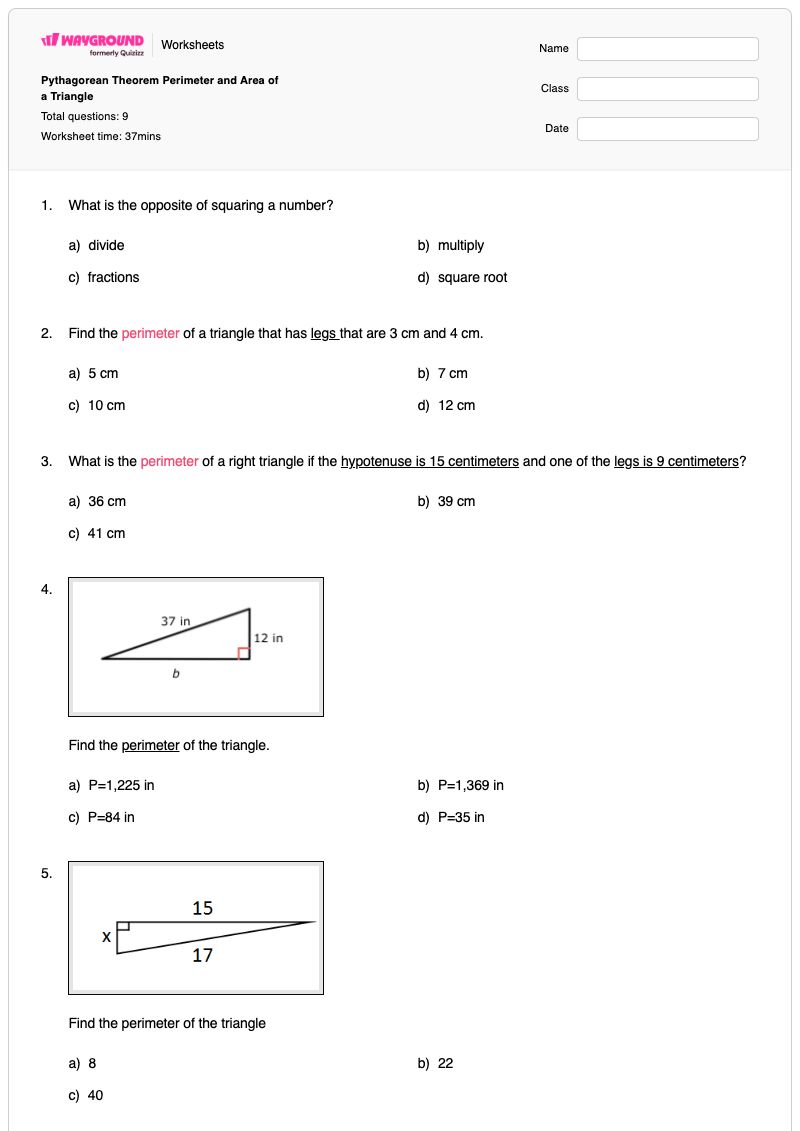
This Grade 8 mathematics worksheet gives students focused practice applying the Pythagorean theorem to right-triangle perimeter problems. Across nine multiple-choice questions, students identify the square root as the inverse of squaring, find missing side lengths, add all three sides to calculate perimeter, and recognize the hypotenuse in ladder and travel scenarios.
The worksheet also includes real-world route problems that compare a right-triangle shortcut with a longer two-part journey, plus a proof question about the relationship between the areas of the squares formed on a right triangle’s sides. These items help students connect calculations, diagrams, vocabulary, and the theorem’s area-based justification. It is a free printable worksheet for Grade 8 math instruction, independent practice, review, or assessment, and it includes an answer key for checking student work.
Worksheet settings
Font size
S
M
L
XL
Worksheets
Pythagorean Theorem Perimeter and Area of a Triangle
Total questions: 9
Name
Class
Date
1.
What is the opposite of squaring a number?
a)
divide
b)
multiply
c)
fractions
d)
square root
2.
Find the perimeter of a triangle that has legs that are 3 cm and 4 cm.
a)
5 cm
b)
7 cm
c)
10 cm
d)
12 cm
3.
What is the perimeter of a right triangle if the hypotenuse is 15 centimeters and one of the legs is 9 centimeters?
a)
36 cm
b)
39 cm
c)
41 cm
4.
Find the perimeter of the triangle.
a)
P=1,225 in
b)
P=1,369 in
c)
P=84 in
d)
P=35 in
5.
Find the perimeter of the triangle
a)
8
b)
22
c)
40
6.
”Real-world” word problems often have ladders leaning against trees, houses, or other structures. In these problems, the ladder represents the...
a)
Vertex
b)
Leg
c)
Right Angle
d)
Hypotenuse
7.
Jayson travels from his house directly west to the bank and then directly north from the bank to the mall. He then travels home on the road connecting the mall and his house. What is his total distance traveled?
a)
17 miles
b)
32 miles
c)
37 miles
d)
40 miles
8.
CHALLENGE: Destiny leaves her house and walks north 6 blocks. She turns and heads east 8 blocks until she reaches the skating rink for her birthday celebration.
How MUCH FURTHER did Destiny walk using this route instead of taking a straight shortcut path through Branch Brook Park to arrive at the skating rink? (Hint: Draw and label a model to help you visualize this situation.)
a)
4 blocks
b)
10 blocks
c)
14 blocks
d)
100 blocks
9.
Which of the following sentences would belong in the proof that describes this image?
a)
The sum of the areas of the two smaller squares is equal to the area of the large square.
b)
The sum of the side lengths of the two smaller squares is equal to the side length of the large square.
c)
The difference of the areas of the two smaller squares is equal to the area of the large square.
d)
The differences of the side lengths of the two smaller squares is equal to the side length of the large square.
Answer Key
Pythagorean Theorem Perimeter and Area of a Triangle
Total questions: 9
1.
d) square root
2.
d)
12 cm
3.
a)
36 cm
4.
c)
P=84 in
5.
c) 40
6.
d)
Hypotenuse
7.
d)
40 miles
8.
a)
4 blocks
9.
a) The sum of the areas of the two smaller squares is equal to the area of the large square.
140 %
Browse by subjects
Browse by grades
Browse by format
FAQs
What does this Pythagorean Theorem Perimeter and Area of a Triangle worksheet cover?
This Grade 8 worksheet contains nine multiple-choice questions on applying the Pythagorean theorem to right-triangle perimeter and distance situations. Students identify square roots, find missing side lengths, add the three sides to find perimeter, interpret ladders and travel routes as right-triangle models, and recognize the area relationship used in a proof of the theorem.
How can I use this worksheet to teach Pythagorean theorem perimeter problems?
Introduce the worksheet by reviewing that the square root reverses squaring and that the hypotenuse is opposite the right angle. Model one triangle by finding a missing leg, then adding both legs and the hypotenuse for the perimeter; afterward, have students use labeled sketches to represent the ladder and route problems before selecting an answer. Use the final proof item to discuss why the sum of the areas of the two smaller squares equals the area of the large square.
What mistakes should I watch for when students complete this worksheet?
Students may choose multiplication or division instead of the square root when asked for the operation that reverses squaring. In the perimeter items, check that they include all three sides rather than reporting only the known sides or the missing side, and remind them that the ladder is the hypotenuse. For the travel questions, students may confuse the longer two-part route with the straight shortcut or compare distances incorrectly; in the proof item, watch for confusing areas with side lengths.
How do I assign and grade this Pythagorean theorem worksheet?
On Wayground, you can assign this worksheet as a printable PDF or as a digital quiz, with all nine multiple-choice items ready for student practice. It includes a complete answer key, and printable submissions can be graded by scanning student work with the Wayground for Teachers app. The printable format also gives schools an option for reducing screen time.
How can I differentiate this right-triangle perimeter worksheet for my students?
Use the worksheet’s Advanced Settings to adjust font spacing and font size so the nine multiple-choice items and any diagrams or models are easier to read. You can also enable a dyslexia-friendly font or translate the worksheet into another language, helping students access the perimeter, distance, ladder, and proof questions without changing the mathematical tasks.
Where can I find more worksheets like this on Wayground?
Wayground offers a broad collection of free printable worksheets and practice problems across subjects, with downloadable PDFs and answer keys to help students master essential skills and concepts. Browse more resources at https://wayground.com/en-us/worksheets.

 Worksheets


