

Wayground
Understanding Area and Shapes - Printable Mathematics Worksheets - Wayground

Understanding Area and Shapes

15 questions

8th - 8th Grade

Mathematics

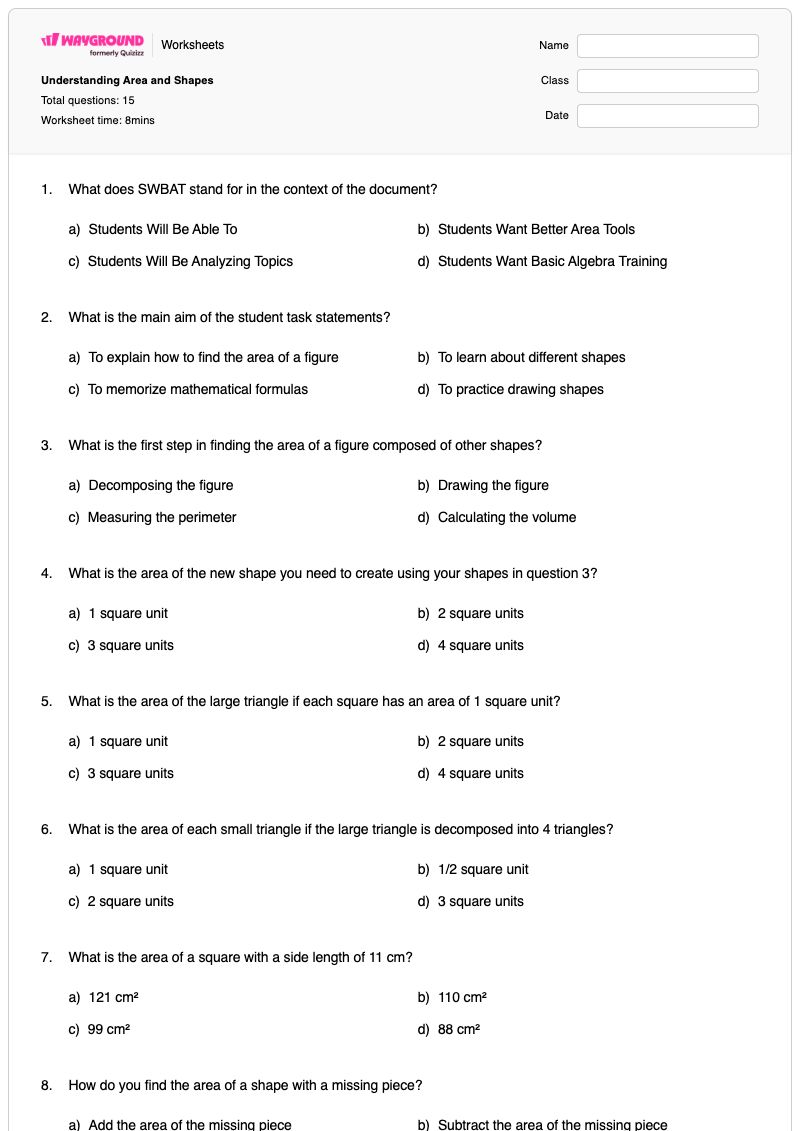
Understanding Area and Shapes is a Grade 8 mathematics worksheet with 15 multiple-choice questions focused on finding and comparing area through decomposition and recomposition. Students identify the first step in breaking composite figures into smaller shapes, calculate the areas of squares, rectangles, triangles, and figures with missing pieces, and interpret how rearranging parts affects area. The questions also connect visual models, grid representations, and student task statements to area reasoning. This free printable worksheet is designed for guided practice, independent review, or a quick check of understanding after teaching area strategies. Its answer choices help reveal whether students can distinguish area from perimeter and volume, select the correct operation for missing pieces, and apply formulas such as length × width and side × side. A complete answer key is included for efficient checking and feedback.

Worksheet settings

Font size

S
M
L
XL
WaygroundWorksheets

Understanding Area and Shapes

Total questions: 15

Name
Class
Date
1.

What does SWBAT stand for in the context of the document?

a)

Students Will Be Able To

b)

Students Want Better Area Tools

c)

Students Will Be Analyzing Topics

d)

Students Want Basic Algebra Training

2.

What is the main aim of the student task statements?

a)

To explain how to find the area of a figure

b)

To learn about different shapes

c)

To memorize mathematical formulas

d)

To practice drawing shapes

3.

What is the first step in finding the area of a figure composed of other shapes?

a)

Decomposing the figure

b)

Drawing the figure

c)

Measuring the perimeter

d)

Calculating the volume

4.

What is the area of the new shape you need to create using your shapes in question 3?

a)

1 square unit

b)

2 square units

c)

3 square units

d)

4 square units

5.

What is the area of the large triangle if each square has an area of 1 square unit?

a)

1 square unit

b)

2 square units

c)

3 square units

d)

4 square units

6.

What is the area of each small triangle if the large triangle is decomposed into 4 triangles?

a)

1 square unit

b)

1/2 square unit

c)

2 square units

d)

3 square units

7.

What is the area of a square with a side length of 11 cm?

a)

121 cm²

b)

110 cm²

c)

99 cm²

d)

88 cm²

8.

How do you find the area of a shape with a missing piece?

a)

Add the area of the missing piece

b)

Subtract the area of the missing piece

c)

Multiply the side lengths

d)

Estimate the area

9.

What is the purpose of decomposing a shape into smaller shapes?

a)

To make it look nicer

b)

To find the perimeter

c)

To calculate the area more easily

d)

To change its color

10.

What is the area of a rectangle if its length is 8 cm and width is 4 cm?

a)

24 square centimeters

b)

32 square centimeters

c)

40 square centimeters

d)

48 square centimeters

11.

What is the task in problem 6 related to the rectangle?

a)

Decompose the rectangle along the diagonal and recompose the pieces.

b)

Calculate the perimeter of the rectangle.

c)

Find the volume of the rectangle.

d)

Determine the color of the rectangle.

12.

What is the main question asked in problem 6b?

a)

How does the area of the new shape compare to the original rectangle?

b)

What is the perimeter of the new shape?

c)

How many sides does the new shape have?

d)

What is the color of the new shape?

13.

What does Priya do with 4 of the small squares in problem 7?

a)

Cuts them out and attaches them around the outside.

b)

Colors them red.

c)

Discards them.

d)

Uses them to form a triangle.

14.

How many small squares are cut out by Priya in problem 7?

a)

4

b)

2

c)

6

d)

8

15.

What is the grid used for in problem 6?

a)

To show the decomposition of the rectangle.

b)

To calculate the volume.

c)

To measure the perimeter.

d)

To determine the color.

WaygroundAnswer Key

Understanding Area and Shapes

Total questions: 15

1.
a)

Students Will Be Able To

2.
a)

To explain how to find the area of a figure

3.
a)

Decomposing the figure

4.
b)

2 square units

5.
b)

2 square units

6.
b)

1/2 square unit

7.
a)

121 cm²

8.
b)

Subtract the area of the missing piece

9.
c)

To calculate the area more easily

10.
b)

32 square centimeters

11.
a)

Decompose the rectangle along the diagonal and recompose the pieces.

12.
a)

How does the area of the new shape compare to the original rectangle?

13.
a)

Cuts them out and attaches them around the outside.

14.
a)

4

15.
a)

To show the decomposition of the rectangle.

FAQs

What does the Understanding Area and Shapes worksheet cover?

This Grade 8 worksheet uses 15 multiple-choice questions to practise finding and comparing area by decomposing composite figures, including triangles, rectangles, squares, and shapes with missing pieces. Students also interpret grid models and rearranged pieces, apply area calculations such as 11 × 11 and 8 × 4, and identify why decomposition makes area easier to calculate.

How can I use this worksheet to teach decomposing and recomposing shapes?

Introduce the worksheet by modeling how a composite figure can be split into familiar shapes and how a missing section can be handled by subtraction. Then use the questions about the large triangle, the diagonal cut in the rectangle, and the grid to have students explain why rearranging pieces preserves or changes the way area is represented. Finish with the multiple-choice items as independent practice or an exit check.

What mistakes should I watch for on this area and shapes worksheet?

Watch for students choosing perimeter or volume when a question asks for area, especially in the rectangle and decomposition items. They may also add rather than subtract the missing piece, forget that a large triangle divided into four equal triangles gives each small triangle one-fourth of the total, or treat rearranged pieces as changing the original area without examining the comparison.

How do I assign and grade this worksheet?

Wayground provides Understanding Area and Shapes as a printable PDF and as a digital quiz, and it includes a complete answer key for all 15 multiple-choice questions. You can assign the digital version through Wayground or print the PDF for handwritten responses; printable submissions can be graded by scanning student work with the Wayground for Teachers app.

How can I differentiate this worksheet for my students?

Use the worksheet’s Advanced Settings to adjust font spacing and font size so the 15 multiple-choice items and their answer choices are easier to read. You can also enable a dyslexia-friendly font or translate the area and shapes worksheet into another language when that supports access to the directions and mathematical vocabulary.

Where can I find more worksheets like this on Wayground?

Wayground offers a comprehensive collection of free printable worksheets and practice problems across all subjects, with downloadable PDFs and answer keys to support essential skills and concepts. Browse more resources at https://wayground.com/en-us/worksheets.