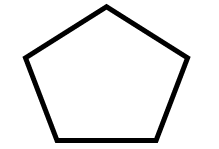
Angles of Regular Polygons is a Grade 8 mathematics worksheet that develops students’ ability to determine the sum of interior angles and the measure of one interior angle in regular polygons. The 11-item set includes 10 multiple-choice questions and one fill-in-the-blank question covering triangles, hexagons, octagons, and other polygons, along with the meanings of regular polygon and congruency. Students apply angle reasoning to identify total interior-angle measures, solve for a single angle, and distinguish between related geometric definitions.
Use this free printable worksheet for guided practice, independent work, review, or a quick check of understanding after teaching regular polygons. The varied items move from foundational facts about triangles and congruent figures to calculations involving polygons with different numbers of sides, helping teachers see whether students can transfer the idea across examples. A complete answer key is included for efficient checking and feedback.
Worksheet settings
Font size
S
M
L
XL
Worksheets
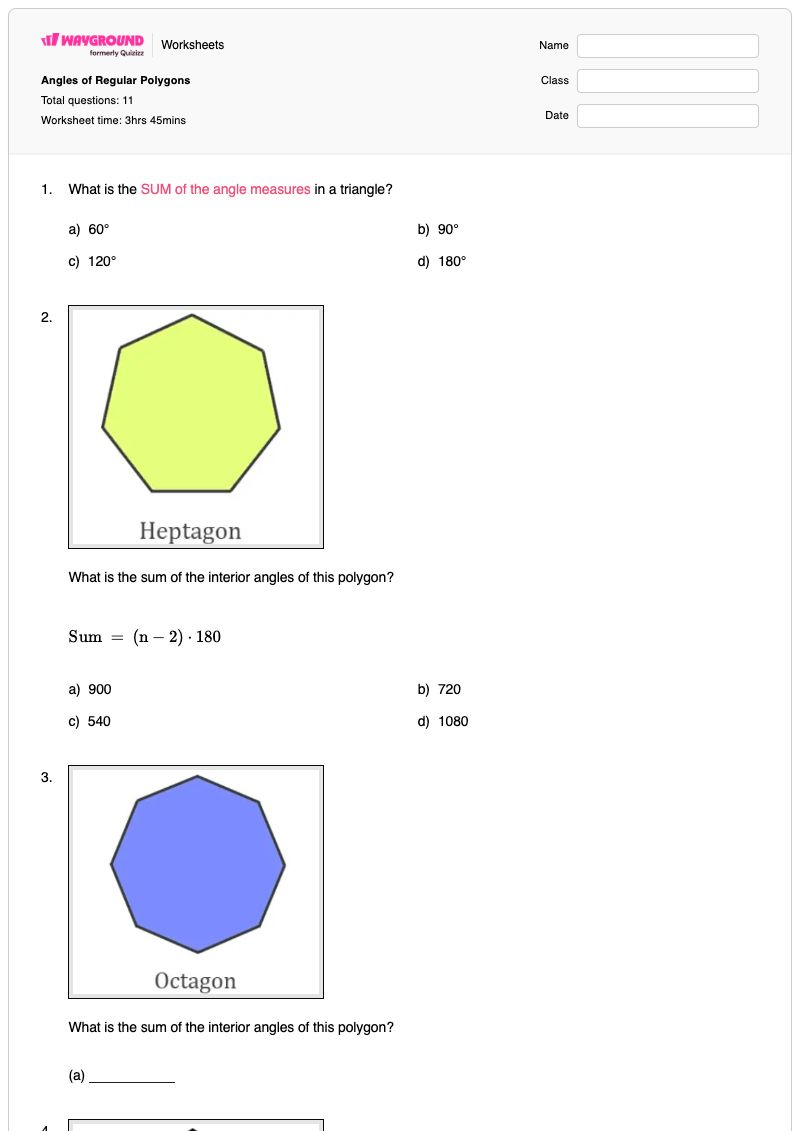
Angles of Regular Polygons
Total questions: 11
Name
Class
Date
1.
What is the SUM of the angle measures in a triangle?
a)
60°
b)
90°
c)
120°
d)
180°
2.
What is the sum of the interior angles of this polygon?
Sum=(n−2)⋅180
a)
900
b)
720
c)
540
d)
1080
3.
What is the sum of the interior angles of this polygon?
(a)
4.
Question 1b. Find the measure of one interior angle for the regular polygon.
a)
108°
b)
180°
c)
360°
d)
540°
5.
Find the size of angle x
a)
108o
b)
120o
c)
90o
d)
144o
6.
Find the size of angle x
a)
135o
b)
150o
c)
144o
d)
140o
7.
What is the measure of a single interior angle for a regular octagon (8 sides)?
a)
1440
b)
1080
c)
1800
d)
135
8.
What is the measure of ONE interior angle in a regular hexagon (6 sides)?
a)
60°
b)
80°
c)
108°
d)
120°
9.
What is a regular polygon?
a)
Polygon with all sides congruent
b)
Polygon with all angles congruent
c)
Polygon with all sides and angles congruent
d)
Polygon with no sides or angles congruent
10.
What is congruency?
a)
Same size and shape
b)
Same size
c)
segment
d)
congruent
11.
What is the measure of ONE interior angle in a regular triangle (3 sides)?
a)
15°
b)
30°
c)
60°
d)
90°
Answer Key
Angles of Regular Polygons
Total questions: 11
1.
d) 180°
2.
a)
900
3.
1080, 1,080, 1080
4.
a)
108°
5.
b)
120o
6.
d)
140o
7.
d)
135
8.
d) 120°
9.
c) Polygon with all sides and angles congruent
10.
a) Same size and shape
11.
c) 60°
140 %
Browse by subjects
Browse by grades
Browse by format
FAQs
What does the Angles of Regular Polygons worksheet cover?
This Grade 8 worksheet covers finding the sum of interior angles and the measure of one interior angle in regular polygons. Its 10 multiple-choice items and one fill-in-the-blank item ask students to work with triangles, hexagons, octagons, and other polygons while also identifying regular polygons and congruent figures. Completing the set helps students distinguish a polygon’s total interior-angle sum from the measure of each individual angle.
How can I use this worksheet to teach angles of regular polygons?
Begin by reviewing the meanings of regular polygon and congruency, then model the difference between a polygon’s total interior-angle sum and one interior angle. Work through a triangle example before comparing the hexagon and octagon questions, asking students how the number of sides affects their calculation. Use the multiple-choice options to prompt students to explain why a tempting answer represents the total sum rather than a single angle.
What mistakes should I watch for when students complete this worksheet?
Students may confuse the sum of all interior angles with the measure of one interior angle, especially when both types of questions appear together. Watch for errors in identifying the number of sides in the polygon diagrams, choosing an answer for a regular polygon without checking that all sides and angles are congruent, or selecting a familiar angle measure without applying it to the specified triangle, hexagon, or octagon. The fill-in-the-blank item also checks whether students can record the total angle sum accurately rather than relying only on recognition.
How do I assign and grade this Angles of Regular Polygons worksheet?
On Wayground, assign it as a printable PDF or as a digital quiz, depending on how you want students to complete the 11 angle and terminology questions. The worksheet includes a complete answer key, and printable submissions can be graded by scanning student work with the Wayground for Teachers app. The printable format also gives schools an option for reducing screen time.
How can I differentiate this regular-polygon angle worksheet for my students?
Use the worksheet’s Advanced Settings to adjust font spacing or choose a larger font size so the polygon-angle questions and answer choices are easier to read. You can also enable a dyslexia-friendly font or translate the worksheet into another language when those changes support access to the geometry vocabulary and calculations. These options modify the worksheet file while preserving its multiple-choice and fill-in-the-blank format.
Where can I find more worksheets like this on Wayground?
Wayground offers a comprehensive collection of free printable worksheets and practice problems across subjects, with downloadable PDFs and answer keys to help students master essential skills and concepts. Browse more resources at https://wayground.com/en-us/worksheets.

 Worksheets