

Wayground
Bill of Rights Matching - Printable Social studies Worksheets 8th Grade - Wayground

Bill of Rights Matching

Rayanne Mcgee

Created by Rayanne Mcgee

5 questions

8th Grade

Social studies

Updated Sep 2026

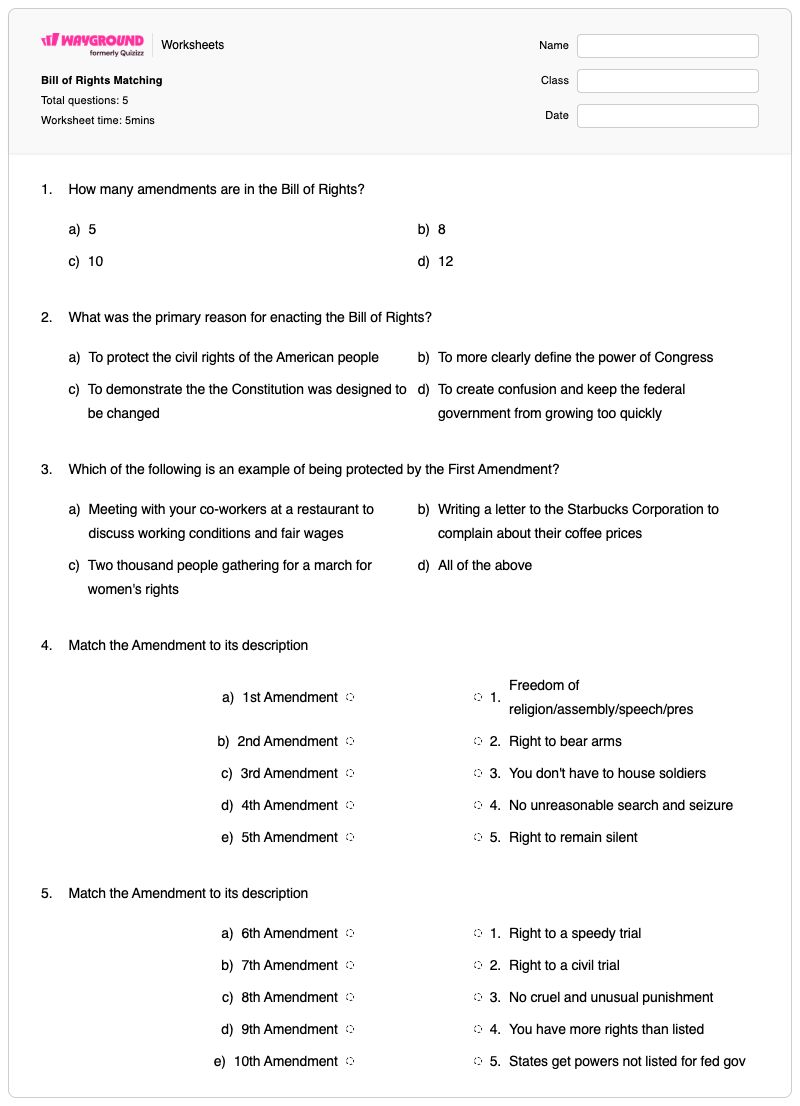
Bill of Rights Matching is a free printable Grade 8 social studies worksheet that helps students review the first ten amendments to the U.S. Constitution. It uses three multiple-choice questions to check understanding of how many amendments make up the Bill of Rights, why it was enacted, and how First Amendment protections apply to examples involving discussion, complaints, and peaceful marches. The worksheet also includes two matching questions in which students pair Amendments 1–5 and 6–10 with their corresponding descriptions. This format moves students from recalling key facts to identifying the amendment associated with a described protection. Use it for independent practice, a review activity, or a formative check of students’ understanding. The worksheet is available as a free printable PDF and includes a complete answer key.

Worksheet settings

Font size

S
M
L
XL
WaygroundWorksheets

Bill of Rights Matching

Total questions: 5

Name
Class
Date
1.

How many amendments are in the Bill of Rights? 

a)

5

b)

8

c)

10

d)

12

2.

What was the primary reason for enacting the Bill of Rights?

a)

To protect the civil rights of the American people

b)

To more clearly define the power of Congress

c)

To demonstrate the the Constitution was designed to be changed

d)

To create confusion and keep the federal government from growing too quickly

3.

Which of the following is an example of being protected by the First Amendment?

a)

Meeting with your co-workers at a restaurant to discuss working conditions and fair wages

b)

Writing a letter to the Starbucks Corporation to complain about their coffee prices

c)

Two thousand people gathering for a march for women's rights

d)

All of the above

4.

Match the Amendment to its description

1st Amendment

Freedom of religion/assembly/speech/pres

2nd Amendment

Right to bear arms

3rd Amendment

You don't have to house soldiers

4th Amendment

No unreasonable search and seizure

5th Amendment

Right to remain silent

5.

Match the Amendment to its description

6th Amendment

Right to a speedy trial

7th Amendment

Right to a civil trial

8th Amendment

No cruel and unusual punishment

9th Amendment

You have more rights than listed

10th Amendment

States get powers not listed for fed gov

WaygroundAnswer Key

Bill of Rights Matching

Total questions: 5

1.
c)

10

2.
a)

To protect the civil rights of the American people

3.
d)

All of the above

4.

1st Amendment

 - 

Freedom of religion/assembly/speech/pres

, 

2nd Amendment

 - 

Right to bear arms

, 

3rd Amendment

 - 

You don't have to house soldiers

, 

4th Amendment

 - 

No unreasonable search and seizure

, 

5th Amendment

 - 

Right to remain silent

5.

6th Amendment

 - 

Right to a speedy trial

, 

7th Amendment

 - 

Right to a civil trial

, 

8th Amendment

 - 

No cruel and unusual punishment

, 

9th Amendment

 - 

You have more rights than listed

, 

10th Amendment

 - 

States get powers not listed for fed gov

FAQs

What does the Bill of Rights Matching worksheet cover?

This Grade 8 worksheet covers the first ten amendments, the purpose of enacting the Bill of Rights, and examples of First Amendment protection. Three multiple-choice questions assess recall and interpretation, while two matching sections require students to connect Amendments 1–5 and 6–10 with their corresponding descriptions.

How can I use this worksheet to teach the Bill of Rights?

Introduce the worksheet by reviewing that the Bill of Rights contains ten amendments and discussing why protections for civil rights were included. Then have students explain why each First Amendment example fits the protection described before completing the two amendment-to-description matching sections. Use the matching results to prompt students to justify how an amendment’s number connects to its stated protection.

What mistakes should I watch for when students complete this Bill of Rights worksheet?

Watch for students choosing a distractor instead of identifying ten amendments or the purpose of protecting civil rights. In the First Amendment item, students may overlook that several listed examples fit and fail to select “All of the above.” During matching, check whether students are confusing amendment numbers or pairing a description with the wrong amendment group.

How do I assign and grade this Bill of Rights worksheet?

You can assign this worksheet as a printable PDF or as a digital quiz on Wayground. It includes a complete answer key for the three multiple-choice items and two matching sections, and printable submissions can be graded by scanning student work with the Wayground for Teachers app. The printable format also supports schools that are reducing screen time.

How can I differentiate this Bill of Rights matching worksheet for my students?

Use the worksheet’s Advanced Settings to adjust font spacing or increase the font size so the multiple-choice options and amendment-matching entries are easier to follow. You can also apply a dyslexia-friendly font or translate the worksheet into another language. These changes preserve the worksheet’s questions while making its text and matching format more accessible.

Where can I find more worksheets like this on Wayground?

Wayground offers a comprehensive collection of free printable worksheets and practice problems across all subjects, with downloadable PDFs and answer keys to support essential skills and concepts. Browse more resources at https://wayground.com/en-us/worksheets.