

Wayground
Bill of Rights Scenarios Quiz - Printable Social studies Worksheets 8th Grade - Wayground

Bill of Rights Scenarios Quiz

Matthew Gugino

Created by Matthew Gugino

10 questions

8th Grade

Social studies

Updated Oct 2026

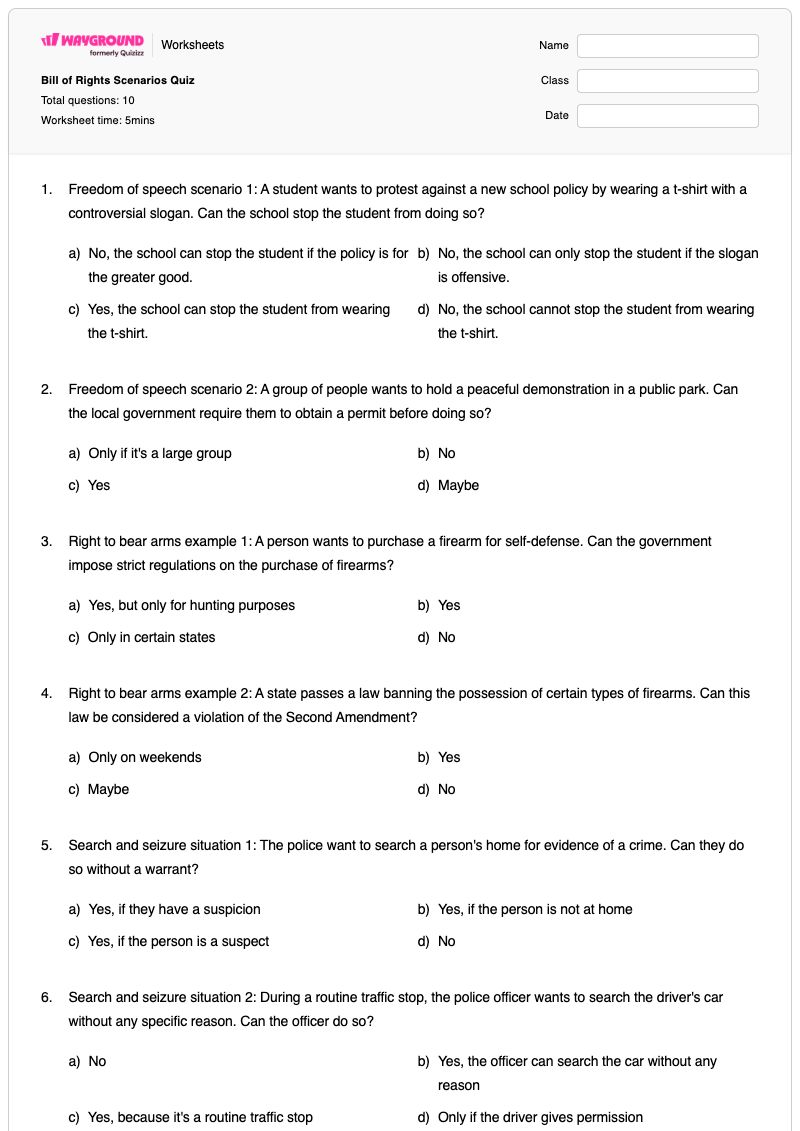
Bill of Rights Scenarios Quiz is a Grade 8 history worksheet with 10 multiple-choice questions that asks students to apply constitutional rights to everyday legal situations. Students evaluate scenarios involving freedom of speech and peaceful assembly, the right to bear arms, search and seizure, rights of the accused, and cruel and unusual punishment. Rather than recalling amendment names alone, they determine whether a government action is permitted or may violate a protected right. This free printable worksheet helps students connect Bill of Rights principles to concrete examples, including school expression, public demonstrations, police searches, custodial questioning, access to a public defender, firearm regulations, and sentencing or execution methods. It is useful for guided instruction, independent practice, or a formative check of students’ ability to interpret constitutional protections in context. An answer key is included for efficient review and grading.

Worksheet settings

Font size

S
M
L
XL
WaygroundWorksheets

Bill of Rights Scenarios Quiz

Total questions: 10

Name
Class
Date
1.

Freedom of speech scenario 1: A student wants to protest against a new school policy by wearing a t-shirt with a controversial slogan. Can the school stop the student from doing so?

a)

No, the school can stop the student if the policy is for the greater good.

b)

No, the school can only stop the student if the slogan is offensive.

c)

Yes, the school can stop the student from wearing the t-shirt.

d)

No, the school cannot stop the student from wearing the t-shirt.

2.

Freedom of speech scenario 2: A group of people wants to hold a peaceful demonstration in a public park. Can the local government require them to obtain a permit before doing so?

a)

Only if it's a large group

b)

No

c)

Yes

d)

Maybe

3.

Right to bear arms example 1: A person wants to purchase a firearm for self-defense. Can the government impose strict regulations on the purchase of firearms?

a)

Yes, but only for hunting purposes

b)

Yes

c)

Only in certain states

d)

No

4.

Right to bear arms example 2: A state passes a law banning the possession of certain types of firearms. Can this law be considered a violation of the Second Amendment?

a)

Only on weekends

b)

Yes

c)

Maybe

d)

No

5.

Search and seizure situation 1: The police want to search a person's home for evidence of a crime. Can they do so without a warrant?

a)

Yes, if they have a suspicion

b)

Yes, if the person is not at home

c)

Yes, if the person is a suspect

d)

No

6.

Search and seizure situation 2: During a routine traffic stop, the police officer wants to search the driver's car without any specific reason. Can the officer do so?

a)

No

b)

Yes, the officer can search the car without any reason

c)

Yes, because it's a routine traffic stop

d)

Only if the driver gives permission

7.

Rights of the accused scenario 1: A person is arrested and taken into custody. Can the police interrogate the person without informing them of their right to remain silent?

a)

No

b)

Yes, they can interrogate without informing the right to remain silent

c)

The person can be interrogated only if they have committed a serious crime

d)

The person can be interrogated only if they have a lawyer present

8.

Rights of the accused scenario 2: A defendant in a criminal trial cannot afford to hire a lawyer. Can the court provide them with a public defender?

a)

No, the defendant must represent themselves

b)

Yes

c)

Yes, but only if the defendant is a minor

d)

No, the court does not provide legal representation

9.

Cruel and unusual punishment example 1: A person convicted of a crime is sentenced to life imprisonment without the possibility of parole for a non-violent offense. Can this be considered cruel and unusual punishment?

a)

Yes

b)

No

c)

Maybe

d)

Depends on the circumstances

10.

Cruel and unusual punishment example 2: A state allows the use of a particular method of execution that has been deemed to cause extreme pain. Can this method be considered cruel and unusual punishment?

a)

No

b)

Maybe

c)

Not sure

d)

Yes

WaygroundAnswer Key

Bill of Rights Scenarios Quiz

Total questions: 10

1.
d)

No, the school cannot stop the student from wearing the t-shirt.

2.
c)

Yes

3.
b)

Yes

4.
b)

Yes

5.
d)

No

6.
a)

No

7.
a)

No

8.
b)

Yes

9.
a)

Yes

10.
d)

Yes

FAQs

What does the Bill of Rights Scenarios Quiz help Grade 8 students practice?

This worksheet helps students apply Bill of Rights protections to 10 multiple-choice scenarios rather than simply identify amendment names. They decide whether situations involving speech and assembly, firearms, searches, interrogation, legal representation, and punishment are consistent with the rights presented in the quiz.

How can I use this worksheet to teach the Bill of Rights through scenarios?

Introduce each protection with a brief class definition, then have students explain which right applies before selecting an answer for each scenario. Use paired discussion to compare the school T-shirt and public-park demonstration items, then review why the worksheet treats police searches, custodial questioning, public defenders, and extreme punishment as distinct rights questions.

What mistakes should I watch for when students complete this Bill of Rights quiz?

Students may confuse freedom of speech with an unrestricted right to demonstrate, or overlook that the quiz gives different answers for a controversial school T-shirt and a permit requirement for a public demonstration. They may also choose suspicion alone as sufficient for a home search, assume a routine traffic stop automatically permits a car search, or miss the separate protections involving silence and a public defender. Watch for students who treat firearm regulations, firearm bans, and punishment questions as interchangeable instead of evaluating each scenario on its own terms.

How do I assign and grade this Bill of Rights worksheet?

The worksheet is available as a printable PDF and as a digital quiz on Wayground, and it includes a complete answer key. Grade printed responses manually or scan student work with the Wayground for Teachers app; assign the digital version when you want responses collected online.

How can I differentiate this Bill of Rights scenarios worksheet for my students?

In the worksheet’s Advanced Settings, adjust font spacing or font size to make the multiple-choice scenarios easier to read. You can also apply a dyslexia-friendly font or translate the worksheet into another language while keeping the Bill of Rights question format.

Where can I find more free worksheets like this on Wayground?

Wayground offers a comprehensive collection of free printable worksheets and practice problems across subjects, with downloadable PDFs and answer keys to support essential skills and concepts. Browse more resources at https://wayground.com/en-us/worksheets.