
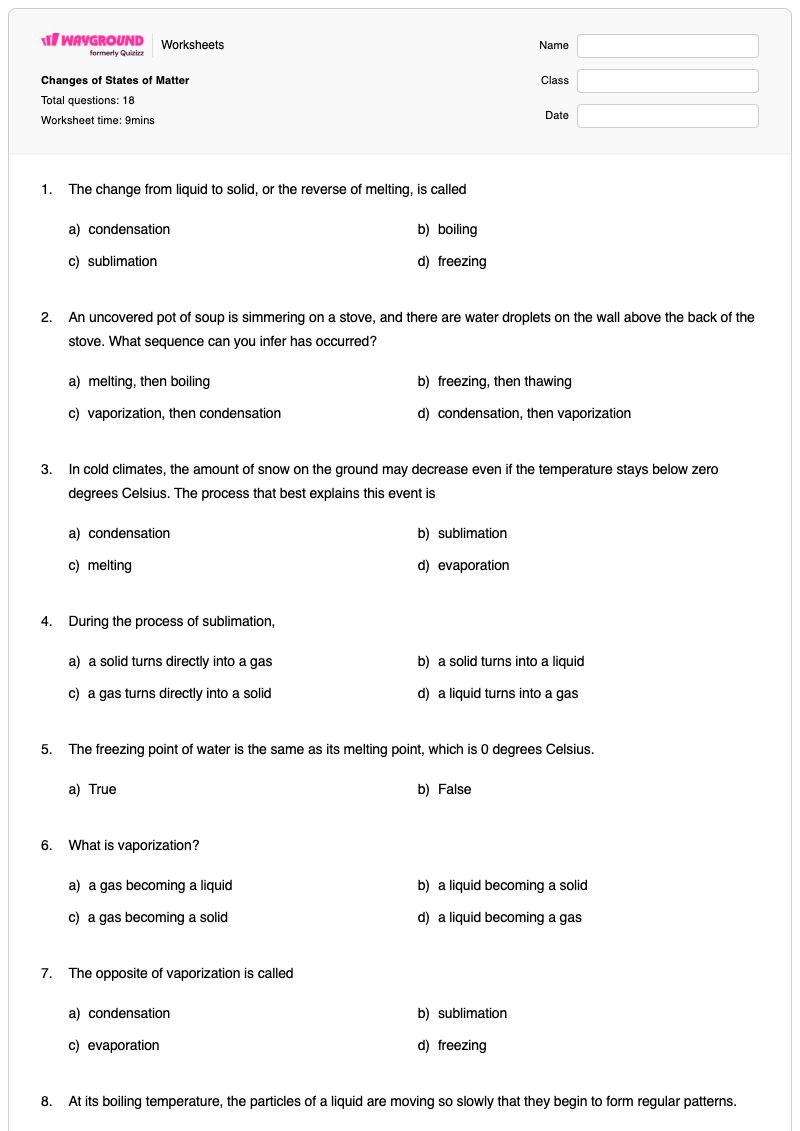

Changes of States of Matter is a Grade 8 science worksheet that helps students distinguish freezing, vaporization, condensation, and sublimation. Across 18 multiple-choice questions, students identify phase changes from definitions, compare opposite processes, interpret everyday situations such as simmering soup and shrinking ice, and connect changes of state to particle motion and thermal energy. True-or-false items also check common misconceptions about water vapor, boiling, dry ice, and sublimation.
This worksheet is useful for introducing or reviewing how matter changes between solid, liquid, and gas. Students must apply vocabulary to real-world observations, select accurate descriptions of particle behavior, and recognize that sublimation can occur without melting. It is a free printable worksheet with a complete answer key, making it suitable for independent practice, classwork, homework, or a quick science review. Teachers can use the results to identify whether students need further support with phase-change terminology or particle-level explanations.
Worksheet settings
Font size
S
M
L
XL
Worksheets
Changes of States of Matter
Total questions: 18
Name
Class
Date
1.
The change from liquid to solid, or the reverse of melting, is called
a)
condensation
b)
boiling
c)
sublimation
d)
freezing
2.
An uncovered pot of soup is simmering on a stove, and there are water droplets on the wall above the back of the stove. What sequence can you infer has occurred?
a)
melting, then boiling
b)
freezing, then thawing
c)
vaporization, then condensation
d)
condensation, then vaporization
3.
In cold climates, the amount of snow on the ground may decrease even if the temperature stays below zero degrees Celsius. The process that best explains this event is
a)
condensation
b)
sublimation
c)
melting
d)
evaporation
4.
During the process of sublimation,
a)
a solid turns directly into a gas
b)
a solid turns into a liquid
c)
a gas turns directly into a solid
d)
a liquid turns into a gas
5.
The freezing point of water is the same as its melting point, which is 0 degrees Celsius.
a)
True
b)
False
6.
What is vaporization?
a)
a gas becoming a liquid
b)
a liquid becoming a solid
c)
a gas becoming a solid
d)
a liquid becoming a gas
7.
The opposite of vaporization is called
a)
condensation
b)
sublimation
c)
evaporation
d)
freezing
8.
At its boiling temperature, the particles of a liquid are moving so slowly that they begin to form regular patterns.
a)
True
b)
False
9.
Piece of dry ice (solid carbon dioxide) become smaller through the process of melting.
a)
True
b)
False
10.
Water vapor is a colorless gas that is impossible to see.
a)
True
b)
False
11.
When a gas cools to become a liquid it loses thermal energy.
a)
True
b)
False
12.
Which of the following describes the process of freezing?
a)
Freezing occurs when the temperature of a substance drops to zero degrees Celsius.
b)
Freezing occurs when the particles of a solid vibrate so fast that they break free.
c)
Freezing occurs when the temperature drops enough that a gas turns into a solid.
d)
Freezing occurs when the particles in a liquid slow down and take fixed positions.
13.
The process that makes ice cubes shrink as they sit in a freezer is called
a)
sublimation
b)
condensation
c)
freezing
d)
boiling
14.
Which state of matter has particles with the greatest amount of thermal energy?
a)
liquid
b)
crystalline solid
c)
amorphous solid
d)
gas
15.
Sublimation and boiling both only happen at the surface of a substance.
a)
True
b)
False
16.
Boiling is the reverse process to freezing.
a)
True
b)
False
17.
The two types of vaporization are
a)
boiling and subliming
b)
boiling and evaporation
c)
evaporation and subliming
d)
evaporation and condensation
18.
The type of vaporization that happens only at the surface of a liquid is
a)
sublimation
b)
boiling
c)
evaporation
d)
condensation
Answer Key
Changes of States of Matter
Total questions: 18
1.
d)
freezing
2.
c)
vaporization, then condensation
3.
b)
sublimation
4.
a)
a solid turns directly into a gas
5.
a)
True
6.
d)
a liquid becoming a gas
7.
a)
condensation
8.
b)
False
9.
b)
False
10.
b)
False
11.
a)
True
12.
d)
Freezing occurs when the particles in a liquid slow down and take fixed positions.
13.
a)
sublimation
14.
d)
gas
15.
b)
False
16.
b)
False
17.
b)
boiling and evaporation
18.
c)
evaporation
140 %
Browse by subjects
Browse by grades
Browse by format
FAQs
What does the Changes of States of Matter worksheet cover?
This Grade 8 science worksheet uses 18 multiple-choice questions to assess freezing, vaporization, condensation, and sublimation. Students identify phase changes from definitions and real-world examples, such as water droplets forming above simmering soup and ice shrinking in a freezer, while also explaining changes through particle motion and thermal energy.
How can I use this worksheet to teach changes of state?
Introduce the four phase changes with a solid-liquid-gas diagram and a particle model, then have students complete the multiple-choice items independently or in pairs. Ask students to justify scenario-based answers, such as why snow can decrease below 0°C or why droplets appear above a simmering pot, using the vocabulary of vaporization, condensation, and sublimation.
What mistakes should I watch for when students complete this phase-changes worksheet?
Watch for students confusing sublimation with melting or evaporation, especially in the dry-ice and shrinking-ice examples; sublimation is the direct change from solid to gas. Students may also reverse vaporization and condensation, assume boiling occurs only at a surface, or overlook the particle explanation for freezing in which liquid particles slow down and take fixed positions.
How do I assign and grade the Changes of States of Matter worksheet?
Wayground provides this worksheet as a printable PDF and as a digital quiz, with a complete answer key for all 18 multiple-choice questions. Printable submissions can be graded by scanning student work with the Wayground for Teachers app, while the digital version can be assigned through Wayground for online response collection and grading.
How can I differentiate this phase-changes worksheet for my students?
In the worksheet's Advanced Settings, adjust font spacing and font size to make the 18 multiple-choice items easier to read, and enable a dyslexia-friendly font when useful. You can also translate the worksheet into another language so students can focus on distinguishing freezing, vaporization, condensation, and sublimation while building content vocabulary.
Where can I find more worksheets like this on Wayground?
Wayground offers a comprehensive collection of free printable worksheets and practice problems across subjects, with downloadable PDFs and answer keys to support mastery of essential skills and concepts. Browse more resources at https://wayground.com/en-us/worksheets.