 Worksheets
Types of Communities
Total questions: 10
Name
Class
Date
Answer KeyTypes of Communities
Total questions: 10
1.
a)
rural
2.
b)
suburb
3.
n/a
4.
c)
urban
5.
urban
6.
b)
suburb
7.
n/a
8.
n/a
9.
b)
parks
10.
urban

10 questions
2nd - 3rd Grade
Social studies
Updated Jun 2026
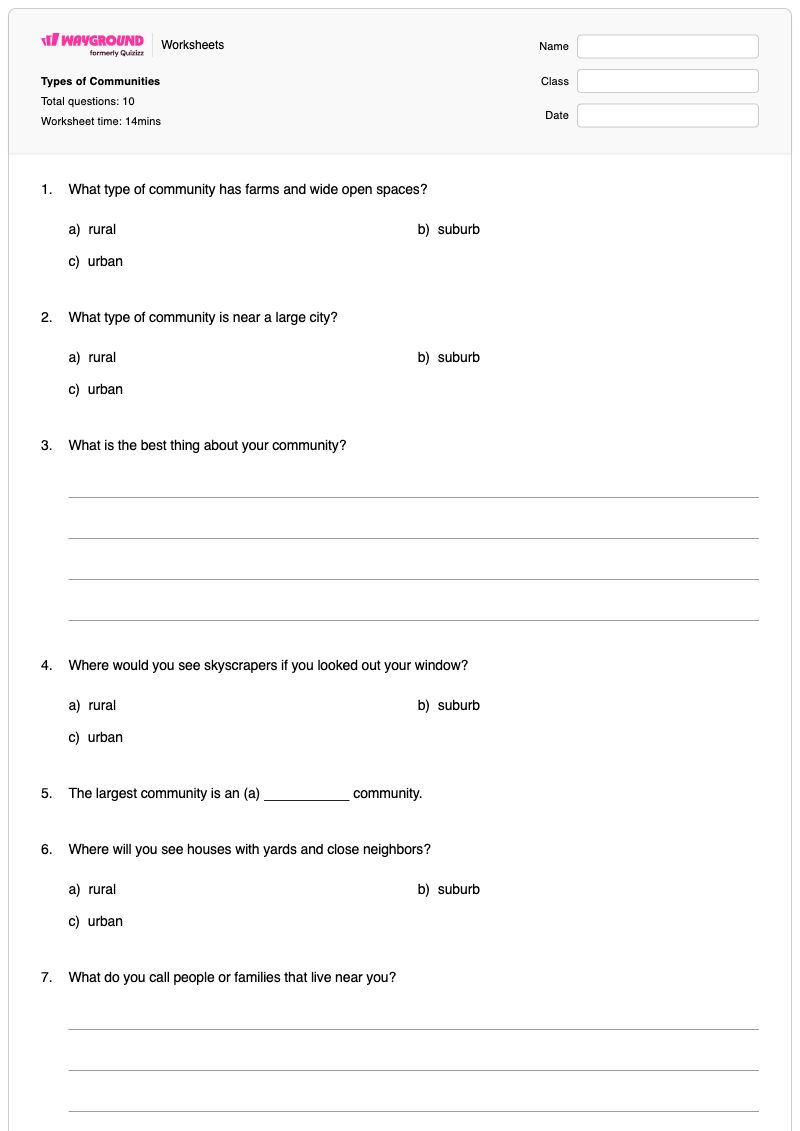
Types of Communities is a free printable Social Studies worksheet for students in Grades 2–3. It builds recognition of rural, suburban, and urban communities through five multiple-choice questions about farms, open spaces, city locations, skyscrapers, houses with yards, and nearby neighbors. Students also complete two fill-in-the-blank statements about urban communities, including public transportation and community size. Three open-ended prompts extend the identification work by asking students to describe what they value about their community, name people or families who live nearby, and explain in a complete sentence how they know they live in a rural community. This combination of selected-response, fill-in-the-blank, and written-response items helps teachers check both vocabulary recognition and students’ ability to apply community characteristics to their own surroundings. The worksheet includes a complete answer key for efficient review and grading.
Worksheet settings
Font size
WorksheetsAnswer Keyrural
suburb
urban
suburb
parks
This Grade 2–3 Social Studies worksheet helps students distinguish rural, suburban, and urban communities by matching each type with characteristics such as farms and open spaces, proximity to a city, houses with yards, skyscrapers, parks, subways, and trains. Its five multiple-choice, two fill-in-the-blank, and three open-ended items move students from recognizing vocabulary to explaining community characteristics in their own words.
Begin by introducing the three community types with the worksheet’s concrete clues: farms and wide-open spaces for rural areas, houses with yards and nearby neighbors for suburbs, and skyscrapers and subways for urban areas. Have students complete the multiple-choice items first, then discuss why each clue fits before they answer the fill-in-the-blank and complete-sentence prompts about their own communities.
Students may confuse suburbs with rural communities because both can include homes and open space, so check whether they recognize that a suburb is near a large city and may have houses with yards and close neighbors. They may also select farms or ranches instead of parks for natural open spaces in a suburb, or identify skyscrapers and subways as rural features. In the written response, watch for answers that name a community type without explaining the evidence in a complete sentence.
You can assign it as a printable PDF or as a digital quiz on Wayground, and it includes a complete answer key for the objective items. For printable submissions, scan student work with the Wayground for Teachers app to help grade the completed worksheet, while reviewing the three open-ended responses for accurate community vocabulary and clear explanations.
In the worksheet’s Advanced Settings, adjust font spacing or choose a larger font size to make the community descriptions, answer choices, and open-ended prompts easier to read. You can also turn on a dyslexia-friendly font or translate the worksheet into another language, which may support students as they interpret terms such as rural, suburb, urban, parks, and neighbors.
Wayground offers a broad collection of free printable worksheets and practice problems across subjects, with downloadable PDFs and answer keys to help students master essential skills and concepts. Browse more resources at https://wayground.com/en-us/worksheets.