

Wayground
Counting Money - Printable Mathematics Worksheets class 3 - Wayground

Counting Money

10 questions

3rd - 3rd Grade

Mathematics

Counting Money is a Grade 3 mathematics worksheet that builds fluency with identifying coin and bill values, counting mixed denominations, and expressing amounts in dollars and cents. Students solve 10 items—six multiple-choice questions and four open-ended questions—about finding totals, selecting combinations that make a target amount, determining a missing coin, identifying a purchase from its price, and making an amount with the least number of bills and coins. The worksheet gives students practice applying money-value reasoning in both selected-response and written formats. It includes amounts such as $0.65, $2.80, $2.56, $4.64, and mixed bills and coins, requiring students to add carefully and explain or record their own solutions. This free printable worksheet is designed for Grade 3 math practice, independent work, review, or assessment, and includes a complete answer key for efficient checking.

Worksheet settings

Font size

S
M
L
XL
Worksheets

Counting Money

Total questions: 10

Name
Class
Date
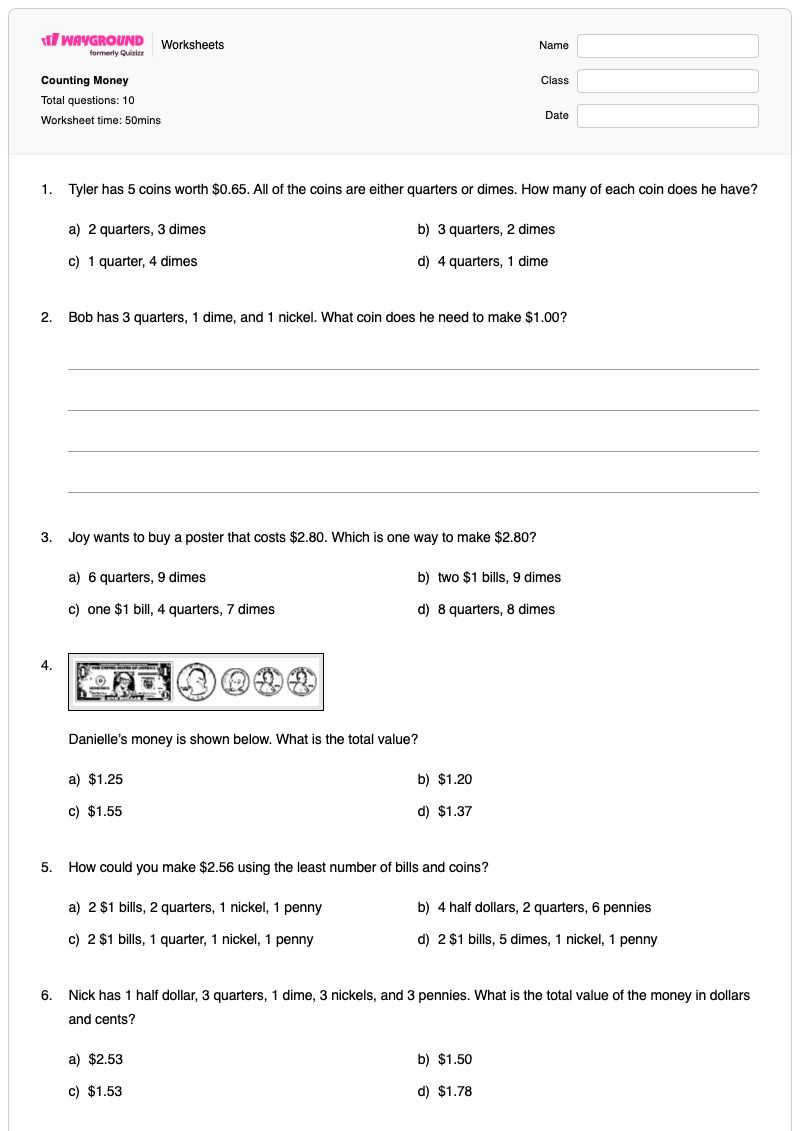
1.

Tyler has 5 coins worth $0.65. All of the coins are either quarters or dimes. How many of each coin does he have?

a)

2 quarters, 3 dimes

b)

3 quarters, 2 dimes

c)

1 quarter, 4 dimes

d)

4 quarters, 1 dime

2.

Bob has 3 quarters, 1 dime, and 1 nickel. What coin does he need to make $1.00?

4 lines
3.

Joy wants to buy a poster that costs $2.80. Which is one way to make $2.80?

a)

6 quarters, 9 dimes

b)

two $1 bills, 9 dimes

c)

one $1 bill, 4 quarters, 7 dimes

d)

8 quarters, 8 dimes

4.

Danielle’s money is shown below. What is the total value?

a)

$1.25

b)

$1.20

c)

$1.55

d)

$1.37

5.

How could you make $2.56 using the least number of bills and coins?

a)

2 $1 bills, 2 quarters, 1 nickel, 1 penny

b)

4 half dollars, 2 quarters, 6 pennies

c)

2 $1 bills, 1 quarter, 1 nickel, 1 penny

d)

2 $1 bills, 5 dimes, 1 nickel, 1 penny

6.

Nick has 1 half dollar, 3 quarters, 1 dime, 3 nickels, and 3 pennies. What is the total value of the money in dollars and cents?

a)

$2.53

b)

$1.50

c)

$1.53

d)

$1.78

7.

Ariel bought a gift for her younger sister. The gifts she looked at are listed below.


Small red ball: $1.31

Book: $4.49

Small stuffed bird: $3.89

Game: $9.39


Ariel paid for the gift with the bills and coins below. Which gift did she buy?

a)

Small red ball

b)

Book

c)

Small stuffed bird

d)

Game

8.

Ian did some chores for his neighbors. He earned 1 five-dollar bill, 2 one-dollar bills, 3 dimes, and 2 pennies. How much money did he earn?

4 lines
9.

Jackie has these coins. When she adds the values of the coins together, how many cents does she have?

4 lines
10.

How could you make $4.64 using the least number of bills and coins?

4 lines
Answer Key

Counting Money

Total questions: 10

1.
c)

1 quarter, 4 dimes

2.
n/a
3.
d)

8 quarters, 8 dimes

4.
d)

$1.37

5.
a)

2 $1 bills, 2 quarters, 1 nickel, 1 penny

6.
c)

$1.53

7.
d)

Game

8.
n/a
9.
n/a
10.
n/a

FAQs

What does the Counting Money worksheet cover?

This Grade 3 worksheet covers counting mixed bills and coins, finding totals in dollars and cents, making specific amounts such as $2.80 and $4.64, identifying a missing coin, and using the least number of bills and coins. Its 10 questions combine six multiple-choice items with four open-ended responses, so students apply money-value skills and produce their own calculations.

How can I use this worksheet to teach students to count mixed bills and coins?

First, review the value of pennies, nickels, dimes, quarters, half dollars, and dollar bills, then model organizing denominations before adding their values. Use the multiple-choice items to discuss why different combinations can represent the same amount, and follow with the open-ended questions so students independently find a missing coin, calculate earnings, count pictured coins, and build $4.64 with the fewest pieces.

What mistakes should I watch for when students complete this money worksheet?

Watch for students confusing the number of coins with their total value, especially when combining quarters, dimes, nickels, and pennies. Students may also write cents as dollars incorrectly, overlook a denomination when adding mixed bills and coins, or choose a combination that makes the right amount without using the least number of pieces. In the purchase question, check that students compare the calculated payment with each listed price rather than selecting the closest price.

How do I assign and grade the Counting Money worksheet?

You can assign this worksheet as a printable PDF or use it as a digital quiz on Wayground. It includes a complete answer key for checking the six multiple-choice and four open-ended responses, and printable student work can be graded by scanning it with the Wayground for Teachers app. The printable format also supports classrooms that are reducing screen time.

How can I differentiate this Counting Money worksheet for my students?

In the worksheet’s Advanced Settings, adjust font spacing or choose a larger font size to make the money word problems and open-ended response areas easier to read. You can also apply a dyslexia-friendly font or translate the worksheet into another language, helping students access the directions and denomination vocabulary while they solve the mixed-money questions.

Where can I find more worksheets like this on Wayground?

Wayground offers a broad collection of free printable worksheets and practice problems across subjects, with downloadable PDFs and answer keys to support mastery of essential skills and concepts. Browse more resources at https://wayground.com/en-us/worksheets.