

Wayground
GDP Practice - Printable Social Studies Worksheets class 10 - Wayground

GDP Practice

18 questions

9th - 12th Grade

Social Studies

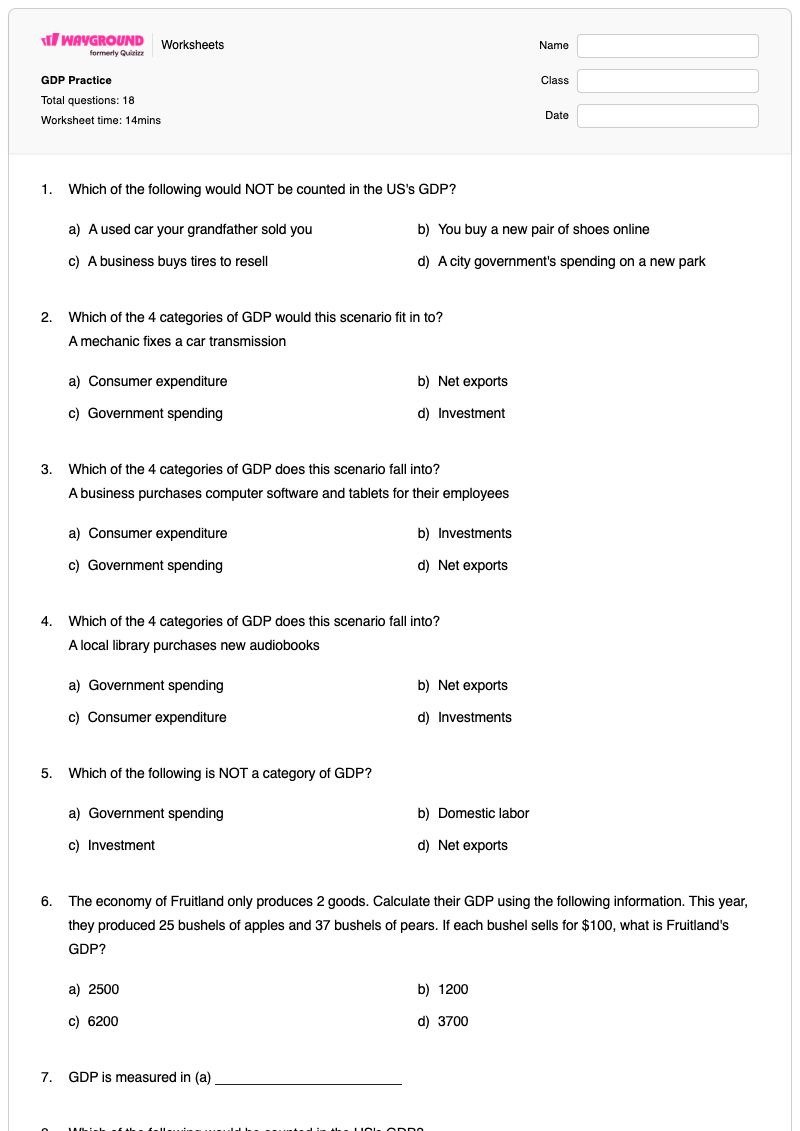
GDP Practice is a free printable Social Studies worksheet for students in Grades 9–12. It helps learners identify which domestic goods and services count toward GDP, distinguish final goods from transactions that are excluded, and classify examples into consumer expenditure, investment, government spending, and net exports. Students also calculate GDP from quantities and prices, identify the monetary measurement of GDP, and connect GDP growth with economic growth and standard of living. The 18-item worksheet combines 12 multiple-choice questions, five fill-in-the-blank items, and one open-ended reflection. Questions include real-world scenarios such as business purchases, government spending, and production by foreign companies based in the United States, along with a comparison of GDP and real GDP. It is useful for introducing, reviewing, or checking understanding of national economic measurement, and includes a complete answer key for efficient checking.

Worksheet settings

Font size

S
M
L
XL
Worksheets

GDP Practice

Total questions: 18

Name
Class
Date
1.

Which of the following would NOT be counted in the US's GDP?

a)

A used car your grandfather sold you

b)

You buy a new pair of shoes online

c)

A business buys tires to resell

d)

A city government's spending on a new park

2.

Which of the 4 categories of GDP would this scenario fit in to?

A mechanic fixes a car transmission

a)

Consumer expenditure

b)

Net exports

c)

Government spending

d)

Investment

3.

Which of the 4 categories of GDP does this scenario fall into?

A business purchases computer software and tablets for their employees

a)

Consumer expenditure

b)

Investments

c)

Government spending

d)

Net exports

4.

Which of the 4 categories of GDP does this scenario fall into?

A local library purchases new audiobooks

a)

Government spending

b)

Net exports

c)

Consumer expenditure

d)

Investments

5.

Which of the following is NOT a category of GDP?

a)

Government spending

b)

Domestic labor

c)

Investment

d)

Net exports

6.

The economy of Fruitland only produces 2 goods. Calculate their GDP using the following information. This year, they produced 25 bushels of apples and 37 bushels of pears. If each bushel sells for $100, what is Fruitland's GDP?

a)

2500

b)

1200

c)

6200

d)

3700

7.

GDP is measured in (a)  

8.

Which of the following would be counted in the US's GDP?

a)

A car produced in Korea by an American car company

b)

Your aunt pays you to babysit your cousin

c)

A French company based in the US makes frozen pastries

d)

A business buys ingredients to make canned soups

9.

An increase in GDP is an indicator of (a)  

10.

A positive economic growth rate is related to an improved (a)  

11.

How confidently do you understand today's lesson?

Rate yourself on a scale of 1-4:

1 being not confident, 4 being very confident

a)

1

b)

2

c)

3

d)

4

12.

How helpful did you find this practice? Rate it on a scale from 1-4:

1 being not at all, 4 being very helpful

a)

1

b)

2

c)

3

d)

4

13.

What is 1 thing from this lesson you need more help with?

4 lines
14.

Since GDP only calculates the value of final goods and services, these interactions take place in the (a)   market

15.

How is real GDP different than GDP?

a)

real GDP counts products produced overseas

b)

real GDP doesn't subtract imports

c)

real GDP is adjusted for price changes

d)

GDP is only counted for a year period, real is calculated for a decade

16.

If I export $1000 worth of goods and services and import $500, my net exports equals (a)  

17.

Which country has the world's largest GDP?

a)

China

b)

Russia

c)

India

d)

US

18.

In the US, which category of GDP is the largest?

a)

Government spending

b)

Consumer expenditure

c)

Net exports

d)

Investments

Answer Key

GDP Practice

Total questions: 18

1.
a)

A used car your grandfather sold you

2.
a)

Consumer expenditure

3.
b)

Investments

4.
a)

Government spending

5.
b)

Domestic labor

6.
c)

6200

7.
dollars, money, monetary value
8.
c)

A French company based in the US makes frozen pastries

9.
economic growth, growth
10.
standard of living
11.
n/a
12.
n/a
13.
n/a
14.
product
15.
c)

real GDP is adjusted for price changes

16.
$500, 500
17.
d)

US

18.
b)

Consumer expenditure

FAQs

What does this GDP worksheet cover, and how does it help students apply GDP concepts?

This worksheet uses multiple-choice, fill-in-the-blank, and open-ended items to have students decide which transactions count in U.S. GDP, classify examples as consumer expenditure, investment, government spending, or net exports, and calculate GDP from quantities and prices. It also checks whether students understand that GDP is measured in monetary value, that an increase in GDP indicates economic growth, and that real GDP is adjusted for price changes.

How can I use this GDP worksheet to teach students how GDP is calculated?

Begin by reviewing the distinction between domestic production, final goods and services, and excluded transactions such as a used car sale. Then have students classify the worksheet’s mechanic, business-software, and library-purchase scenarios before completing the Fruitland calculation, so they connect the four GDP categories to a numerical total. Use the real GDP and economic-growth items as a closing discussion about why price changes matter when interpreting GDP.

What mistakes should I watch for when students complete this GDP worksheet?

Students may count a used car sale or a business purchase of ingredients for resale as new GDP, confuse a company’s nationality with where production occurs, or label domestic labor as a GDP category. In the calculation item, check that they add the values of both goods rather than use only one price or quantity. Students may also confuse GDP with real GDP by overlooking that real GDP is adjusted for price changes.

How do I assign and grade this GDP worksheet?

The GDP Practice worksheet is available as a printable PDF and as a digital quiz on Wayground, and it includes a complete answer key for the objective questions and fill-in-the-blank items. For printable submissions, teachers can scan student work with the Wayground for Teachers app to support grading and review.

How can I differentiate this GDP worksheet for my students?

Use the worksheet’s Advanced Settings to adjust font spacing and font size for the GDP scenarios, calculations, and fill-in-the-blank prompts. You can also apply a dyslexia-friendly font or translate the worksheet into another language when that supports access to its economic vocabulary and questions.

Where can I find more free worksheets like this on Wayground?

Wayground offers a comprehensive collection of free printable worksheets and practice problems across subjects, with downloadable PDFs and answer keys to help students master essential skills and concepts. Browse more resources at https://wayground.com/en-us/worksheets.