

Wayground
Sectors of the US Economy - Printable Social studies Worksheets class 5 - Wayground

Sectors of the US Economy

Virginia Lak

Created by Virginia Lak

9 questions

5th Grade

Social studies

Updated May 2025

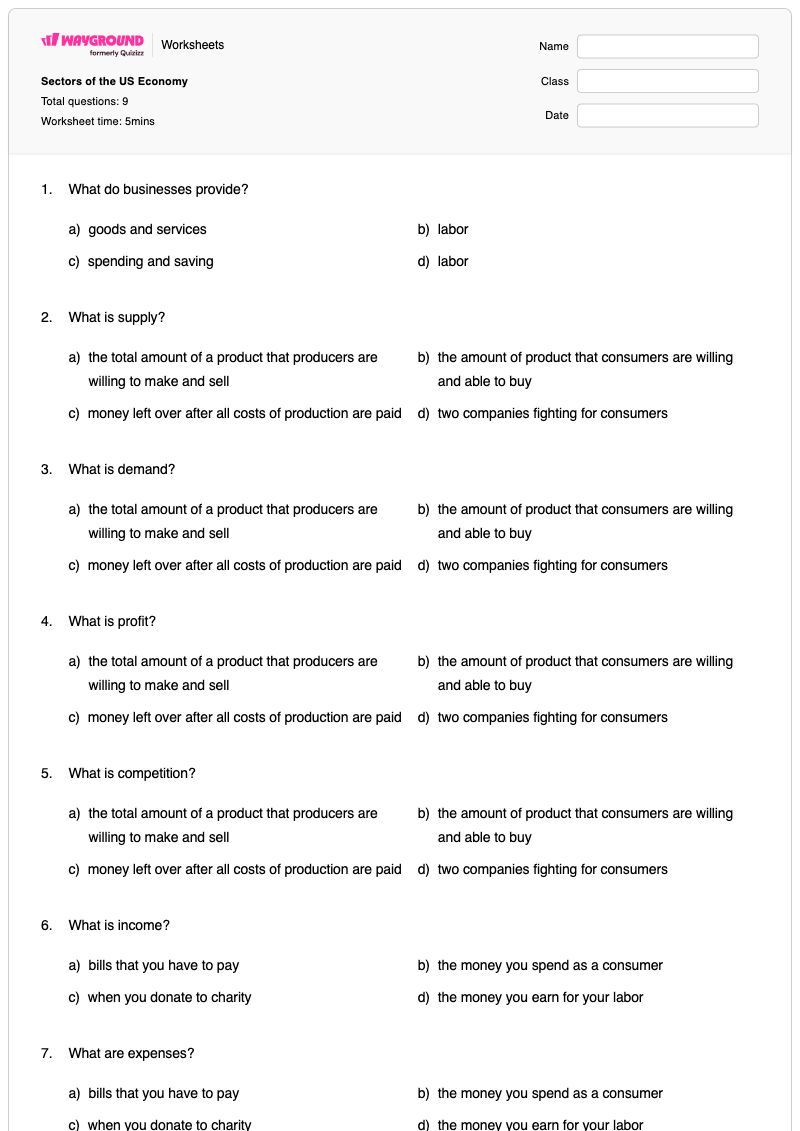
Sectors of the US Economy is a Grade 5 social studies worksheet that builds foundational economic vocabulary through nine questions: seven multiple-choice items and two multiple-select items. Students identify what businesses provide and distinguish among supply, demand, profit, competition, income, expenses, volunteering, and capital. The answer choices require students to separate closely related ideas such as what producers offer, what consumers buy, and money earned or spent. This free printable worksheet is useful for introducing or reviewing basic economic concepts before students study how people, businesses, and resources interact in an economy. Its multiple-select questions also ask students to recognize more than one correct example of expenses and capital, strengthening careful reading and classification. The worksheet includes a complete answer key for efficient review, independent practice, or formative assessment.

Worksheet settings

Font size

S
M
L
XL
WaygroundWorksheets

Sectors of the US Economy

Total questions: 9

Name
Class
Date
1.

What do businesses provide?

a)

goods and services

b)

labor

c)

spending and saving

d)

labor

2.

What is supply?

a)

the total amount of a product that producers are willing to make and sell

b)

the amount of product that consumers are willing and able to buy

c)

money left over after all costs of production are paid

d)

two companies fighting for consumers

3.

What is demand?

a)

the total amount of a product that producers are willing to make and sell

b)

the amount of product that consumers are willing and able to buy

c)

money left over after all costs of production are paid

d)

two companies fighting for consumers

4.

What is profit?

a)

the total amount of a product that producers are willing to make and sell

b)

the amount of product that consumers are willing and able to buy

c)

money left over after all costs of production are paid

d)

two companies fighting for consumers

5.

What is competition?

a)

the total amount of a product that producers are willing to make and sell

b)

the amount of product that consumers are willing and able to buy

c)

money left over after all costs of production are paid

d)

two companies fighting for consumers

6.

What is income?

a)

bills that you have to pay

b)

the money you spend as a consumer

c)

when you donate to charity

d)

the money you earn for your labor

7.

What are expenses?

a)

bills that you have to pay

b)

the money you spend as a consumer

c)

when you donate to charity

d)

the money you earn for your labor

8.

What does it mean to volunteer?

a)

to help out and not earn an income

b)

to earn an income

c)

to work for a wage

9.

What is capital?

a)

money

b)

income

c)

taxes

d)

bills

WaygroundAnswer Key

Sectors of the US Economy

Total questions: 9

1.
a)

goods and services

2.
a)

the total amount of a product that producers are willing to make and sell

3.
b)

the amount of product that consumers are willing and able to buy

4.
c)

money left over after all costs of production are paid

5.
d)

two companies fighting for consumers

6.
d)

the money you earn for your labor

7.
c)

when you donate to charity

, a)

bills that you have to pay

, b)

the money you spend as a consumer

8.
a)

to help out and not earn an income

9.
a)

money

, b)

income

FAQs

What does the Sectors of the US Economy worksheet cover?

This Grade 5 social studies worksheet uses seven multiple-choice and two multiple-select questions to assess foundational economic vocabulary. Students identify the meanings of goods and services, supply, demand, profit, competition, income, expenses, volunteering, and capital, including cases where more than one answer is correct.

How can I use this worksheet to teach basic economic vocabulary?

Introduce the terms in connected pairs before students work independently: producers provide goods and services, supply reflects what producers will sell, and demand reflects what consumers will buy. Then use the worksheet’s answer choices to discuss why income differs from expenses, why volunteering does not earn an income, and why the capital item includes money and income.

What mistakes should I watch for when students complete this worksheet?

Students may reverse supply and demand, choose income as money spent, or select only bills rather than all three correct examples of expenses. They may also treat volunteering as paid work or overlook that the capital question has two correct answers, so review whether students read the multiple-select directions carefully.

How do I assign and grade this worksheet?

Assign it as a printable PDF or as a digital quiz on Wayground; both versions assess the worksheet’s nine economic-vocabulary questions. A complete answer key is included, and printable submissions can be graded by scanning student work with the Wayground for Teachers app.

How can I differentiate this economic vocabulary worksheet for my students?

Use the worksheet’s Advanced Settings to adjust font spacing and font size so the nine multiple-choice and multiple-select items are easier to navigate. You can also apply a dyslexia-friendly font or translate the economic vocabulary questions into another language when appropriate.

Where can I find more worksheets like this on Wayground?

Wayground offers a broad collection of free printable worksheets and practice problems across subjects, with downloadable PDFs and answer keys to support essential skills and concepts. Browse more resources at https://wayground.com/en-us/worksheets.