

Wayground
Heats of Formation Quiz 2 - Printable Science Worksheets 10th - 10th Grade - Wayground

Heats of Formation Quiz 2

Amy Johnson

By Amy Johnson

10 questions

10th - 10th Grade

Science

77 plays

Updated Nov 2025

Heats of Formation Quiz 2 is a Grade 10 chemistry worksheet that builds fluency with thermochemistry and standard enthalpy calculations. Across 10 multiple-choice questions, students identify whether processes are endothermic or exothermic, define enthalpy as heat absorbed or released, compare the heats of formation of products and reactants, and use formation-data tables to select or calculate ΔH values for carbon monoxide, propane, methane, ethanol, and ammonia. The quiz also asks students to scale heats of formation for specified amounts, distinguish heats of formation from bond energies, and recognize that endothermic reactions absorb heat. Its focused answer choices make it useful for checking both conceptual understanding and calculation setup, including the organization of reactant and product terms in enthalpy expressions. This is a free printable worksheet with a complete answer key for Grade 10 chemistry practice, review, or assessment.

Worksheet settings

Font size

S
M
L
XL
WaygroundWorksheets

Heats of Formation Quiz 2

Total questions: 10

Name
Class
Date
1.
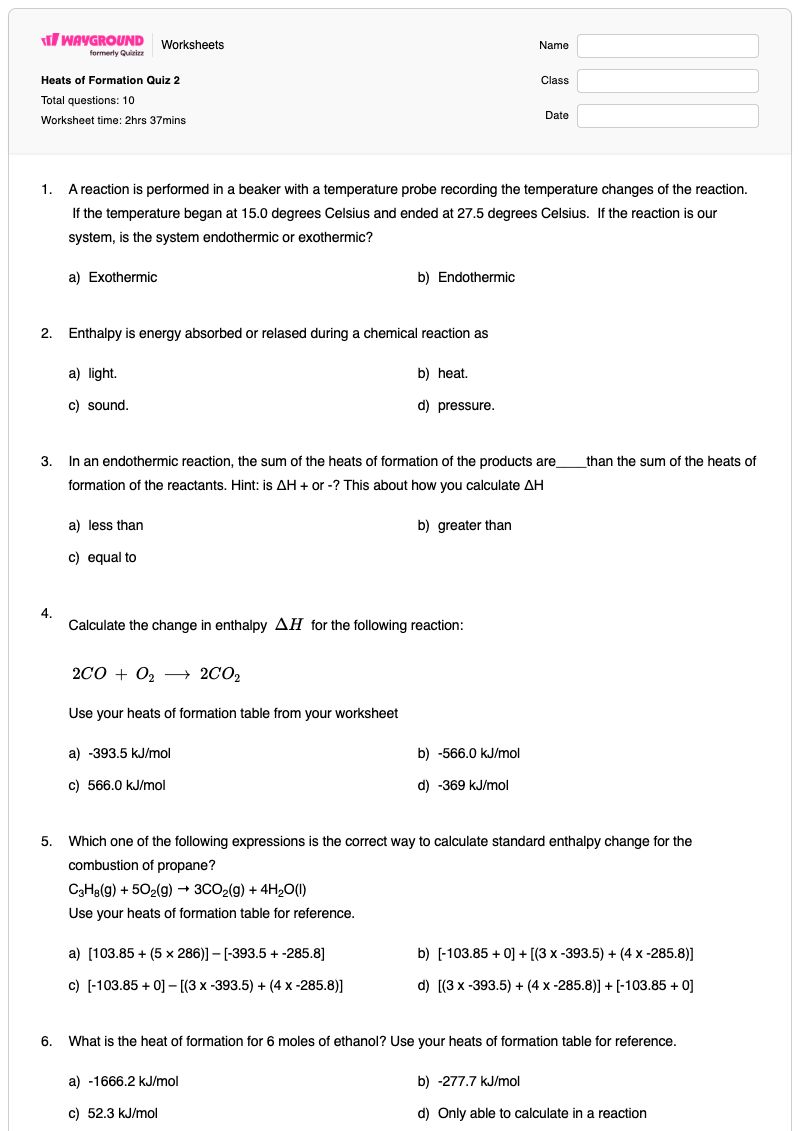
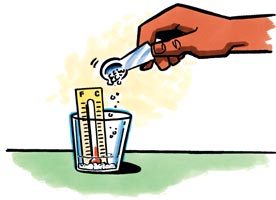
A reaction is performed in a beaker with a temperature probe recording the temperature changes of the reaction.  If the temperature began at 15.0 degrees Celsius and ended at 27.5 degrees Celsius.  If the reaction is our system, is the system endothermic or exothermic?
a)
Exothermic
b)
Endothermic
2.
Enthalpy is energy absorbed or relased during a chemical reaction as
a)
light.
b)
heat.
c)
sound.
d)
pressure.
3.
In an endothermic reaction, the sum of the heats of formation of the products are____than the sum of the heats of formation of the reactants. Hint: is ΔH + or -? This about how you calculate ΔH
a)
less than
b)
greater than
c)
equal to
4.

Calculate the change in enthalpy  ΔH\Delta H  for the following reaction:
 2CO + O2 ⟶ 2CO22CO\ +\ O_{2_{\ _{ }}^{ }}\longrightarrow\ 2CO_{2_{ }}  
Use your heats of formation table from your worksheet

a)

-393.5 kJ/mol

b)

-566.0 kJ/mol

c)

566.0 kJ/mol

d)

-369 kJ/mol

5.

Which one of the following expressions is the correct way to calculate standard enthalpy change for the combustion of propane?

C3H8(g) + 5O2(g) → 3CO2(g) + 4H2O(l)

Use your heats of formation table for reference.

a)

[103.85 + (5 × 286)] – [-393.5 + -285.8]

b)

[-103.85 + 0] + [(3 x -393.5) + (4 x -285.8)]

c)

[-103.85 + 0] – [(3 x -393.5) + (4 x -285.8)]

d)

[(3 x -393.5) + (4 x -285.8)] + [-103.85 + 0]

6.

What is the heat of formation for 6 moles of ethanol? Use your heats of formation table for reference.

a)

-1666.2 kJ/mol

b)

-277.7 kJ/mol

c)

52.3 kJ/mol

d)

Only able to calculate in a reaction

7.

Calculate ΔH\Delta H  using heats of formation for the combustion of methane:
 CH4(g) + 2O2(g) → CO2(g) +2H2O(l)CH_4\left(g\right)\ +\ 2O_2\left(g\right)\ \rightarrow\ CO_2\left(g\right)\ +2H_2O\left(l\right)  
Use your heats of formation table for reference.

a)

-890.25 kJ/mol

b)

-604.45 kJ/mol

c)

-754.15 kJ/mol

d)

No way to tell

8.

What is the difference between calculating ΔH\Delta H   with bond energies versus with heats of formation?

a)

Bond energies are averages based on multiple scenarios of breaking bonds, heats of formation is the energy required to form a specific molecule from its elemental forms.

b)

Heats of formation are averages based on multiple scenarios of breaking bonds, bond energies is the energy required to form a specific molecule from its elemental forms.

c)

Bond energies are calculated using only lewis dot structures, but heats of formation requires a reference table

d)

Heats of formation helps calculate enthalpy, while bond energies helps calculate entropy

9.

What is the heat of formation for 8 moles of ammonia? Use your heats of formation table for reference.

a)

-369.52 kJ/mol

b)

-46.19 kJ/mol

c)

-92.38 kJ/mol

d)

-102.4 kJ/mol

10.
In an endothermic reaction, heat is ...
a)
taken in or absorbed
b)
given out or released 
WaygroundAnswer Key

Heats of Formation Quiz 2

Total questions: 10

1.
b) Endothermic
2.
b) heat.
3.
b) greater than
4.
b)

-566.0 kJ/mol

5.
c)

[-103.85 + 0] – [(3 x -393.5) + (4 x -285.8)]

6.
a)

-1666.2 kJ/mol

7.
a)

-890.25 kJ/mol

8.
a)

Bond energies are averages based on multiple scenarios of breaking bonds, heats of formation is the energy required to form a specific molecule from its elemental forms.

9.
a)

-369.52 kJ/mol

10.
a) taken in or absorbed

FAQs

What does the Heats of Formation Quiz 2 worksheet cover?

This worksheet uses 10 multiple-choice questions to assess how students interpret endothermic and exothermic reactions and use heats of formation to determine ΔH. Students select correct enthalpy expressions, calculate values for combustion reactions such as methane and carbon monoxide, scale formation values for amounts of ethanol and ammonia, and distinguish heats of formation from bond energies.

How can I use this worksheet to teach calculating enthalpy from heats of formation?

Introduce the worksheet by reviewing what enthalpy represents and how endothermic reactions relate to heat absorption. Then model how to read a heats-of-formation table, organize the species in a reaction, and evaluate an expression before students work through the propane and combustion calculation questions. Use the multiple-choice distractors to ask which setup or sign decision caused an incorrect result.

What mistakes should I watch for when students complete this heats of formation quiz?

Watch for students who confuse heat absorbed with heat released or misidentify whether a reaction is endothermic or exothermic. In the calculation items, students may choose an incorrect arrangement of reactant and product terms, forget stoichiometric coefficients, or fail to multiply a formation value for six moles of ethanol or eight moles of ammonia. Students may also confuse heats of formation with bond energies, which the comparison question addresses directly.

How do I assign and grade the Heats of Formation Quiz 2 worksheet?

The worksheet is available as a printable PDF and as a digital quiz on Wayground, and it includes a complete answer key. You can grade printable student submissions by scanning their work with the Wayground for Teachers app, or use the digital version for online responses and results.

How can I differentiate this heats of formation worksheet for my students?

In the worksheet’s Advanced Settings, adjust font spacing or choose a larger font size to make the multiple-choice enthalpy expressions and numerical options easier to read. You can also apply a dyslexia-friendly font or translate the worksheet into another language while preserving its thermochemistry question format.

Where can I find more worksheets like this on Wayground?

Wayground offers a comprehensive collection of free printable worksheets and practice problems across all subjects, with downloadable PDFs and answer keys to support mastery of essential skills and concepts. Browse more resources at https://wayground.com/en-us/worksheets.