

Wayground
Replication notes - Printable Science Worksheets class 9 - Wayground

Replication notes

11 questions

9th - 9th Grade

Science

Replication Notes is a Grade 9 science worksheet that checks students’ understanding of DNA replication and the enzymes involved in the process. Across 11 items—9 multiple-choice questions and 2 multiple-select questions—students identify DNA replication, explain when DNA is copied before cell division, recognize the main replication steps, and distinguish the roles of helicase and DNA polymerase. The worksheet also reviews enzyme shape, enzyme function, and enzymes as protein-based biological catalysts. This free printable worksheet is useful for reviewing replication vocabulary, checking prerequisite knowledge, or assessing learning after instruction. Students must select all correct responses in the multiple-select items, including the circumstances that require DNA replication and the sequence of replication events. A complete answer key is included, making it easier to review misconceptions about enzymes, nucleotides, and DNA copying with Grade 9 learners.

Worksheet settings

Font size

S
M
L
XL
Worksheets

Replication notes

Total questions: 11

Name
Class
Date
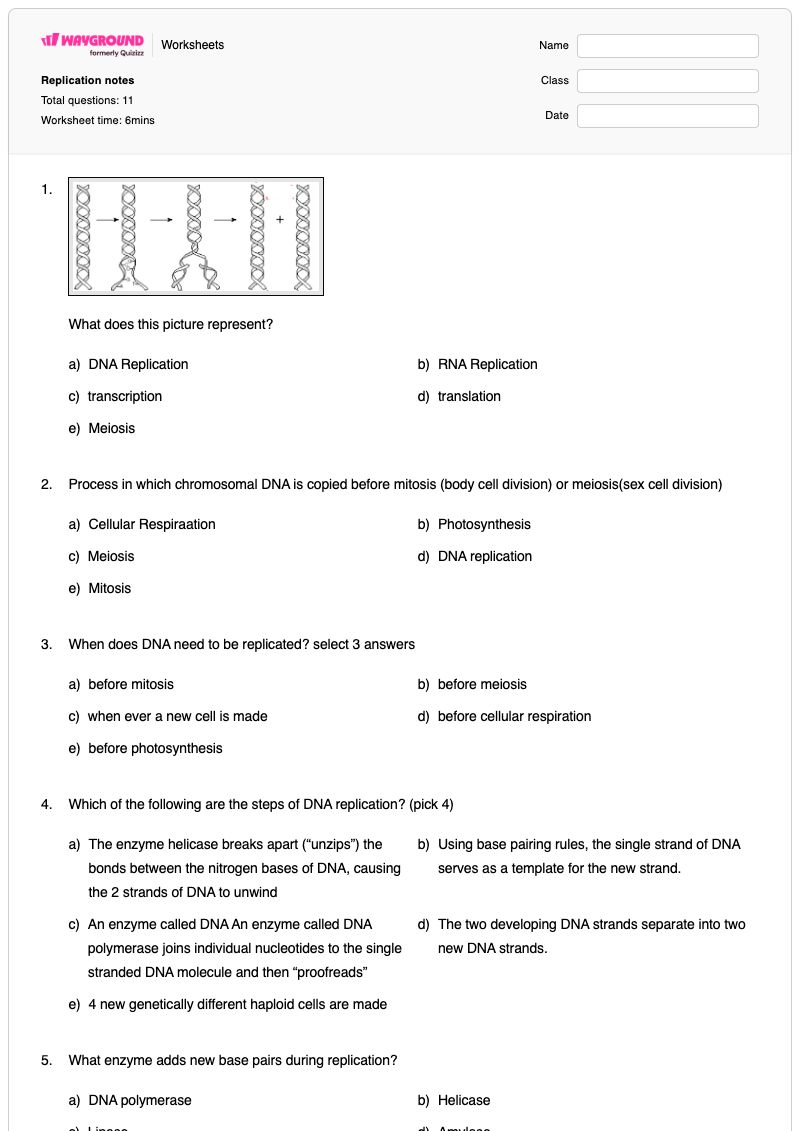
1.

What does this picture represent?

a)

DNA Replication

b)

RNA Replication

c)

transcription

d)

translation

e)

Meiosis

2.

Process in which chromosomal DNA is copied before mitosis (body cell division) or meiosis(sex cell division)

a)

Cellular Respiraation

b)

Photosynthesis

c)

Meiosis

d)

DNA replication

e)

Mitosis

3.

When does DNA need to be replicated? select 3 answers

a)

before mitosis

b)

before meiosis

c)

when ever a new cell is made

d)

before cellular respiration

e)

before photosynthesis

4.

Which of the following are the steps of DNA replication? (pick 4)

a)

The enzyme helicase breaks apart (“unzips”) the bonds between the nitrogen bases of DNA, causing the 2 strands of DNA to unwind

b)

Using base pairing rules, the single strand of DNA serves as a template for the new strand.

c)

An enzyme called DNA An enzyme called DNA polymerase joins individual nucleotides to the single stranded DNA molecule and then “proofreads”

d)

The two developing DNA strands separate into two new DNA strands.

e)

4 new genetically different haploid cells are made

5.

What enzyme adds new base pairs during replication?

a)

DNA polymerase

b)

Helicase

c)

Lipase

d)

Amylase

e)

Sucrase

6.

What enzyme unzips DNA during replication?

a)

DNA polymerase

b)

Helicase

c)

Lipase

d)

Amylase

e)

Sucrase

7.

Enzymes have a VERY specific ________________ so...

If the reactant shape matches the enzyme, the enzyme breaks or forms bonds to make products

a)

texture

b)

shape

c)

identity

d)

personality

8.

What is the purpose or function of an enzyme?

a)

To speed up chemical reactions

b)

To slow down chemical reactions

c)

to use up excess oxygen and carbon dioxide

d)

To store genetic information in the nucleus of cells

9.

What type of macromolecule are enzymes?

a)

proteins

b)

carbohydrates

c)

Lipids

d)

amino acids

e)

nucleic acids

10.

___________ are a biological catalyst and is almost always a protein. They Speed up the rate of chemical reactions in the cell while not being used up during the reaction.

a)

Enzymes

b)

DNA

c)

RNA

d)

Nucleotides

e)

Amino Acids

11.

Nucleotides are joined together by bonds with the help of __________.

a)

Enzymes

b)

oxygen

c)

lipids

d)

carbohydrates

e)

Amino Acids

Answer Key

Replication notes

Total questions: 11

1.
a)

DNA Replication

2.
d)

DNA replication

3.
a)

before mitosis

, b)

before meiosis

, c)

when ever a new cell is made

4.
a)

The enzyme helicase breaks apart (“unzips”) the bonds between the nitrogen bases of DNA, causing the 2 strands of DNA to unwind

, b)

Using base pairing rules, the single strand of DNA serves as a template for the new strand.

, c)

An enzyme called DNA An enzyme called DNA polymerase joins individual nucleotides to the single stranded DNA molecule and then “proofreads”

, d)

The two developing DNA strands separate into two new DNA strands.

5.
a)

DNA polymerase

6.
b)

Helicase

7.
b)

shape

8.
a)

To speed up chemical reactions

9.
a)

proteins

10.
a)

Enzymes

11.
a)

Enzymes

FAQs

What does the Replication Notes worksheet cover, and how does it help students learn DNA replication?

This Grade 9 science worksheet uses 9 multiple-choice and 2 multiple-select questions to assess DNA replication, including when DNA is copied before mitosis or meiosis, the roles of helicase and DNA polymerase, and the main replication steps. Students also connect replication to enzyme concepts by identifying enzymes as proteins that speed chemical reactions and help join nucleotides.

How can I use this worksheet to teach DNA replication and the roles of helicase and DNA polymerase?

Introduce the picture-based identification item and the question about DNA copying before cell division, then model replication as a sequence: helicase unzips DNA, base-pairing rules guide new strands, and DNA polymerase adds and proofreads nucleotides. Have students explain why each of the four selected replication steps belongs in the process before using the enzyme questions as a quick check for vocabulary and function.

What mistakes should I watch for when students complete the Replication Notes worksheet?

Students may confuse helicase, which unzips DNA, with DNA polymerase, which adds and proofreads nucleotides. In the multiple-select questions, watch for students choosing cellular respiration or photosynthesis as times when DNA is replicated, or selecting the formation of four genetically different haploid cells as a replication step. They may also confuse enzymes with nucleic acids or overlook that enzymes speed reactions without being used up.

How do I assign and grade the Replication Notes worksheet?

The Replication Notes worksheet is available as a printable PDF and as a digital quiz on Wayground, with a complete answer key for all 11 questions. Printable submissions can be graded by scanning student work with the Wayground for Teachers app. The printable format can also support schools working to reduce screen time.

How can I differentiate the Replication Notes worksheet for my students?

In the worksheet’s Advanced Settings, adjust font spacing or choose a larger font size to make the DNA replication prompts and enzyme answer choices easier to read. You can also apply a dyslexia-friendly font or translate the worksheet into another language while keeping its multiple-choice and multiple-select format.

Where can I find more worksheets like this on Wayground?

Wayground offers a comprehensive collection of free printable worksheets and practice problems across subjects, with downloadable PDFs and answer keys to support essential skills and concepts. Browse more resources at https://wayground.com/en-us/worksheets.