

Wayground
"The Tell-Tale Heart" Test Review - Printable English Worksheets class 8 - Wayground

"The Tell-Tale Heart" Test Review

19 questions

8th - 8th Grade

English

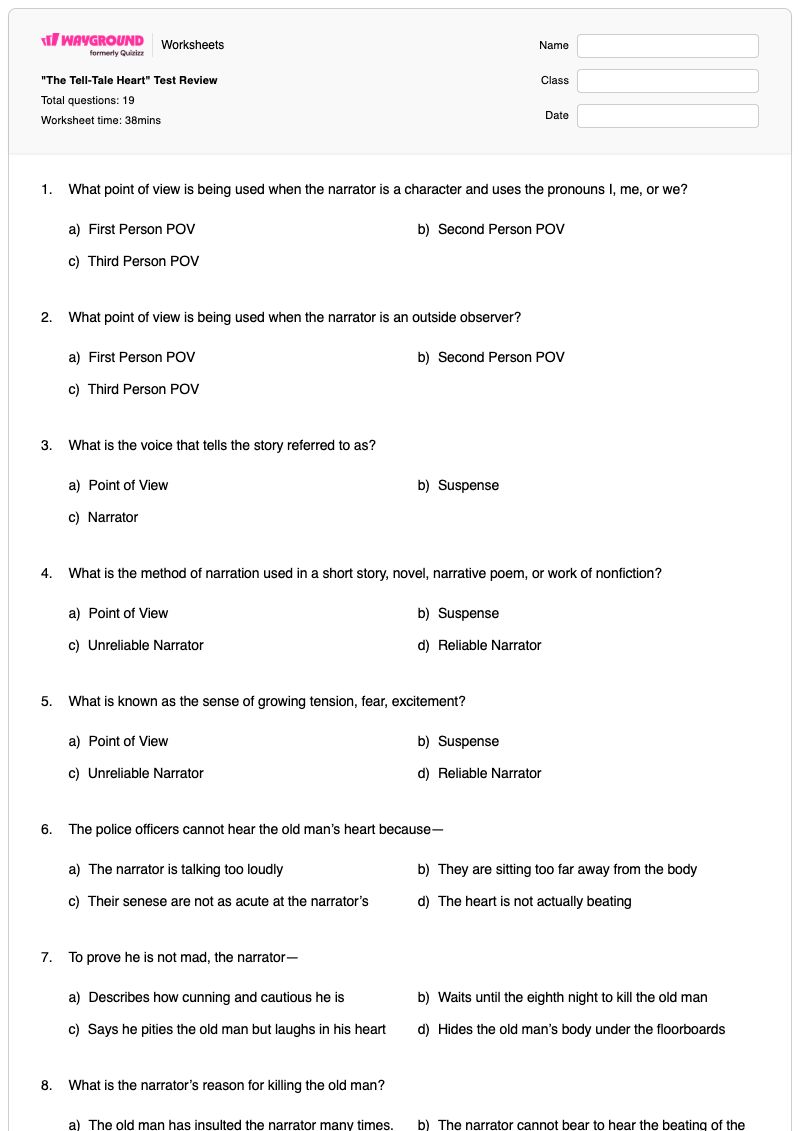
The Tell-Tale Heart Test Review is a free printable Grade 8 English worksheet that checks students’ understanding of Edgar Allan Poe’s short story and its literary elements. Its 19 questions include 15 multiple-choice items, one multiple-select item, and three fill-in-the-blank items. Students identify first- and third-person point of view, define narrator and suspense, and analyze how the narrator’s perspective reveals his mental instability. The review also asks students to interpret plot details, character motivation, tone, vocabulary, main idea, and foreshadowing. They examine why the narrator targets the old man, why the murder cannot be committed during the first seven nights, how the narrator responds to the police, and how acute hearing anticipates the story’s ending. This worksheet is useful for checking close reading and literary analysis before an assessment, and it includes a complete answer key for efficient review and grading.

Worksheet settings

Font size

S
M
L
XL
Worksheets

"The Tell-Tale Heart" Test Review

Total questions: 19

Name
Class
Date
1.

What point of view is being used when the narrator is a character and uses the pronouns I, me, or we?

a)

First Person POV

b)

Second Person POV

c)

Third Person POV

2.

What point of view is being used when the narrator is an outside observer?

a)

First Person POV

b)

Second Person POV

c)

Third Person POV

3.

What is the voice that tells the story referred to as?

a)

Point of View

b)

Suspense

c)

Narrator

4.

What is the method of narration used in a short story, novel, narrative poem, or work of nonfiction?

a)

Point of View

b)

Suspense

c)

Unreliable Narrator

d)

Reliable Narrator

5.

What is known as the sense of growing tension, fear, excitement?

a)

Point of View

b)

Suspense

c)

Unreliable Narrator

d)

Reliable Narrator

6.

The police officers cannot hear the old man’s heart because—

a)

The narrator is talking too loudly

b)

They are sitting too far away from the body

c)

Their senese are not as acute at the narrator’s

d)

The heart is not actually beating

7.

To prove he is not mad, the narrator—

a)

Describes how cunning and cautious he is

b)

Waits until the eighth night to kill the old man

c)

Says he pities the old man but laughs in his heart

d)

Hides the old man’s body under the floorboards

8.

What is the narrator’s reason for killing the old man?

a)

The old man has insulted the narrator many times.

b)

The narrator cannot bear to hear the beating of the old man’s heart.

c)

The old man’s eye remind the narrator of a vulture’s.

d)

The narrator hopes to inherit the old man’s treasures.

9.

The use of a first-person narrator in the story —

a)

allows readers to understand each character’s point of view

b)

helps to explain how the characters are related to each other

c)

gives readers insight into the narrator’s mental instability

d)

illustrates how the old man treats the narrator every day

10.

Which word from paragraph 18 is closest to meaning contempt?

a)

Agony

b)

Derision

c)

Swore

d)

Hypocritical

11.

In paragraphs 14–15, the narrator describes his cleanup and first encounter with the police with a tone of--

a)

Anxiety

b)

Melancholy

c)

Confidence

d)

Indifference

12.

Which choice best expresses the main idea of paragraph 8?

a)

The old man stirs and cries out when he hears the narrator at the door and scares the narrator away.

b)

The narrator can relate to the old man’s fear, but that only makes the narrator feel more powerful.

c)

The narrator chooses to wake the old man so that he can face him directly for the murder.

d)

The narrator slips into the room when the old man wakes, hoping that the old man will not see him.

13.

In paragraph 4, the narrator describes visiting the old man every night at midnight. Why is he unable to commit the murder for the first seven nights?

a)

The old man is a restless sleeper, so the narrator cannot sneak in.

b)

The narrator does not have enough light from the lantern to commit the murder.

c)

He is trying to be kind by giving the old man a few more days to live.

d)

He cannot see the old man’s eye, which is what he feels he needs to kill.

14.

In paragraph 2, the word conceived means to —

a)

become pregnant with a child

b)

have an opinion on an issue

c)

form a plan in the mind

d)

imagine something abstract

15.

How does the narrator’s mention of his acute hearing in paragraph 1 foreshadow the old man’s death?

a)

It foreshadows the point when the old man’s heartbeat drives the narrator to kill him.

b)

It foreshadows his ability to hear the police coming when they respond to the old man’s murder.

c)

It foreshadows his decision to murder the old man because he was tired of listening to him.

d)

It foreshadows the moment when the old man hears the narrator at the door and wakes up.

16.

Which two are examples of irony in the story?

a)

The narrator’s attempts to hide the murder actually result in him giving himself up to the police.

b)

The narrator chooses to commit the murder in the middle of the night, when the old man is asleep.

c)

The more the narrator insists that he is not mad, the more readers can detect evidence of his madness.

d)

The narrator admits that he liked, even loved, the old man, and that he only objected to his pale, filmy eye.

e)

The neighbor hears the old man shriek and summons the police out of concern for his safety.

17.

After the meeting, he (a)   an idea for how to make the process easier for consumers.

18.

When I get home from school in the afternoon, my brother likes to (a)   me by hiding my phone from me.

19.

I could not believe she had the (a)   to yell at her own mother like that.

Answer Key

"The Tell-Tale Heart" Test Review

Total questions: 19

1.
a)

First Person POV

2.
c)

Third Person POV

3.
c)

Narrator

4.
a)

Point of View

5.
b)

Suspense

6.
d)

The heart is not actually beating

7.
a)

Describes how cunning and cautious he is

8.
c)

The old man’s eye remind the narrator of a vulture’s.

9.
c)

gives readers insight into the narrator’s mental instability

10.
b)

Derision

11.
c)

Confidence

12.
b)

The narrator can relate to the old man’s fear, but that only makes the narrator feel more powerful.

13.
d)

He cannot see the old man’s eye, which is what he feels he needs to kill.

14.
c)

form a plan in the mind

15.
a)

It foreshadows the point when the old man’s heartbeat drives the narrator to kill him.

16.
a)

The narrator’s attempts to hide the murder actually result in him giving himself up to the police.

, c)

The more the narrator insists that he is not mad, the more readers can detect evidence of his madness.

17.
conceived
18.
vex
19.
audacity

FAQs

What does The Tell-Tale Heart Test Review help students practice?

This Grade 8 English review uses 15 multiple-choice questions, one multiple-select question, and three fill-in-the-blank items to assess students’ understanding of point of view, narrator, suspense, and literary analysis in The Tell-Tale Heart. Students connect the first-person narration to the narrator’s mental instability and use details about the old man, the murder, the police, tone, vocabulary, main idea, and foreshadowing to support their interpretations.

How can I use this worksheet to teach point of view and literary analysis in The Tell-Tale Heart?

Use the point-of-view items first to establish the difference between a narrator who is a character and an outside observer. Then have students explain how the story’s first-person narration reveals the narrator’s mental instability, using the worksheet’s questions about the old man’s eye, the narrator’s acute hearing, the cleanup, and the police encounter as evidence. Finish by discussing how suspense, tone, and foreshadowing shape the reading experience.

What mistakes should I watch for when students complete this review?

Students may confuse the narrator with point of view, or select third person simply because the narrator describes another character. Watch for students who identify the heartbeat as the narrator’s reason for the murder instead of the old man’s eye, overlook that the eye must be visible before the narrator can act, or interpret the narrator’s confidence during the cleanup and police visit as anxiety. Vocabulary items may also reveal confusion between “derision” and the other choices for contempt, or between “conceived” as forming a plan and its unrelated meanings.

How do I assign and grade The Tell-Tale Heart Test Review?

Wayground provides this worksheet as a printable PDF and as a digital quiz, and it includes a complete answer key for all 19 items. You can grade printable submissions by scanning student work with the Wayground for Teachers app, or review responses from the digital quiz in Wayground.

Which reading-analysis skills are covered beyond identifying point of view?

The review asks students to interpret how specific paragraphs develop meaning, including the narrator’s reaction to the old man’s fear and the reason he waits seven nights. It also checks vocabulary in context, tone, main idea, character motivation, and foreshadowing, including how the narrator’s acute hearing anticipates the old man’s death.

Where can I find more worksheets like this on Wayground?

Wayground offers a broad collection of free printable worksheets and practice problems across subjects, with downloadable PDFs and answer keys to support essential skills and concepts. Browse more resources at https://wayground.com/en-us/worksheets.