
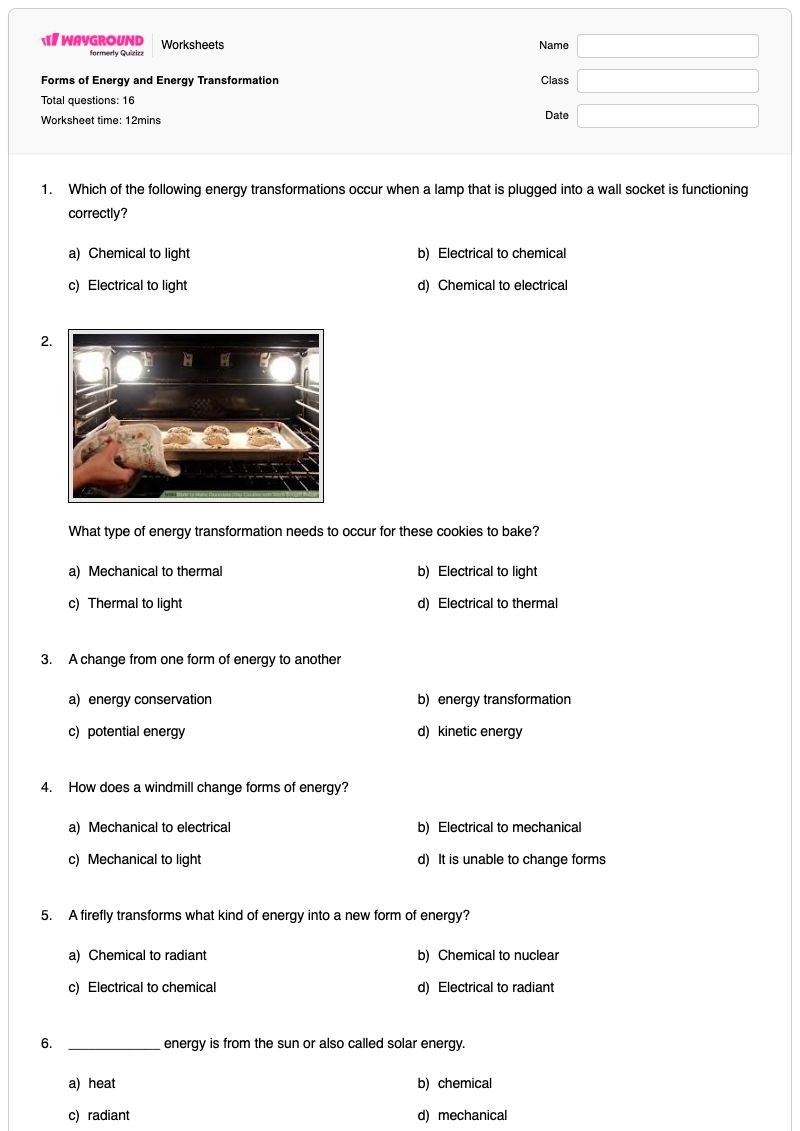

Forms of Energy and Energy Transformation is a Grade 7 science worksheet with 16 multiple-choice questions that builds students’ ability to identify energy forms and trace transformations between them. Students define energy transformation and conservation, recognize radiant, heat, mechanical, electromagnetic, electrical, and chemical energy, and apply those terms to examples such as lamps, baking cookies, windmills, fireflies, coal, and hairdryers.
This free printable worksheet helps students connect energy vocabulary to familiar devices, materials, and processes rather than memorizing isolated definitions. The multiple-choice format provides focused practice distinguishing the energy involved in an object or process and identifying how energy changes from one form to another. It is suitable for Grade 7 science instruction, review, or formative assessment, and includes a complete answer key for efficient checking.
Worksheet settings
Font size
S
M
L
XL
Worksheets
Forms of Energy and Energy Transformation
Total questions: 16
Name
Class
Date
1.
Which of the following energy transformations occur when a lamp that is plugged into a wall socket is functioning correctly?
a)
Chemical to light
b)
Electrical to chemical
c)
Electrical to light
d)
Chemical to electrical
2.
What type of energy transformation needs to occur for these cookies to bake?
a)
Mechanical to thermal
b)
Electrical to light
c)
Thermal to light
d)
Electrical to thermal
3.
A change from one form of energy to another
a)
energy conservation
b)
energy transformation
c)
potential energy
d)
kinetic energy
4.
How does a windmill change forms of energy?
a)
Mechanical to electrical
b)
Electrical to mechanical
c)
Mechanical to light
d)
It is unable to change forms
5.
A firefly transforms what kind of energy into a new form of energy?
a)
Chemical to radiant
b)
Chemical to nuclear
c)
Electrical to chemical
d)
Electrical to radiant
6.
____________ energy is from the sun or also called solar energy.
a)
heat
b)
chemical
c)
radiant
d)
mechanical
7.
____________ energy is transferred from gasses, solids, and liquids.
a)
chemical
b)
radiant
c)
mechanical
d)
heat
8.
__________ energy is possessed by an object due to its motion or due to its position.
a)
chemical
b)
radiant
c)
mechanical
d)
heat
9.
Coal is an Earth material that is often used to heat people's homes. How has coal improved the quality of life for people on Earth?
a)
People use coal as a fuel source
b)
People use coal to build bridges
c)
people use coal to power wind turbines
d)
people use coal to prevent disease
10.
___________ energy can move through empty space.
a)
Sound
b)
Nuclear
c)
Electromagnetic
d)
Chemical
11.
This is the energy of moving electrons.
a)
nuclear
b)
electricity
c)
potential
d)
sound
12.
Light is a form of __________ energy.
a)
Sound
b)
Electromagnetic
c)
Fun
d)
Thermal
13.
Energy can't be .....
a)
transformed.
b)
made or destroyed.
c)
converted.
d)
harnessed or produced.
14.
Which object shows an energy transformation from electrical to mechanical?
a)
b)
c)
d)
15.
A hairdryer converts --
a)
electrical energy into chemical
b)
electrical energy into thermal
c)
chemical energy into mechanical
d)
thermal energy into mechanical
16.
Which items would have this energy transformation: chemical energy -> thermal and light energy?
a)
tanning bed
b)
candle burning
c)
wind turbine turning
d)
solar calculator
Answer Key
Forms of Energy and Energy Transformation
Total questions: 16
1.
c) Electrical to light
2.
d)
Electrical to thermal
3.
b)
energy transformation
4.
a)
Mechanical to electrical
5.
a)
Chemical to radiant
6.
c) radiant
7.
d) heat
8.
c) mechanical
9.
a) People use coal as a fuel source
10.
c) Electromagnetic
11.
b) electricity
12.
b) Electromagnetic
13.
b)
made or destroyed.
14.
d)
15.
b) electrical energy into thermal
16.
b)
candle burning
140 %
Browse by subjects
Browse by grades
Browse by format
FAQs
What does the Forms of Energy and Energy Transformation worksheet cover?
This Grade 7 science worksheet uses 16 multiple-choice questions to practice identifying forms of energy and recognizing transformations between them. Students apply terms such as radiant, heat, mechanical, electromagnetic, electrical, and chemical energy to examples including lamps, cookies baking, windmills, fireflies, coal, and hairdryers, while also reviewing energy transformation and conservation.
How can I use this worksheet to teach energy transformations?
Introduce the vocabulary first, then have students describe each example by naming the starting energy and the resulting form. Use the lamp, baking, windmill, firefly, and hairdryer questions as discussion prompts: ask students what energy is involved before and after the process and why one answer describes a transformation more accurately than the distractors. Finish with the definition and energy-conservation items to connect the examples to the larger concept.
What mistakes should I watch for when students complete this energy worksheet?
Students may identify only the most visible result—for example, light from a lamp—without recognizing the electrical energy involved at the start of the transformation. They may also confuse energy forms such as radiant, electromagnetic, heat, and mechanical, or choose a familiar energy type instead of matching the direction shown in examples like a windmill or hairdryer. Review the distinction between changing energy forms and making or destroying energy when checking the conservation item.
How do I assign and grade this Forms of Energy worksheet?
You can assign this worksheet as a printable PDF or as a digital quiz on Wayground. It includes a complete answer key, and printable submissions can be graded by scanning student work with the Wayground for Teachers app. The printable format also gives schools an option for practicing energy vocabulary with less screen use.
How can I differentiate this energy transformations worksheet for my students?
Use the worksheet’s Advanced Settings to adjust font spacing or increase the font size for the 16 multiple-choice questions and their answer choices. You can also apply a dyslexia-friendly font or translate the worksheet into another language. These options can make the energy terms and transformation choices easier to read without changing the question format.
Where can I find more worksheets like this on Wayground?
Wayground offers a broad collection of free printable worksheets and practice problems across subjects, with downloadable PDFs and answer keys to support essential skills and concepts. Browse more resources at https://wayground.com/en-us/worksheets.