
 Worksheets
Kinchler - TCAP - 7th - Genetics, Heredity
Total questions: 21

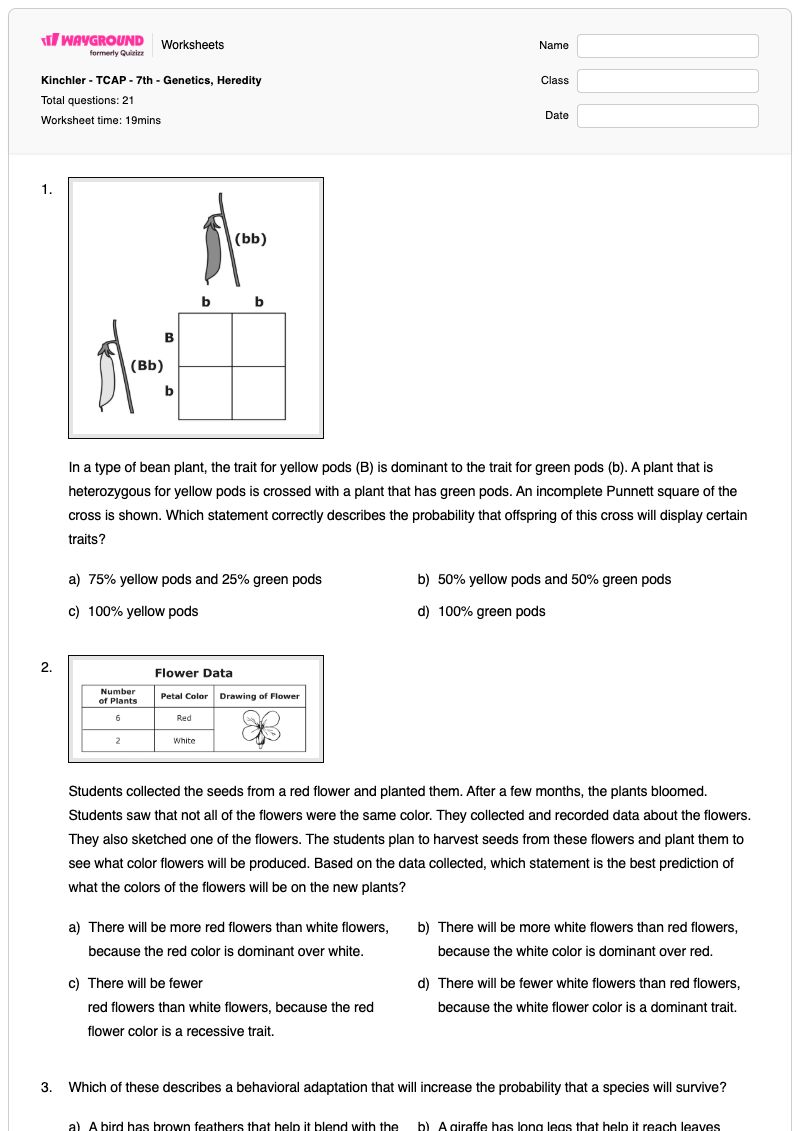
In a type of bean plant, the trait for yellow pods (B) is dominant to the trait for green pods (b). A plant that is heterozygous for yellow pods is crossed with a plant that has green pods. An incomplete Punnett square of the cross is shown. Which statement correctly describes the probability that offspring of this cross will display certain traits?
75% yellow pods and 25% green pods
50% yellow pods and 50% green pods
100% yellow pods
100% green pods

Students collected the seeds from a red flower and planted them. After a few months, the plants bloomed. Students saw that not all of the flowers were the same color. They collected and recorded data about the flowers. They also sketched one of the flowers. The students plan to harvest seeds from these flowers and plant them to see what color flowers will be produced. Based on the data collected, which statement is the best prediction of what the colors of the flowers will be on the new plants?
There will be more red flowers than white flowers, because the red color is dominant over white.
There will be more white flowers than red flowers, because the white color is dominant over red.
There will be fewer
red flowers than white flowers, because the red flower color is a recessive trait.
There will be fewer white flowers than red flowers, because the white flower color is a dominant trait.
Which of these describes a behavioral adaptation that will increase the probability that a species will survive?
A bird has brown feathers that help it blend with the ground where its nest is located.
A giraffe has long legs that help it reach leaves growing at the tops of acacia trees.
A moth has large dark spots on its wings that resemble eyes and scare away predators.
A mother bear stays with her cubs for a year and a half until they learn skills to live on their own.

A data table shows a section of a gene from four animals. Based on the partial gene segments, which pair of animals will produce the most similar proteins?
Rat and Chimpanzee
Chimpanzee and Mouse
Gorilla and Chimpanzee
Rat and Mouse
The union of a sperm and an egg during the life cycle of a jellyfish is best described as (a)
Which is the best example of sexual reproduction?
A new plant cell results from mitosis.
Offspring receive genetic material from two parents.
A bacterium divides into offspring identical to the parent.
Daughter cells receive all the genetic material of a parent cell.

The diagram shows a flower. Which arrow points to the part of the flower where the seeds develop? (a)

A cross section of a flower is shown below. Which number represents the part of the flower where pollen is produced? (a)
Which statement best describes the role of the flower petal in plant reproduction?
attracts pollinators
produces pollen
collects water
produces eggs

The characteristic for having dimples (D) is dominant to the characteristic for not having dimples (d). A Punnett square showing a cross between a dimpled person and a non-dimpled person is shown below. What percentage of the offspring from this cross will most likely have dimples?
25%
50%
75%
100%

In guinea pigs, black fur (B) is dominant to white fur (b). A Punnett square of a cross between a black-furred and a white-furred guinea pig is shown below. What can be determined from this Punnett square?
There is a 100% chance that these guinea pigs will have live offspring.
There is a 100% chance that these guinea pigs will have four offspring.
There is a 50% chance that the offspring will have gray fur.
There is a 50% chance that the offspring will have black fur.
In some breeds of dogs, wire hair texture is dominant to smooth hair texture. Two parents with wire hair produce an offspring with smooth hair. To express smooth hair, the offspring would need to have inherited ...
the same chromosomes from each parent.
an allele for smooth hair from each parent.
two of the same type of chromosomes from one of its parents.
an allele for wire hair from one parent and an allele for smooth hair from the other.

In watermelons, a solid green color (G) is dominant to green stripes (g). Two solid green watermelons are crossed, as shown in the Punnett square. Which type of watermelon has the greatest chance of being produced by this cross?
homozygous solid
heterozygous solid
homozygous striped
heterozygous striped
Where are the genes for the physical traits of an organism located?
on a strand of RNA
on a chromosome
inside a hormone
inside a carbohydrate

In some fruit flies, the allele for having black eyes (B) is dominant to the allele for having red eyes (b). A scientist mated a batch of fruit flies with genotypes as shown in the Punnett Square below. What is the probability of the offspring will be born with red eyes?
25%
50%
75%
100%
A scientific researcher was interested in determining the length of time it took to domesticate an animal. He kept and bred over 300 wild silver foxes. He would select the tamest puppy from each litter to breed with another hand-picked tame puppy.
cloning
genetic engineering
interbreeding
selective breeding

The trait for straight thumbs (T) is dominant to the trait for curved thumbs (t). A parent that is homozygous for straight thumbs and a heterozygous parent produce an offspring.
TT and Tt
TT and tt
Tt only
TT only

In humans, free earlobes (F) are dominant to attached earlobes (f). A female with attached earlobes has an offspring with a male who is homozygous for free earlobes. What is the probability that the offspring will have free earlobes?
0%
25%
50%
100%

One flower that is heterozygous red (Rr) is crossed with another that is homozygous white (rr). The cross of the parents produces a red offspring. Which statement best explains why the offspring expresses the red color trait?
Red color is a recessive trait.
White color is a seasonal trait.
Red color is a dominant trait.
White color can only be expressed by females.
Which statement best describes a dominant gene?
Only dominant genes are passed from parent to offspring.
Dominant genes are always expressed as beneficial traits.
Dominant genes remove recessive genes from chromosomes.
Dominant genes mask the expression of recessive genes.
In humans, dimples are a dominant trait. Which statement is accurate about this trait?
A child will not have dimples if one dominant gene for dimples is received.
A child will have dimples if at least one dominant gene for dimples is received.
A child will not have dimples if the child receives two dominant genes for dimples.
A child will have dimples if the child has two recessive genes for dimples.
Answer KeyKinchler - TCAP - 7th - Genetics, Heredity
Total questions: 21
50% yellow pods and 50% green pods
There will be more red flowers than white flowers, because the red color is dominant over white.
A mother bear stays with her cubs for a year and a half until they learn skills to live on their own.
Rat and Mouse
Offspring receive genetic material from two parents.
attracts pollinators
50%
There is a 50% chance that the offspring will have black fur.
an allele for smooth hair from each parent.
heterozygous solid
on a chromosome
25%
selective breeding
TT and Tt
100%
Red color is a dominant trait.
Dominant genes mask the expression of recessive genes.
A child will have dimples if at least one dominant gene for dimples is received.