

Wayground
Elements of Short Stories & "Calling the Shots" - Printable English Worksheets class 9 - Wayground

Elements of Short Stories & "Calling the Shots"

20 questions

9th - 9th Grade

English

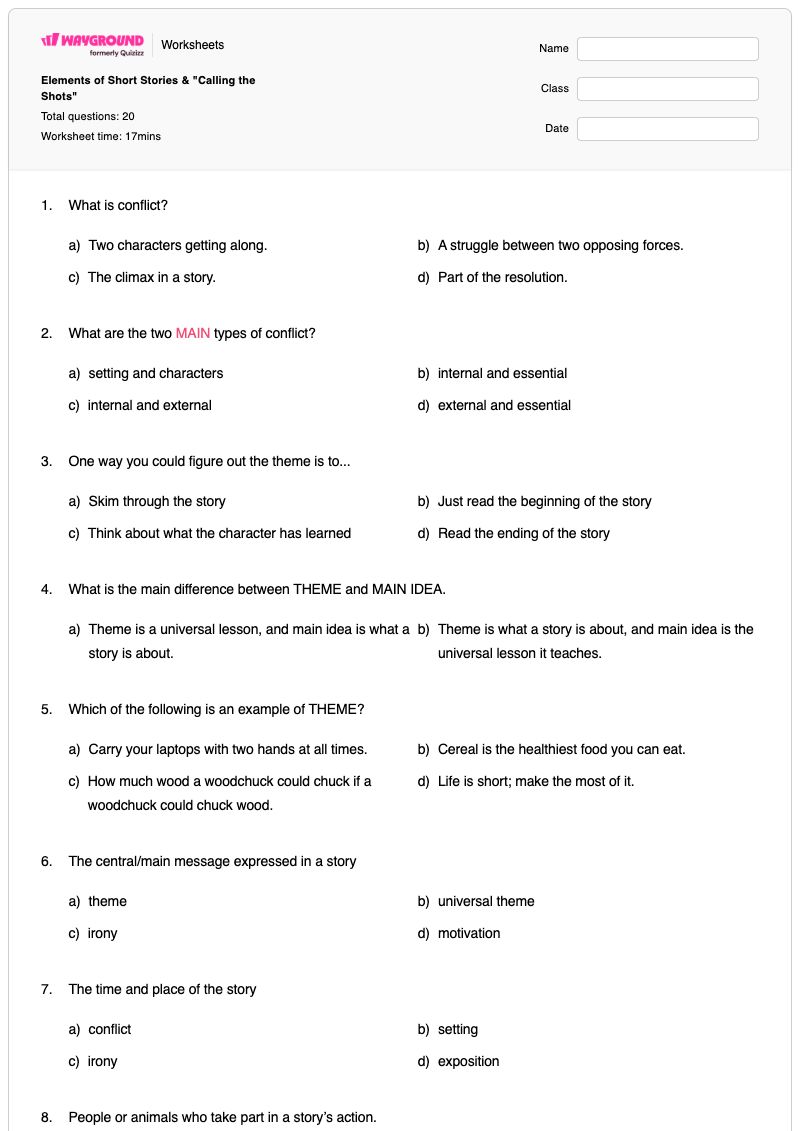
Elements of Short Stories & “Calling the Shots” is a free Grade 9 English printable worksheet with an answer key. Across 20 questions—including multiple-choice, fill-in-the-blank, and multiple-select items—students identify core short-story elements such as conflict, internal and external conflict, theme, main idea, setting, characters, and plot. They also distinguish a universal theme from a story’s main idea and identify how a reader can infer theme from what a character learns. The “Calling the Shots” questions ask students to apply these concepts to specific story details. Students recall Jason’s role and actions, identify why he leaves Jenny, determine a possible theme, and interpret the expression “calls the shots.” This combination of literary-term recognition and focused story analysis helps teachers check whether students can move from defining short-story elements to using them when interpreting a narrative. The worksheet is suitable for guided practice, independent review, or an English language arts assessment.

Worksheet settings

Font size

S
M
L
XL
Worksheets

Elements of Short Stories & "Calling the Shots"

Total questions: 20

Name
Class
Date
1.
What is conflict?
a)
Two characters getting along.
b)
A struggle between two opposing forces.
c)
The climax in a story.
d)
Part of the resolution.
2.
What are the two MAIN types of conflict?
a)
setting and characters
b)
internal and essential
c)
internal and external
d)
external and essential
3.
One way you could figure out the theme is to...
a)
Skim through the story
b)
Just read the beginning of the story
c)
Think about what the character has learned
d)
Read the ending of the story
4.
What is the main difference between THEME and MAIN IDEA. 
a)
Theme is a universal lesson, and main idea is what a story is about.
b)
Theme is what a story is about, and main idea is the universal lesson it teaches.
5.
Which of the following is an example of THEME?
a)
Carry your laptops with two hands at all times.
b)
Cereal is the healthiest food you can eat.
c)
How much wood a woodchuck could chuck if a woodchuck could chuck wood.
d)
Life is short; make the most of it.
6.
The central/main message expressed in a story
a)
theme
b)
universal theme
c)
irony
d)
motivation
7.
The time and place of the story
a)
conflict
b)
setting
c)
irony
d)
exposition
8.
People or animals who take part in a story’s action.
a)
indirect characterization
b)
motivation
c)
resolution
d)
characters
9.
The sequence of events in a short story, usually divided into five parts.
a)
plot
b)
theme
c)
exposition
d)
flashback
10.

(a)   leaves his pregnant girlfriend at the beginning of the story.

11.
What is conflict?
a)
Two characters getting along.
b)
A struggle between two opposing forces.
c)
The climax in a story.
d)
Part of the resolution.
12.

What is Jason's job?

a)

Lumberjack

b)

Farmer

c)

Paper creator

d)

Saw opperator

13.

Jason leaves Jenny because...

a)

Jenny cheated on him

b)

He imagines her like her mother in the future

c)

Her dad does not like him

d)

He is not able to focus on his job and her at the same time

14.

A possible theme for "Calling the Shots" could be

a)

Do not go into the woods alone

b)

You should never make girls cry

c)

Treating others carelessly will eventually come back to haunt you

d)

Trees are friends not enemies

15.

If someone "calls the shots", what does this mean?

a)

When someone sees something bad they yell "SHOTS"

b)

That someone holds the power/someone that is in charge

c)

Someone that yells out plays in a Basketball game

d)

Someone that calls people who have been shot

16.

At the beginning of the story, who "calls the shots". More than one

a)

Jenny

b)

Jason

c)

Jenny's mom

d)

Jenny's dad

17.

At the end of the story, who is calling the shots?

a)

Jason

b)

Jenny

c)

Jenny's dad

d)

Jenny's mom

18.

Based on the ending, we can assume that...

a)

Jason is saved by Jenny's mom

b)

Jason becomes a great dad

c)

Jenny's mom lets Jason die

d)

Jason marries Jenny

19.

Jason leaves his ______ in his jacket pocket.

a)

phone

b)

truck keys

c)

water bottle

d)

hunting knife

20.

Why was it dangerous for Jason to do his job alone

a)

Wild animals could attack him

b)

He could get injured

c)

His truck could get stuck in the mud

d)

It wasn't dangerous. Jason was a super smart dude

Answer Key

Elements of Short Stories & "Calling the Shots"

Total questions: 20

1.
b) A struggle between two opposing forces.
2.
c) internal and external
3.
c) Think about what the character has learned
4.
a) Theme is a universal lesson, and main idea is what a story is about.
5.
d) Life is short; make the most of it.
6.
a) theme
7.
b) setting
8.
d) characters
9.
a) plot
10.
Jason, jason, jasen, jasin
11.
b) A struggle between two opposing forces.
12.
a)

Lumberjack

13.
b)

He imagines her like her mother in the future

14.
c)

Treating others carelessly will eventually come back to haunt you

15.
b)

That someone holds the power/someone that is in charge

16.
d)

Jenny's dad

, b)

Jason

17.
d)

Jenny's mom

18.
c)

Jenny's mom lets Jason die

19.
b)

truck keys

20.
b)

He could get injured

FAQs

What does this worksheet cover, and how does it help students analyze short stories?

This Grade 9 worksheet uses 20 multiple-choice, fill-in-the-blank, and multiple-select questions to assess short-story elements, including conflict, internal and external conflict, theme, main idea, setting, characters, and plot. Students then apply those terms to “Calling the Shots” by recalling story details, identifying a possible theme, and interpreting the phrase “calls the shots.”

How can I use this worksheet to teach short-story elements and theme?

Introduce the literary terms first, especially the difference between theme and main idea and between internal and external conflict. Have students complete the definition items before discussing the “Calling the Shots” questions, then ask them to justify the story’s possible theme using what Jason learns or does and the events described in the worksheet.

What mistakes should I watch for when students complete this worksheet?

Students may confuse a story’s theme—a universal lesson—with its main idea, or select setting when a question asks for the sequence of events, which is plot. In the “Calling the Shots” items, watch for guesses about why Jason leaves Jenny, confusion about his job, and treating “calls the shots” as a literal reference to shooting rather than as meaning that someone is in charge.

How do I assign and grade this short-story elements worksheet?

The worksheet is available as a printable PDF and as a digital quiz on Wayground, and it includes a complete answer key for checking the multiple-choice, fill-in-the-blank, and multiple-select responses. For printable submissions, you can scan student work with the Wayground for Teachers app to support grading and review.

What does the “Calling the Shots” section assess?

This section checks whether students can connect literary analysis to specific story information. Students identify Jason’s job, the reason he leaves Jenny, a possible theme of the story, and the meaning of “calls the shots,” combining recall with interpretation.

Where can I find more worksheets like this on Wayground?

Wayground offers a broad collection of free printable worksheets and practice problems across all subjects, with downloadable PDFs and answer keys to help students master essential skills and concepts. Browse more resources at https://wayground.com/en-us/worksheets.