

Wayground
Grammar quiz: Homophones, Homographs, & Homonyms - Printable English Worksheets - Wayground

Grammar quiz: Homophones, Homographs, & Homonyms

22 questions

4th - 6th Grade

English

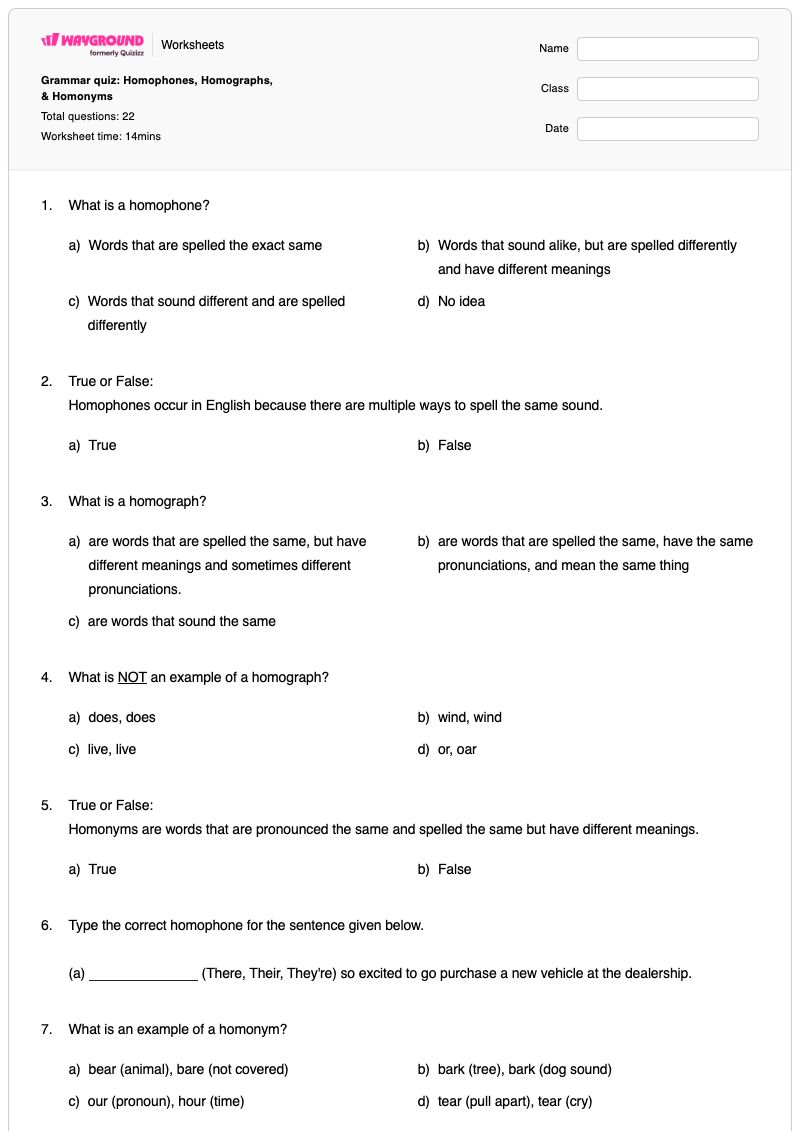
This free printable English worksheet for Grades 4–6 helps students distinguish homophones, homographs, and homonyms. It includes 21 multiple-choice questions and one fill-in-the-blank item that ask students to identify word-group definitions, recognize examples and nonexamples, interpret homographs such as “bow,” “present,” “light,” and “spring” in context, and choose correctly spelled homophones such as “too,” “your/you’re,” “loose/lose,” and “there/their/they’re.” Students build vocabulary and grammar accuracy by connecting spelling, pronunciation, meaning, and sentence context. The fill-in-the-blank question requires students to select the correct form of “they’re,” while the multiple-choice items check both terminology and application. Use this free printable worksheet for independent practice, review, or a short assessment, and use the included answer key to check understanding efficiently.

Worksheet settings

Font size

S
M
L
XL
Worksheets

Grammar quiz: Homophones, Homographs, & Homonyms

Total questions: 22

Name
Class
Date
1.
What is a homophone? 
a)
Words that are spelled the exact same 
b)
Words that sound alike, but are spelled differently and have different meanings
c)
Words that sound different and are spelled differently 
d)
No idea
2.
True or False: 
Homophones occur in English because there are multiple ways to spell the same sound. 
a)
True
b)
False
3.

What is a homograph?

a)

are words that are spelled the same, but have different meanings and sometimes different pronunciations.

b)

are words that are spelled the same, have the same pronunciations, and mean the same thing

c)

are words that sound the same

4.

What is NOT an example of a homograph?

a)

does, does

b)

wind, wind

c)

live, live

d)

or, oar

5.

True or False:

Homonyms are words that are pronounced the same and spelled the same but have different meanings.

a)

True

b)

False

6.

Type the correct homophone for the sentence given below.


(a)   (There, Their, They're) so excited to go purchase a new vehicle at the dealership.

7.

What is an example of a homonym?

a)

bear (animal), bare (not covered)

b)

bark (tree), bark (dog sound)

c)

our (pronoun), hour (time)

d)

tear (pull apart), tear (cry)

8.

The singer made a low bow to the audience after the concert.

a)

decorative ribbon (rhymes with so)

b)

bend at the waist (rhymes with how)

c)

a weapon for shooting arrows

9.

All the students were present today.

a)

a gift

b)

existing or occurring now

c)

give (rhymes with resent)

d)

here (rhymes with pleasant)

10.

Can I go to the party _______?

a)

too

b)

to

c)

two

d)

toe

11.

The grocery bag was light because it was packed with bread and hotdog buns.

a)

not heavy

b)

sunshine

c)

to illuminate

d)

bright

12.

Carlo's pants were much too _____________ after his weight loss.

a)

loose

b)

lose

c)

loss

d)

lost

13.

______ my best friend.

a)

your

b)

you're

14.
Spring is my favorite time of the year. 
a)
A season 
b)
A coil of metal that bounces 
15.
Select the correct homophone.
(Theirs/There's) not going to be school on President's day! 
a)
Theirs
b)
There's
16.

What is: bass, bass

a)

homophone

b)

homonym

c)

homograph

d)

N/A

17.

What is: bat, bat?

a)

homophone

b)

homonym

c)

homograph

d)

n/a

18.

What is: buy and by?

a)

homophone

b)

homonym

c)

homograph

d)

n/a

19.

What is: tail, tale

a)

homophone

b)

homonym

c)

homograph

d)

n/a

20.

What is a homonym?

a)

Words that are spelled the same and sound the same but have different meaning.

b)

Words that spelled differently, but sound the same and have different meaning.

c)

Words that are spelled the same but sound different and have a different meaning.

d)

Words that sound the same, are spelled the same and mean the exact same thing.

21.

What is: live, live

a)

homophone

b)

homonym

c)

homograph

d)

n/a

22.

What is: bark, bark

a)

homophone

b)

homonym

c)

homograph

d)

n/a

Answer Key

Grammar quiz: Homophones, Homographs, & Homonyms

Total questions: 22

1.
b) Words that sound alike, but are spelled differently and have different meanings
2.
a) True
3.
a)

are words that are spelled the same, but have different meanings and sometimes different pronunciations.

4.
d)

or, oar

5.
a)

True

6.
They're, they're
7.
b)

bark (tree), bark (dog sound)

8.
b)

bend at the waist (rhymes with how)

9.
d)

here (rhymes with pleasant)

10.
a)

too

11.
a)

not heavy

12.
a)

loose

13.
b)

you're

14.
a) A season 
15.
b) There's
16.
c)

homograph

17.
b)

homonym

18.
a)

homophone

19.
a)

homophone

20.
a)

Words that are spelled the same and sound the same but have different meaning.

21.
c)

homograph

22.
b)

homonym

FAQs

What does this worksheet cover, and how does it help students distinguish homophones, homographs, and homonyms?

This Grade 4–6 English worksheet uses 21 multiple-choice questions and one fill-in-the-blank item to teach students how homophones, homographs, and homonyms differ in spelling, pronunciation, and meaning. Students apply those distinctions by interpreting words such as “bow,” “present,” “light,” and “spring” in context and selecting correctly spelled forms such as “too,” “you’re,” and “there’s.”

How can I use this worksheet to teach homophones, homographs, and homonyms?

Introduce the three word categories with the worksheet’s definition questions, then model how context changes the meaning of words such as “bow” and “present.” Have students explain why “or/oar” is not a homograph and why “bark” is a homonym before completing the contextual spelling items, including “too/to/two” and “there/their/they’re.”

What mistakes should I watch for when students complete this homophones, homographs, and homonyms worksheet?

Students may confuse words that share a sound with words that share spelling, especially when classifying “bark,” “tear,” “wind,” and “live.” In the sentence items, watch for choosing a familiar-looking form without checking meaning or grammar, such as “your” instead of “you’re,” “lose” instead of “loose,” or “theirs” instead of “there’s.”

How do I assign and grade this homophones, homographs, and homonyms worksheet?

You can assign this worksheet as a printable PDF or as a digital quiz on Wayground. It includes a complete answer key, and printable submissions can be graded by scanning student work with the Wayground for Teachers app. The printable option can also support schools that want to reduce screen time while students practise contextual word choice.

How can I differentiate this worksheet for my students?

In the worksheet’s Advanced Settings, adjust font spacing and font size to make the definition, context, and homophone-choice items easier to read. You can also enable a dyslexia-friendly font or translate the worksheet into another language when helpful for students working with the “there/their/they’re,” “your/you’re,” and other word-choice questions.

Where can I find more worksheets like this on Wayground?

Wayground offers a broad collection of free printable worksheets and practice problems across subjects, with downloadable PDFs and answer keys to help students master essential skills and concepts. Browse more resources at https://wayground.com/en-us/worksheets.