

Wayground
4th Grade Reading Check-In - Printable English Worksheets class 4 - Wayground

4th Grade Reading Check-In

13 questions

4th - 4th Grade

English

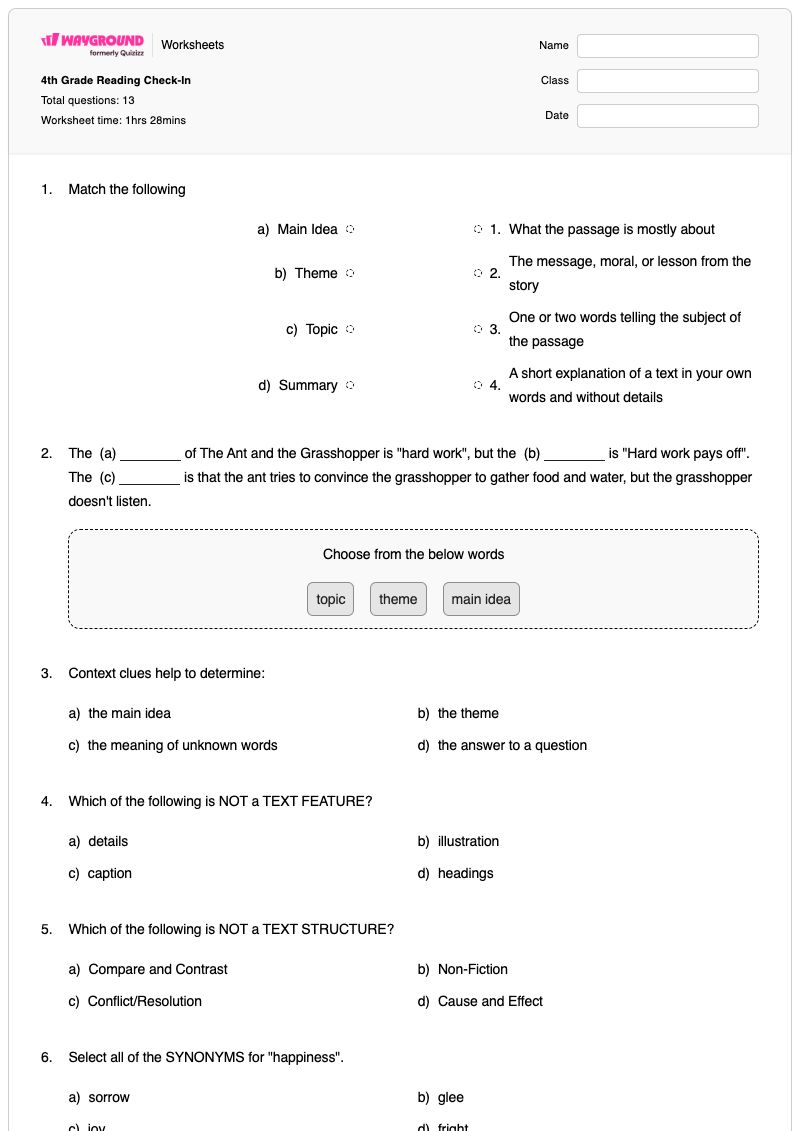
The 4th Grade Reading Check-In is a free printable English worksheet for reviewing essential Grade 4 reading and literary-text skills through 13 varied questions. Students match and sort terms such as topic, theme, main idea, and summary; identify context clues, text features, and text structures; select synonyms and antonyms; and sequence the stages of plot. The worksheet also asks students to analyze poetry by counting stanzas and lines, determine the meaning of “abhor” from context, define “aglet,” and explain what happens in Shel Silverstein’s “Sick” in at least two complete sentences. Its mix of matching, drag-and-drop, multiple-choice, multiple-select, dropdown, and open-ended items gives teachers a concise check of vocabulary, text organization, poetry structure, plot sequencing, and written comprehension. An answer key is included for efficient review and grading.

Worksheet settings

Font size

S
M
L
XL
Worksheets

4th Grade Reading Check-In

Total questions: 13

Name
Class
Date
1.

Match the following

Main Idea

What the passage is mostly about

Theme

The message, moral, or lesson from the story

Topic

One or two words telling the subject of the passage

Summary

A short explanation of a text in your own words and without details

2.

The ​ (a)   of The Ant and the Grasshopper is "hard work", but the ​ (b)   is "Hard work pays off". The ​ (c)   is that the ant tries to convince the grasshopper to gather food and water, but the grasshopper doesn't listen.

Choose from the below words
topic
theme
main idea
3.

Context clues help to determine:

a)

the main idea

b)

the theme

c)

the meaning of unknown words

d)

the answer to a question

4.

Which of the following is NOT a TEXT FEATURE?

a)

details

b)

illustration

c)

caption

d)

headings

5.

Which of the following is NOT a TEXT STRUCTURE?

a)

Compare and Contrast

b)

Non-Fiction

c)

Conflict/Resolution

d)

Cause and Effect

6.

Select all of the SYNONYMS for "happiness".

a)

sorrow

b)

glee

c)

joy

d)

fright

7.

Select all of the ANTONYMS for COLD.

a)

chilly

b)

hot

c)

frigid

d)

humid

8.

Rebecca

Who Slammed Doors For Fun And Perished Miserably

~

A trick that everyone abhors

In little girls is slamming doors.

A wealthy banker’s little daughter

Who lived in Palace Green, Bayswater

(By name Rebecca Offendort),

Was given to this furious sport.

~

She would deliberately go

And slam the door like billy-o!

To make her uncle Jacob start.

She was not really bad at heart,

But only rather rude and wild;

She was an aggravating child…

~

—By Hilaire Belloc

~

How many STANZAS are in the poem?

a)

1

b)

2

c)

3

d)

4

9.

Rebecca

Who Slammed Doors For Fun And Perished Miserably

~

A trick that everyone abhors

In little girls is slamming doors.

A wealthy banker’s little daughter

Who lived in Palace Green, Bayswater

(By name Rebecca Offendort),

Was given to this furious sport.

~

She would deliberately go

And slam the door like billy-o!

To make her uncle Jacob start.

She was not really bad at heart,

But only rather rude and wild;

She was an aggravating child…

~

—By Hilaire Belloc

~

How many LINES are in the poem?

a)

1

b)

2

c)

10

d)

12

10.

Rebecca

Who Slammed Doors For Fun And Perished Miserably

~

A trick that everyone abhors

In little girls is slamming doors.

A wealthy banker’s little daughter

Who lived in Palace Green, Bayswater

(By name Rebecca Offendort),

Was given to this furious sport.

~

She would deliberately go

And slam the door like billy-o!

To make her uncle Jacob start.

She was not really bad at heart,

But only rather rude and wild;

She was an aggravating child…

~

—By Hilaire Belloc

~

In LINE 1 of the poem, what does the word "abhor" mean?

a)

loves

b)

finds funny

c)

hates

d)

wants for themselves

11.

The aglet came off the end of my shoelaces. Now I'll never keep the laces from fraying! I know! Maybe I'll use a piece of tape for the end of my shoelace. That should work!

An aglet is the ​ (a)  

Choose from the below words
plastic piece at the tip of a shoelace
strings that stick out when shoelaces split
the hole the laces go through
12.

Plot is the series of events in a story. The events IN ORDER are:

1. ​ (a)  

2. ​ (b)  

3. ​ (c)  

4. ​ (d)  

5. ​ ​ (e)  

Choose from the below words
introduction
rising action
climax
falling action
conclusion
13.

Sick

Shel Silverstein

"I cannot go to school today,"

Said little Peggy Ann McKay.

"I have the measles and the mumps,

A gash, a rash and purple bumps.

My mouth is wet, my throat is dry,

I'm going blind in my right eye.

My tonsils are as big as rocks,

I've counted sixteen chicken pox

And there's one more—that's seventeen,

And don't you think my face looks green?

My leg is cut—my eyes are blue—

It might be instamatic flu.

I cough and sneeze and gasp and choke,

I'm sure that my left leg is broke—

My hip hurts when I move my chin,

My belly button's caving in,

My back is wrenched, my ankle's sprained,

My 'pendix pains each time it rains.

My nose is cold, my toes are numb.

I have a sliver in my thumb.

My neck is stiff, my voice is weak,

I hardly whisper when I speak.

My tongue is filling up my mouth,

I think my hair is falling out.

My elbow's bent, my spine ain't straight,

My temperature is one-o-eight.

My brain is shrunk, I cannot hear,

There is a hole inside my ear.

I have a hangnail, and my heart is—what?

What's that? What's that you say?

You say today is. . .Saturday?

G'bye, I'm going out to play!"

In your own words, explain what is happening in this poem. Write in COMPLETE SENTENCES. You MUST have AT LEAST 2 sentences!

4 lines
Answer Key

4th Grade Reading Check-In

Total questions: 13

1.

Main Idea

 - 

What the passage is mostly about

, 

Theme

 - 

The message, moral, or lesson from the story

, 

Topic

 - 

One or two words telling the subject of the passage

, 

Summary

 - 

A short explanation of a text in your own words and without details

2.
topic, theme, main idea
3.
c)

the meaning of unknown words

4.
a)

details

5.
b)

Non-Fiction

6.
b)

glee

, c)

joy

7.
b)

hot

, d)

humid

8.
b)

2

9.
d)

12

10.
c)

hates

11.
plastic piece at the tip of a shoelace
12.
introduction, rising action, climax, falling action, conclusion
13.
n/a

FAQs

What does the 4th Grade Reading Check-In worksheet cover?

This worksheet reviews Grade 4 skills through 13 mixed-format questions, including matching reading terms, identifying context clues, recognizing text features and text structures, sorting synonyms and antonyms, sequencing plot stages, and interpreting poetry. Students also count stanzas and lines in “Rebecca Who Slammed Doors for Fun and Perished Miserably,” define “aglet” and “abhor,” and write at least two complete sentences explaining “Sick.”

How can I use this worksheet to teach topic, theme, main idea, and summary?

Begin with a short read-aloud or familiar fable, then have students explain what the text is about, what lesson it conveys, its central point, and how they would retell it briefly. Use the worksheet’s matching and drag-and-drop items to compare these terms, especially the distinction between the topic “hard work,” the theme “Hard work pays off,” and the main idea of the ant and grasshopper example. Finish by asking students to justify their choices with details from the text.

What mistakes should I watch for when students complete this reading worksheet?

Students may treat a broad topic as the theme, confuse details with text features, or select “Non-Fiction” as a text structure instead of recognizing structures such as cause and effect or compare and contrast. In the poetry items, watch for confusing lines with stanzas, misreading “abhor,” and overlooking the meaning of surrounding words. Students may also place plot stages out of order or give an incomplete, sentence-fragment explanation of “Sick.”

How do I assign and grade this worksheet?

The 4th Grade Reading Check-In is available as a printable PDF and as a digital quiz on Wayground, so you can choose paper or online completion. It includes a complete answer key, and printable submissions can be graded by scanning student work with the Wayground for Teachers app. The printable format also gives schools an option for reducing screen time.

How can I differentiate this worksheet for my students?

Use the worksheet’s Advanced Settings to adjust font spacing and font size for the matching terms, poetry excerpts, and open-ended response area. You can also apply a dyslexia-friendly font or translate the worksheet into another language, helping students work through the vocabulary, plot-sequencing, and poetry questions in a more accessible version of the same file.

Where can I find more worksheets like this on Wayground?

Wayground offers a comprehensive collection of free printable worksheets and practice problems across all subjects, with downloadable PDFs and answer keys to support mastery of essential skills and concepts. Browse more resources at https://wayground.com/en-us/worksheets.