

Wayground
Argument - Printable ELA Worksheets kindergarten - Wayground

Argument

Mary McAfee

Created by Mary McAfee

15 questions

7th Grade

ELA

Updated Sep 2026

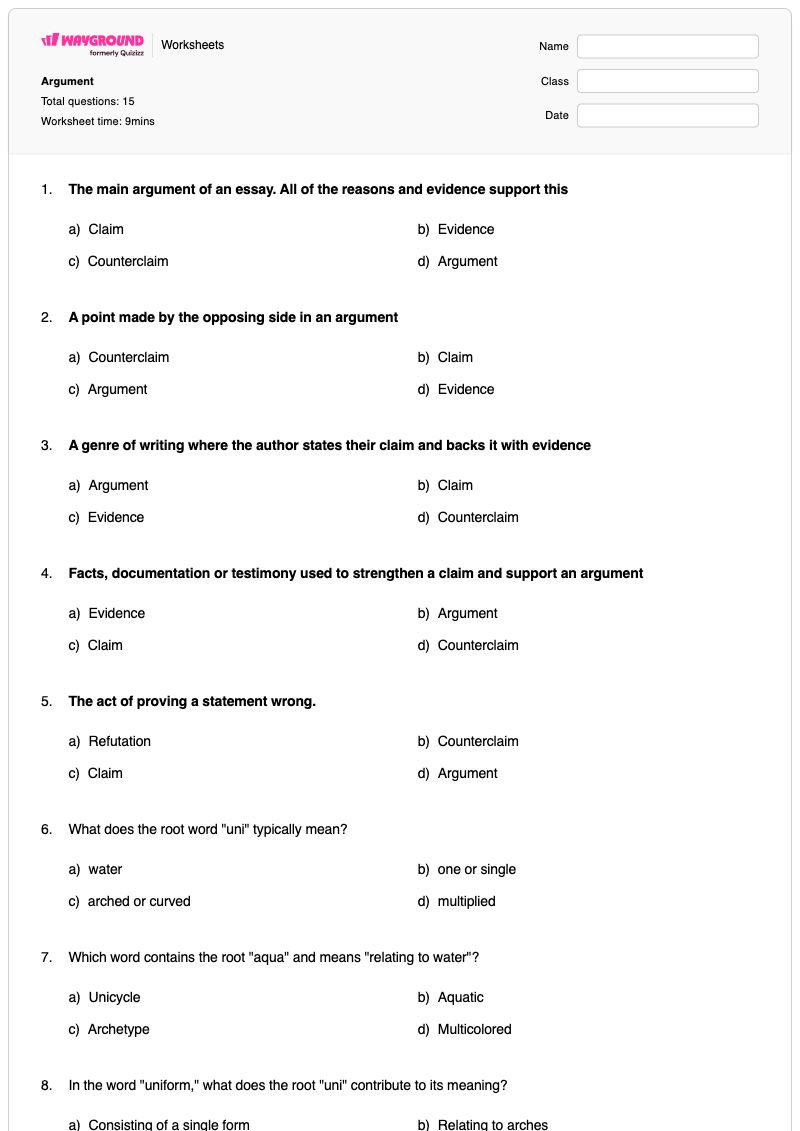
Argument is a Grade 7 English worksheet that develops students’ understanding of how arguments are built and evaluated. Across 15 items, students identify claims, counterclaims, evidence, arguments, and refutations; interpret the roots uni, aqua, and arch; and recognize features of strong claims, including being compelling, debatable, and defensible. The worksheet combines multiple-choice questions with a drag-and-drop item and multiple-select questions so students apply vocabulary and distinguish between related ideas. Students also practise finding a nonfiction text’s central idea and selecting the main ideas, key details, and supporting evidence for an objective summary. Use this resource for direct instruction, guided practice, independent review, or formative assessment in a Grade 7 English classroom. It is a free printable worksheet with a complete answer key, and it is also available digitally through Wayground for flexible assignment and review.

Worksheet settings

Font size

S
M
L
XL
WaygroundWorksheets

Argument

Total questions: 15

Name
Class
Date
1.

The main argument of an essay. All of the reasons and evidence support this

a)

Claim

b)

Evidence

c)

Counterclaim

d)

Argument

2.

A point made by the opposing side in an argument

a)

Counterclaim

b)

Claim

c)

Argument

d)

Evidence

3.

A genre of writing where the author states their claim and backs it with evidence

a)

Argument

b)

Claim

c)

Evidence

d)

Counterclaim

4.

Facts, documentation or testimony used to strengthen a claim and support an argument

a)

Evidence

b)

Argument

c)

Claim

d)

Counterclaim

5.

The act of proving a statement wrong.

a)

Refutation

b)

Counterclaim

c)

Claim

d)

Argument

6.

What does the root word "uni" typically mean?

a)

water

b)

one or single

c)

arched or curved

d)

multiplied

7.

Which word contains the root "aqua" and means "relating to water"?

a)

Unicycle

b)

Aquatic

c)

Archetype

d)

Multicolored

8.

In the word "uniform," what does the root "uni" contribute to its meaning?

a)

Consisting of a single form

b)

Relating to arches

c)

Consisting of many forms

d)

Something you wear

9.

What does the word "archenemy" imply, considering the root "arch"?

a)

A primary and longstanding enemy

b)

A strong aquatic predator

c)

A unique friend

d)

A group of enemies

10.

A strong claim is (a)   ​ because it evokes interest, ​ (b)   , because it is not a fact, and ​ (c)   because it can be supported with reliable evidence.

Choose from the below words
compelling
debatable
defensible
11.

Select all that apply. A strong claim:

a)

Identifies the writer’s stance or position

b)

Avoids words such as "I think" or "I feel"


c)

Uses words such as "I think" or "I feel"

d)

Can't be defended

12.

Select all that apply. A strong claim:

a)

Is a specific statement that shows the direction of the writer’s thinking


b)

May use an umbrella term that relates to the major points instead of listing them

c)

Has to include a list of all major points.

d)

Does not show the direction of the writer's thinking.

13.

Which of the following is NOT a strategy for finding the central idea of a nonfiction text?

a)

Summarizing the text

b)

Identifying key details and supporting evidence

c)

Reading only the first and last paragraphs

d)

Looking for repeated words or phrases

14.

When writing a summary, which information should you include?

a)

Every single detail from the text

b)

Only the introduction and conclusion of the text

c)

The main ideas, key details, and supporting evidence from the text

d)

Your own personal experiences related to the topic

15.

An objective summary means that a summary should not include your opinion on the topic.

a)

True

b)

False

WaygroundAnswer Key

Argument

Total questions: 15

1.
a)

Claim

2.
a)

Counterclaim

3.
a)

Argument

4.
a)

Evidence

5.
a)

Refutation

6.
b)

one or single

7.
b)

Aquatic

8.
a)

Consisting of a single form

9.
a)

A primary and longstanding enemy

10.
compelling, debatable, defensible
11.
a)

Identifies the writer’s stance or position

, b)

Avoids words such as "I think" or "I feel"


12.
a)

Is a specific statement that shows the direction of the writer’s thinking


, b)

May use an umbrella term that relates to the major points instead of listing them

13.
c)

Reading only the first and last paragraphs

14.
c)

The main ideas, key details, and supporting evidence from the text

15.
a)

True

FAQs

What does this Grade 7 Argument worksheet help students learn?

This 15-question worksheet helps students distinguish the parts of an argument—claim, counterclaim, evidence, argument, and refutation—and evaluate characteristics of strong claims. Its multiple-choice, drag-and-drop, and multiple-select items also practise interpreting the roots uni, aqua, and arch and identifying central ideas, key details, and evidence for objective summaries.

How can I use this worksheet to teach argument structure and strong claims?

Introduce the terms claim, evidence, counterclaim, and refutation with a short classroom argument, then ask students to explain how each part functions. Use the drag-and-drop item to discuss why a strong claim should be compelling, debatable, and defensible, and use the multiple-select items to have students justify why a claim should show the writer’s position without relying on “I think” or “I feel.”

What mistakes should I watch for when students complete this Argument worksheet?

Students may confuse a claim with the entire argument, or mistake evidence for the opposing position represented by a counterclaim. They may also select every statement about a strong claim instead of checking whether it is specific and defensible, misinterpret the meanings of uni, aqua, and arch, or include personal opinion when identifying the features of an objective summary.

How do I assign and grade this Argument worksheet?

The worksheet is available as a printable PDF and as a digital quiz on Wayground, with a complete answer key for all 15 items. Printable submissions can be graded by scanning student work with the Wayground for Teachers app, while the digital version supports online completion and grading.

How can I differentiate this Argument worksheet for my students?

In the worksheet’s Advanced Settings, adjust font spacing or font size to make the argument vocabulary, root-word questions, and answer choices easier to read. You can also enable a dyslexia-friendly font or translate the worksheet into another language; these options apply to the worksheet file, including its multiple-choice, drag-and-drop, and multiple-select items.

Where can I find more worksheets like this on Wayground?

Wayground offers a comprehensive collection of free printable worksheets and practice problems across subjects, with downloadable PDFs and answer keys to help students build essential skills and concepts. Browse more resources at https://wayground.com/en-us/worksheets.