

Wayground
Unit 7 Review - Printable Math Worksheets 8th Grade - Wayground

Unit 7 Review

Luke Dulin

Created by Luke Dulin

20 questions

8th Grade

Math

Updated May 2025

Unit 7 Review is a Grade 8 mathematics worksheet with 20 items: 10 fill-in-the-blank questions, 4 multiple-select questions, and 6 multiple-choice questions. Students calculate compound probabilities for spinners, number cubes, cards, and other repeated events; distinguish independent events from dependent events; and write probability answers as simplified fractions. The worksheet also includes a distance-in-time calculation and scatterplot analysis involving positive and negative correlation, reasonable predictions, and lines of best fit. This mixed review helps students apply probability rules to events with and without replacement rather than relying on definitions alone. Its data-analysis questions ask students to interpret scatterplots, identify correlation, select a suitable line of best fit, and use a graph to make a prediction. Unit 7 Review is a free printable worksheet with a complete answer key for independent practice, review, or assessment.

Worksheet settings

Font size

S
M
L
XL
WaygroundWorksheets

Unit 7 Review

Total questions: 20

Name
Class
Date
1.
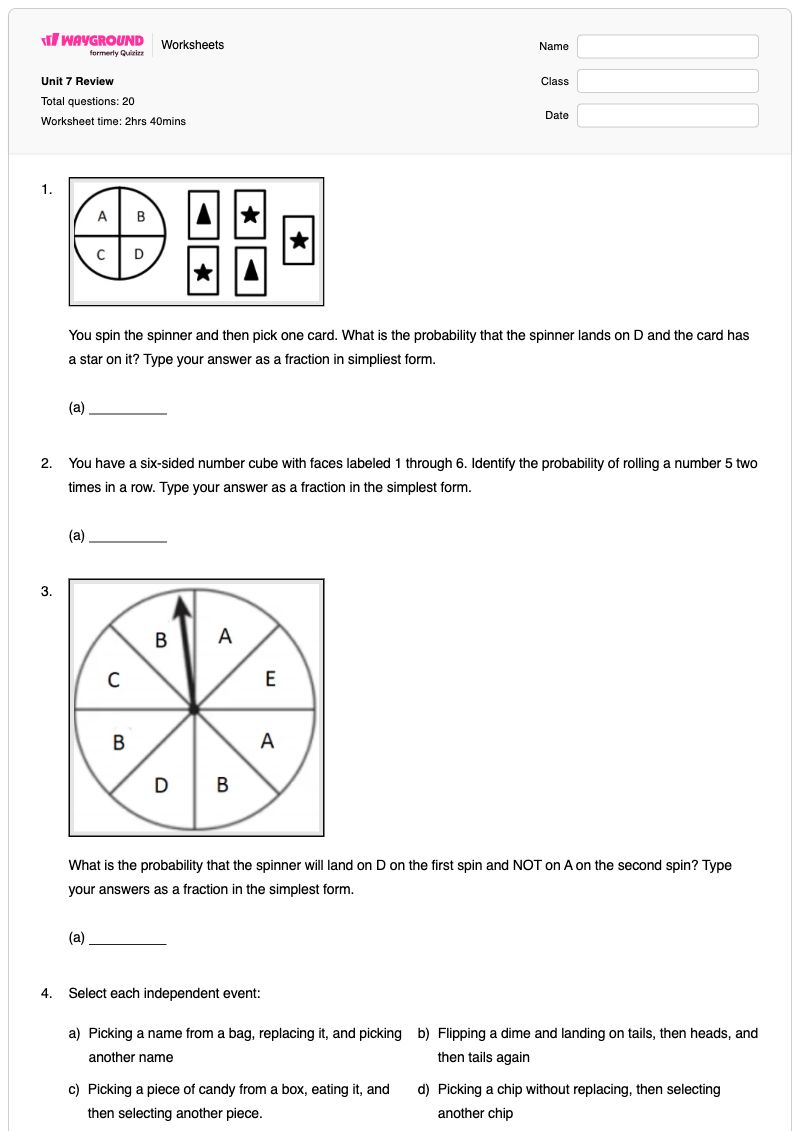
You spin the spinner and then pick one card. What is the probability that the spinner lands on D and the card has a star on…

You spin the spinner and then pick one card. What is the probability that the spinner lands on D and the card has a star on it? Type your answer as a fraction in simpliest form.

(a)  

2.

You have a six-sided number cube with faces labeled 1 through 6. Identify the probability of rolling a number 5 two times in a row. Type your answer as a fraction in the simplest form.

(a)  

3.
What is the probability that the spinner will land on D on the first spin and NOT on A on the second spin? Type your answers…

What is the probability that the spinner will land on D on the first spin and NOT on A on the second spin? Type your answers as a fraction in the simplest form.

(a)  

4.

Select each independent event:

a)

Picking a name from a bag, replacing it, and picking another name

b)

Flipping a dime and landing on tails, then heads, and then tails again

c)

Picking a piece of candy from a box, eating it, and then selecting another piece.

d)

Picking a chip without replacing, then selecting another chip

5.

Select all the independent events.

a)

Drawing a blue chip without replacing, then selecting a purple chip.

b)

Choosing a purple Skittle from a candy bowl, eating it, then selecting a green Skittle.

c)

Drawing the name Dalton from a hat, replacing it, then drawing the name Jayden.

d)

Flipping a coin and landing on tails, then on heads.

6.

Select each dependent event:

a)

picking a pencil from a bag, keeping it, and then picking another

b)

rolling a die, then rolling the die again

c)

spinning a spinner, and then spinning the spinner again

d)

drawing a card form a deck of cards, putting it back in the deck, and then drawing another card

7.

Which of these would be called dependent events?

a)

pulling a red marble from a bag, keeping it, and then pulling another red marble

b)

drawing a heart from a deck of cards, putting it back, and drawing another heart from the same deck of cards

c)

spinning a spinner, recording the result, then spinning another spinner

d)

rolling a die, recording the result, then rolling the die again

8.
There are 13 cards in the hand. What is the probability of picking a club, not replacing the card, and then picking a 2?…

There are 13 cards in the hand. What is the probability of picking a club, not replacing the card, and then picking a 2? Write your answer as a fraction in the simplest form.

(a)  

9.
There are 13 cards in the hand. What is the probability of picking a diamond, not replacing the card, and then picking a…

There are 13 cards in the hand. What is the probability of picking a diamond, not replacing the card, and then picking a club? Write your answer as a fraction in the simplest form.

(a)  

10.
There are 13 cards in the hand. What is the probability of picking a club, not replacing the card, and then picking another…

There are 13 cards in the hand. What is the probability of picking a club, not replacing the card, and then picking another club? Write your answer as a fraction in the simplest form.

(a)  

11.
How many meters did Sheila run in 90 seconds?

How many meters did Sheila run in 90 seconds?

(a)  

12.
Does the following scatterplot have a positive, negative, or no correlation?

Does the following scatterplot have a positive, negative, or no correlation?

a)

Positive

b)

Negative

c)

No Relationship

13.
What would be reasonable predictions for the score of studying 4 hours?

What would be reasonable predictions for the score of studying 4 hours?

a)

85

b)

100

c)

60

d)

75

14.
Choose the graph that demonstrates the appropriate line of best fit.

Choose the graph that demonstrates the appropriate line of best fit.

a)

A

b)

B

c)

C

d)

D

15.
Which scatterplot represents a negative correlation?

Which scatterplot represents a negative correlation?

a)

A

b)

B

c)

C

16.
What is the interquartile range of the data shown below?

What is the interquartile range of the data shown below?

(a)  

17.
What is the median of the data shown below?

What is the median of the data shown below?

(a)  

18.
What percent of the data shown is below 20 inches of snowfall a year?

What percent of the data shown is below 20 inches of snowfall a year?

(a)  

19.
Select each true statement.

Select each true statement.

a)

Dustin's Family and Kari's Family produce spending have equal range values.

b)

In both families, at least 50% of the produce spending was $35 or more.

c)

In Kari's Family, 25% of the spending was less than the lowest produce spending than Dustin's Family.

d)

In each family, the highest spending was above $45.

20.
The boxplot represents the test score of students' last math test. Select all of the true statements.

The boxplot represents the test score of students' last math test. Select all of the true statements.

a)

The upper extreme is 95.

b)

The lower quartile is 78.

c)

Twelve students took the test.

d)

The average score on the test was 85.

WaygroundAnswer Key

Unit 7 Review

Total questions: 20

1.
3/20
2.
1/36
3.
3/32
4.
a)

Picking a name from a bag, replacing it, and picking another name

, b)

Flipping a dime and landing on tails, then heads, and then tails again

5.
c)

Drawing the name Dalton from a hat, replacing it, then drawing the name Jayden.

, d)

Flipping a coin and landing on tails, then on heads.

6.
a)

picking a pencil from a bag, keeping it, and then picking another

7.
a)

pulling a red marble from a bag, keeping it, and then pulling another red marble

8.
1/39
9.
7/78
10.
1/78
11.
305
12.
a)

Positive

13.
a)

85

14.
d)

D

15.
a)

A

16.
10
17.
12
18.
75, 75%
19.
a)

Dustin's Family and Kari's Family produce spending have equal range values.

, b)

In both families, at least 50% of the produce spending was $35 or more.

20.
a)

The upper extreme is 95.

, b)

The lower quartile is 78.

FAQs

What does the Unit 7 Review worksheet cover?

This Grade 8 mathematics worksheet combines fill-in-the-blank probability calculations with multiple-select and multiple-choice questions about independent and dependent events. Students find compound probabilities for spinners, number cubes, and cards drawn with or without replacement, then interpret scatterplots for correlation, predictions, and lines of best fit. Writing answers as simplified fractions and selecting justified graph interpretations builds accuracy across both probability and data analysis.

How can I use this worksheet to teach independent and dependent events and scatterplots?

Begin by modeling one probability item with a tree diagram or sequential multiplication, explicitly tracking whether an item is replaced before the next event. Have students explain their choices in the independent- and dependent-event multiple-select questions, then transition to the scatterplot items by describing the direction of each relationship before discussing predictions and the line of best fit. This sequence moves from identifying the structure of an event to calculating and interpreting results.

What mistakes should I watch for on the Unit 7 Review worksheet?

Students may multiply the wrong second probability, fail to change the denominator after a card is not replaced, or leave compound-probability answers unsimplified. In the event-classification questions, watch for confusing repeated trials with dependent events when the first result does not change the second trial. For the scatterplot items, students may reverse positive and negative correlation, choose an extreme prediction instead of a value supported by the trend, or select a line of best fit that does not follow the data pattern.

How do I assign and grade the Unit 7 Review worksheet?

The Unit 7 Review worksheet is available as a printable PDF and as a digital quiz on Wayground, and it includes a complete answer key. Assign the digital version for automatic quiz grading, or print the PDF and grade student responses against the key. Printable submissions can also be graded by scanning student work with the Wayground for Teachers app.

How can I differentiate this Unit 7 Review worksheet for my students?

For the fraction-response and scatterplot questions in this worksheet, use Advanced Settings to adjust font spacing or increase the font size for easier reading. You can also enable a dyslexia-friendly font or translate the worksheet into another language when those options support access to the probability and data-analysis items.

Where can I find more worksheets like this on Wayground?

Wayground offers a broad collection of free printable worksheets and practice problems across subjects, with downloadable PDFs and answer keys to help students master essential skills and concepts. Browse more resources at https://wayground.com/en-us/worksheets.