

Wayground
4th grade language arts standards review - Printable ELA Worksheets class 4 - Wayground

4th grade language arts standards review

Michelle Myers

Created by Michelle Myers

20 questions

4th Grade

ELA

Updated Apr 2026

The 4th Grade Language Arts Standards Review worksheet gives students focused practice with 20 English language arts questions: 18 multiple-choice items, one fill-in-the-blank item, and one multiple-select item. It reviews identifying sequence words, synonyms and antonyms, story solutions, idioms, compare-and-contrast language, multiple-meaning words, context clues, main idea, prefixes, suffixes, roots, theme, and metaphor. Designed for Grade 4 learners, this worksheet helps students distinguish closely related language arts terms and apply them in short, clearly structured questions. Students identify whether a word part appears at the beginning or end of a word, separate theme from main idea, recognize figurative language such as idioms and metaphors, and select all applicable multiple-meaning words. This free printable worksheet includes a complete answer key for efficient review, practice, or standards-based assessment.

Worksheet settings

Font size

S
M
L
XL
WaygroundWorksheets

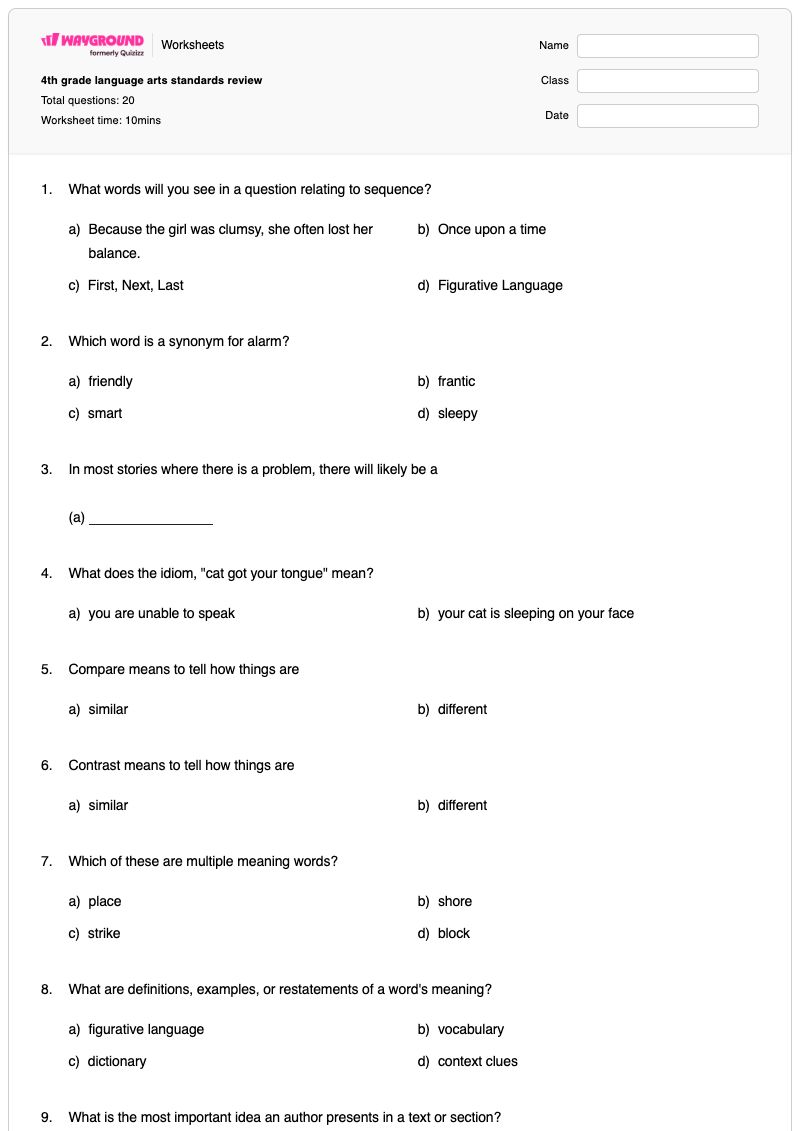
4th grade language arts standards review

Total questions: 20

Name
Class
Date
1.

What words will you see in a question relating to sequence?

a)

Because the girl was clumsy, she often lost her balance.

b)

Once upon a time

c)

First, Next, Last

d)

Figurative Language

2.

Which word is a synonym for alarm?

a)

friendly

b)

frantic

c)

smart

d)

sleepy

3.

In most stories where there is a problem, there will likely be a

(a)  

4.

What does the idiom, "cat got your tongue" mean?

a)

you are unable to speak

b)

your cat is sleeping on your face

5.

Compare means to tell how things are

a)

similar

b)

different

6.

Contrast means to tell how things are

a)

similar

b)

different

7.

Which of these are multiple meaning words?

a)

place

b)

shore

c)

strike

d)

block

8.

What are definitions, examples, or restatements of a word's meaning?

a)

figurative language

b)

vocabulary

c)

dictionary

d)

context clues

9.

What is the most important idea an author presents in a text or section?

a)

main idea

b)

key detail

c)

summary

d)

cause and effect

10.

What is a word part added to the beginning of a word?

a)

prefix

b)

root

c)

suffix

11.

What is the word part added to the end of a word?

a)

prefix

b)

root

c)

suffix

12.

What is the central message or lesson an author wants you to understand?

a)

main idea

b)

key details

c)

theme

d)

summary

13.

What is the simplest form of a word?

a)

prefix

b)

root

c)

suffix

14.

What is an antonym for tense?

a)

scared

b)

stressed

c)

frantic

d)

relaxed

15.

What is the term for a comparison of two unlike things without using like or as?

a)

simile

b)

metaphor

c)

rhyme

d)

meter

16.

What is the term for a comparison between two unlike things that does use like or as?

a)

simile

b)

metaphor

c)

rhyme

d)

meter

17.

What is it called when two words sound the same such as claw and draw?

a)

simile

b)

metaphor

c)

rhyme

d)

meter

18.

In poetry, what is the pattern of stressed and unstressed syllables?

a)

simile

b)

metaphor

c)

rhyme

d)

meter

19.

When you are writing a report about information you have learned, you are writing what type of report?

a)

Narrative

b)

Informational/Explanatory

c)

Opinion

20.

When you are writing to persusade someone to take action, you are writing an

a)

Narrative

b)

Informational/Explanatory piece

c)

Opinion piece

WaygroundAnswer Key

4th grade language arts standards review

Total questions: 20

1.
c)

First, Next, Last

2.
b)

frantic

3.
solution
4.
a)

you are unable to speak

5.
a)

similar

6.
b)

different

7.
d)

block

, c)

strike

, b)

shore

, a)

place

8.
d)

context clues

9.
a)

main idea

10.
a)

prefix

11.
c)

suffix

12.
c)

theme

13.
b)

root

14.
d)

relaxed

15.
b)

metaphor

16.
a)

simile

17.
c)

rhyme

18.
d)

meter

19.
b)

Informational/Explanatory

20.
c)

Opinion piece

FAQs

What does this Grade 4 language arts standards review worksheet cover?

This worksheet reviews specific Grade 4 skills through 20 items: identifying sequence words, synonyms, antonyms, idioms, compare-and-contrast terms, multiple-meaning words, context clues, main idea, theme, prefixes, suffixes, roots, and metaphors. Its 18 multiple-choice questions, fill-in-the-blank item, and multiple-select item require students to distinguish related terms and recall how each language arts concept functions.

How can I use this worksheet to teach Grade 4 language arts standards?

Use the worksheet after mini-lessons on word parts, vocabulary, comprehension, and figurative language. Before students begin, have them explain pairs that are easy to confuse—such as compare and contrast, main idea and theme, or prefix and suffix—then ask them to justify their choices on the multiple-choice items. Review the fill-in-the-blank story-problem item and the multiple-select question together so students explain why each answer fits.

What mistakes should I watch for on this language arts review worksheet?

Students may confuse sequence words with other language features, choose theme when a question asks for the text’s main idea, or mix up prefixes, suffixes, and roots based on where each word part appears. They may also interpret the idiom “cat got your tongue” literally, select a synonym instead of an antonym, or mark only one answer on the multiple-select question about multiple-meaning words. Check that students distinguish context clues from vocabulary and recognize a metaphor as a comparison without “like” or “as.”

How do I assign and grade this worksheet?

This Grade 4 language arts review is available as a printable PDF and as a digital quiz on Wayground. It includes a complete answer key, and printable submissions can be graded by scanning student work with the Wayground for Teachers app. The PDF option can also support schools that are reducing screen time.

How can I differentiate this language arts review worksheet for my students?

In the worksheet’s Advanced Settings, adjust font spacing and font size to make the 20 review items easier to read, including the fill-in-the-blank and multiple-select questions. You can also apply a dyslexia-friendly font or translate the worksheet into another language when appropriate for your learners.

Where can I find more worksheets like this on Wayground?

Wayground offers a comprehensive collection of free printable worksheets and practice problems across all subjects, with downloadable PDFs and answer keys to help students master essential skills and concepts. Browse more resources at https://wayground.com/en-us/worksheets.