

Wayground
Muscular and Skeletal Systems Quiz - Printable Science Worksheets kindergarten - Wayground

Muscular and Skeletal Systems Quiz

16 questions

7th - 7th Grade

Science

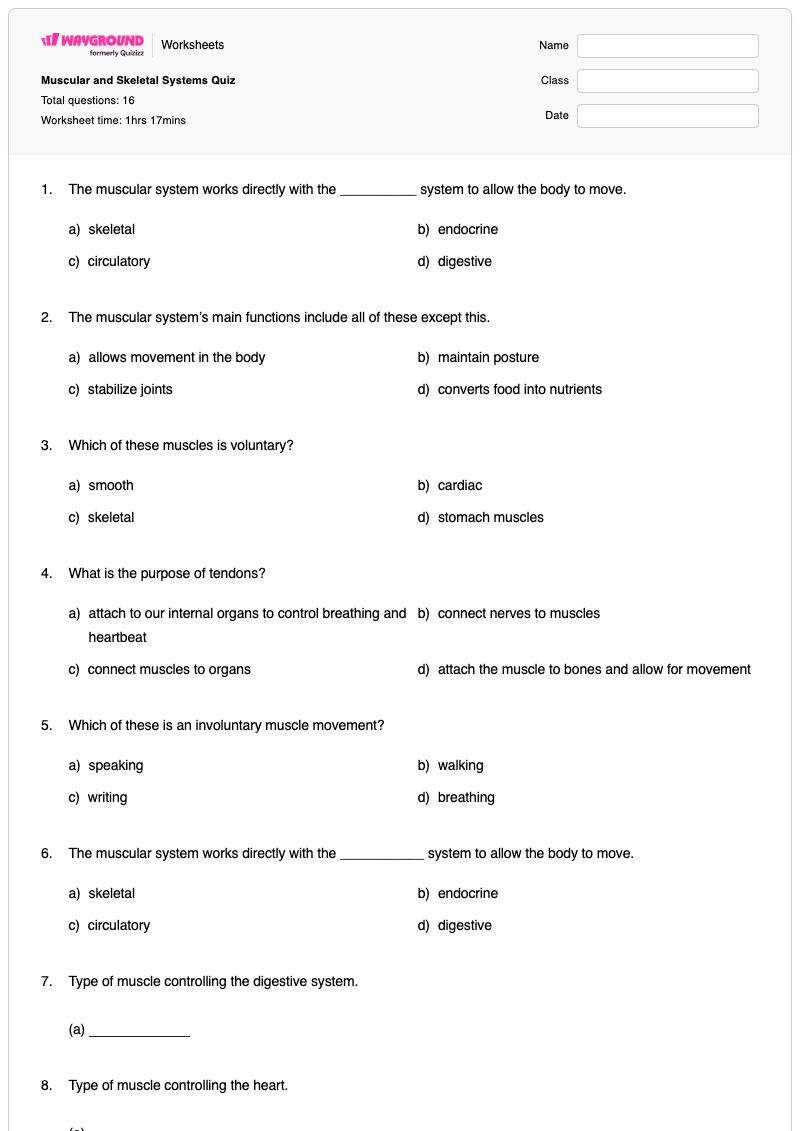
Muscular and Skeletal Systems Quiz is a Grade 7 science worksheet that checks students’ understanding of how the muscular and skeletal systems work together to produce movement. Students identify voluntary and involuntary muscles, distinguish smooth, cardiac, and skeletal muscle, explain the role of tendons, and recognize muscular-system functions such as movement, posture, and joint stabilization. The worksheet also covers skeletal-system structures and functions, including red and spongy bone marrow, axial and appendicular skeletons, ligaments, tendons, fascia, bone count, and the pelvis. This free printable worksheet with an answer key uses a varied 16-item format: multiple-choice questions, fill-in-the-blank items, matching, a dropdown, multiple select, and ordering. The combination requires students to recall vocabulary, connect structures to their functions, classify muscle actions, match skeletal terms with definitions, and select several correct functions of the skeletal system. It is suitable for reviewing or assessing Grade 7 anatomy and body-systems instruction.

Worksheet settings

Font size

S
M
L
XL
Worksheets

Muscular and Skeletal Systems Quiz

Total questions: 16

Name
Class
Date
1.

The muscular system works directly with the __________ system to allow the body to move.

a)

skeletal

b)

endocrine

c)

circulatory

d)

digestive

2.

The muscular system’s main functions include all of these except this.

a)

allows movement in the body

b)

maintain posture

c)

stabilize joints

d)

converts food into nutrients

3.

Which of these muscles is voluntary?

a)

smooth

b)

cardiac

c)

skeletal

d)

stomach muscles

4.

What is the purpose of tendons?

a)

attach to our internal organs to control breathing and heartbeat

b)

connect nerves to muscles

c)

connect muscles to organs

d)

attach the muscle to bones and allow for movement

5.

Which of these is an involuntary muscle movement?

a)

speaking

b)

walking

c)

writing

d)

breathing

6.

The muscular system works directly with the ___________ system to allow the body to move.

a)

skeletal

b)

endocrine

c)

circulatory

d)

digestive

7.

Type of muscle controlling the digestive system.

(a)  

8.

Type of muscle controlling the heart.

(a)  

9.

Match each vocabulary term next to its definition.

an internal skeleton that is comprised of bone and cartilage

Endoskeleton

the bones along the axis of the body that protect internal organs

Axial SKeleton

an external skeletal system that is made up of chitin and calcium carbonate

Exoskeleton

the bones of appendages and girdles that connect them with the axial skeleton and provide support and flexibility

Appendicular Skeleton

10.

This part of the bone produces blood cells.

a)

Red Bone Marrow

b)

Yellow Bone Marrow

c)

Compact Bone

d)

Periosteum

11.

Which part of the bone is porous and less dense?

a)

Spongy Bone

b)

Compact Bone

c)

Periosteum

d)

Axial Skeleton

12.

Ligaments attach​ (a)   , tendons attach​ (b)   and fascia attaches​ (c)   .

Choose from the below words
bones to bones
muscle to bones
muscle to muscle
muscle to joints
axial to appendicular skeleton
joints to sockets
13.

The main difference between the female and the male skeletons is the...

(a)  

14.

The body has how many bones?

(a)  

15.

Which statements refer to the functions of the skeletal system? Choose THREE correct answers.

a)

It breaks down food for energy.

b)

It produces blood cells.

c)

It stores minerals and fatty acids.

d)

It communicates with electrical signals.

e)

It helps with movement.

16.

Put the Levels of Organization in order from least to most complex.

a)

Cell

b)

Tissue

c)

Organ

d)

Organ System

e)

Organism

1)
2)
3)
4)
5)
Answer Key

Muscular and Skeletal Systems Quiz

Total questions: 16

1.
a)

skeletal

2.
d)

converts food into nutrients

3.
c)

skeletal

4.
d)

attach the muscle to bones and allow for movement

5.
d)

breathing

6.
a)

skeletal

7.
smooth
8.
cardiac
9.

an internal skeleton that is comprised of bone and cartilage

 - 

Endoskeleton

, 

the bones along the axis of the body that protect internal organs

 - 

Axial SKeleton

, 

an external skeletal system that is made up of chitin and calcium carbonate

 - 

Exoskeleton

, 

the bones of appendages and girdles that connect them with the axial skeleton and provide support and flexibility

 - 

Appendicular Skeleton

10.
a)

Red Bone Marrow

11.
a)

Spongy Bone

12.
bones to bones, muscle to bones, muscle to muscle
13.
pelvis
14.
206
15.
b)

It produces blood cells.

, c)

It stores minerals and fatty acids.

, e)

It helps with movement.

16.
a, b, c, d, e

FAQs

What does the Muscular and Skeletal Systems Quiz cover?

This Grade 7 science worksheet assesses how the muscular and skeletal systems work together, including voluntary and involuntary muscles, smooth, cardiac, and skeletal muscle, tendons, ligaments, fascia, bone marrow, and skeletal structures. Its 16 mixed-format items ask students to identify functions, complete anatomy terms, match skeletal vocabulary to definitions, select multiple correct answers, and organize information.

How can I use this worksheet to teach the muscular and skeletal systems?

Introduce movement by having students trace the relationship between muscles, tendons, bones, and joints, then use the multiple-choice items to discuss why breathing is involuntary and why skeletal muscle is voluntary. Follow with the fill-in-the-blank and matching items to reinforce smooth and cardiac muscle, bone-system vocabulary, and axial versus appendicular structures before using the multiple-select questions as a review discussion.

What mistakes should I watch for when students complete this muscular and skeletal systems worksheet?

Students may confuse tendons, which attach muscles to bones, with ligaments, which attach bones to bones, or select walking, writing, or speaking instead of breathing as an involuntary movement. Watch for confusion between red and spongy bone marrow, between smooth and cardiac muscle, and in the multiple-select item when students choose only one skeletal-system function instead of all three correct functions.

How do I assign and grade this Muscular and Skeletal Systems Quiz?

On Wayground, assign the worksheet as a printable PDF or use it as a digital quiz, and use the complete answer key to grade the multiple-choice, fill-in-the-blank, matching, dropdown, multiple-select, and ordering items. Printable submissions can be graded by scanning student work with the Wayground for Teachers app.

How can I differentiate this muscular and skeletal systems worksheet for my students?

In the worksheet’s Advanced Settings, adjust font spacing and font size to make the anatomy vocabulary, matching definitions, and fill-in-the-blank prompts easier to read. You can also enable a dyslexia-friendly font or translate the worksheet into another language when students need additional access to terms such as periosteum, fascia, axial skeleton, and appendicular skeleton.

Where can I find more worksheets like this on Wayground?

Wayground offers a comprehensive collection of free printable worksheets and practice problems across subjects, with downloadable PDFs and answer keys to support mastery of essential skills and concepts. Browse more resources at https://wayground.com/en-us/worksheets.