
Wayground
Land Breeze and Sea Breeze - Printable Science Worksheets class 5 - Wayground

Land Breeze and Sea Breeze

14 questions

5th - 5th Grade

Science

This Grade 5 science worksheet helps students explain how uneven heating of Earth’s surface causes wind and creates land breezes and sea breezes. It focuses on identifying each breeze, determining whether it occurs during the day or night, tracking the direction of air movement, and explaining why warm air rises because it is less dense than cooler air. Students complete 14 multiple-choice questions that connect temperature differences between land and water to changing coastal wind direction. Items also ask students to explain why land breezes occur at night and define wind as air moving from areas of high pressure to areas of low pressure. This free printable worksheet is useful for science practice, review, or assessment in Grade 5 and includes a complete answer key.

Worksheet settings

Font size

S
M
L
XL
Worksheets

Land Breeze and Sea Breeze

Total questions: 14

Name
Class
Date
1.

Do sea breezes typically happen during the day or night?

a)

Day

b)

Night

2.
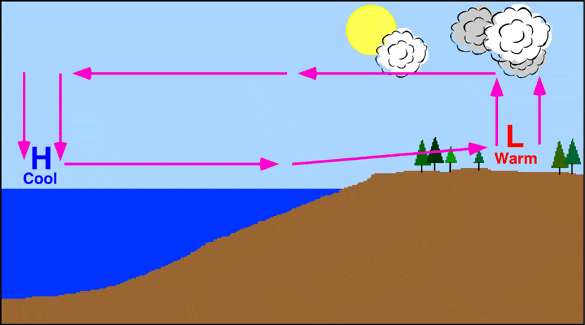
Is this a land or a sea breeze?
a)
land breeze
b)
sea breeze
3.
Do land breezes typically happen during the day or night?
a)
Day
b)
Night
4.
In a sea breeze, the air is warmer above the _____.
a)
land
b)
ocean
c)
sky
d)
beach
5.
Why does warm air rise?
a)
Warm air is more dense than cooler air.
b)
Warm air has more pressure than cooler air.
c)
Warm air is less dense than cooler air.
d)
Warm air has a higher dew point than cooler air.
6.
Why do land breezes occur at night?
a)
Land cools off slower than water, so the air above water is cooler.
b)
Water cools off faster than land, so the air above land is warmer.
c)
Land heats up slower than water, so the air stays cooler during the day.
d)
Water cools off slower than land, so the air above water is warmer.
7.
In a sea breeze, the air is warmer above the _____.
a)
land
b)
ocean
c)
sky
d)
beach
8.
How does the air move in a land breeze?
a)
From east to west
b)
From west to east
c)
From the land to the ocean
d)
From the ocean to the land
9.
How does the air move in a sea breeze?
a)
wind moves from north to south
b)
wind moves from ocean to the land
c)
wind moves from the land to the ocean
d)
wind moves from south to north
10.
Which best describes why winds at the beach change direction between day and night? **
a)
because the temperatures over land and over water change 
b)
because warm air over land sinks and stays in place over land
c)
because cool air rises and is replaced by warm air from the ocean 
d)
because cool air sinks and stays in place over land 
11.
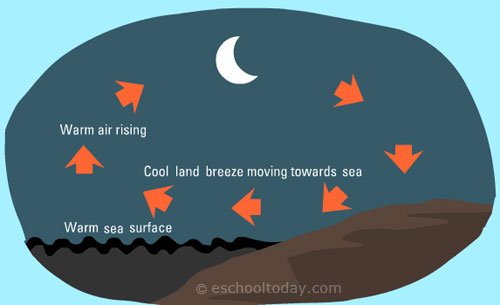
Is this a land or a sea breeze?
a)
land breeze
b)
sea breeze
12.
Is this a land or a sea breeze?
a)
land breeze
b)
sea breeze
13.

What is the main cause of winds?

a)

amount of trees

b)

the moon's gravity

c)

amount of animals

d)

uneven heating of Earth's surface

14.
Which statement correctly defines wind?
a)
Wind is the movement of air from areas of low pressure to areas of high pressure
b)
Wind is the movement of air to a colder area in the atmosphere.
c)
Wind is the movement of air from areas of high pressure to areas of low pressure.
d)
Wind is the movement of air pushed around and bouncing off Earth's surface.
Answer Key

Land Breeze and Sea Breeze

Total questions: 14

1.
a)

Day

2.
b) sea breeze
3.
b) Night
4.
a) land
5.
c) Warm air is less dense than cooler air.
6.
d) Water cools off slower than land, so the air above water is warmer.
7.
a) land
8.
c) From the land to the ocean
9.
b) wind moves from ocean to the land
10.
a) because the temperatures over land and over water change 
11.
b) sea breeze
12.
a) land breeze
13.
d)

uneven heating of Earth's surface

14.
c) Wind is the movement of air from areas of high pressure to areas of low pressure.

FAQs

What does the Land Breeze and Sea Breeze worksheet cover?

This Grade 5 science worksheet uses 14 multiple-choice questions to assess how uneven heating of land and water causes land breezes and sea breezes. Students identify each breeze, distinguish its daytime or nighttime occurrence, determine whether air moves from land to ocean or ocean to land, and connect rising warm air and pressure differences to wind formation.

How can I use this worksheet to teach land breezes and sea breezes?

Introduce the concept by comparing how land and water heat and cool, then have students use that temperature difference to predict which surface has warmer air. As students answer the multiple-choice items, ask them to explain the chain from uneven heating to rising, less-dense warm air and changing wind direction during the day and night. Use the breeze-identification and air-movement questions as a quick check for whether they can apply the explanation, not just recall terms.

What mistakes should I watch for when students complete this land and sea breeze worksheet?

Students may reverse the day-and-night patterns, identify a sea breeze as moving from land to ocean, or confuse the warmer surface with the direction the air travels. Watch for students who choose that warm air is denser or that wind moves from low pressure to high pressure. The repeated identification and direction questions can reveal whether an error is a vocabulary issue or a misunderstanding of the underlying temperature and pressure changes.

How do I assign and grade the Land Breeze and Sea Breeze worksheet?

You can assign this worksheet as a printable PDF or as a digital quiz on Wayground, and it includes a complete answer key for checking all 14 multiple-choice questions. Printable submissions can also be graded by scanning student work with the Wayground for Teachers app. The printable format can support classrooms that are reducing screen time.

How can I differentiate this land and sea breeze worksheet for my students?

In the worksheet’s Advanced Settings, adjust font spacing or choose a larger font size to make the 14 multiple-choice items easier to read. You can also apply a dyslexia-friendly font or translate the worksheet into another language while students work with the land-and-sea temperature, timing, and air-movement questions.

Where can I find more worksheets like this on Wayground?

Wayground offers a comprehensive collection of free printable worksheets and practice problems across all subjects, with downloadable PDFs and answer keys to help students master essential skills and concepts. Browse more resources at https://wayground.com/en-us/worksheets.