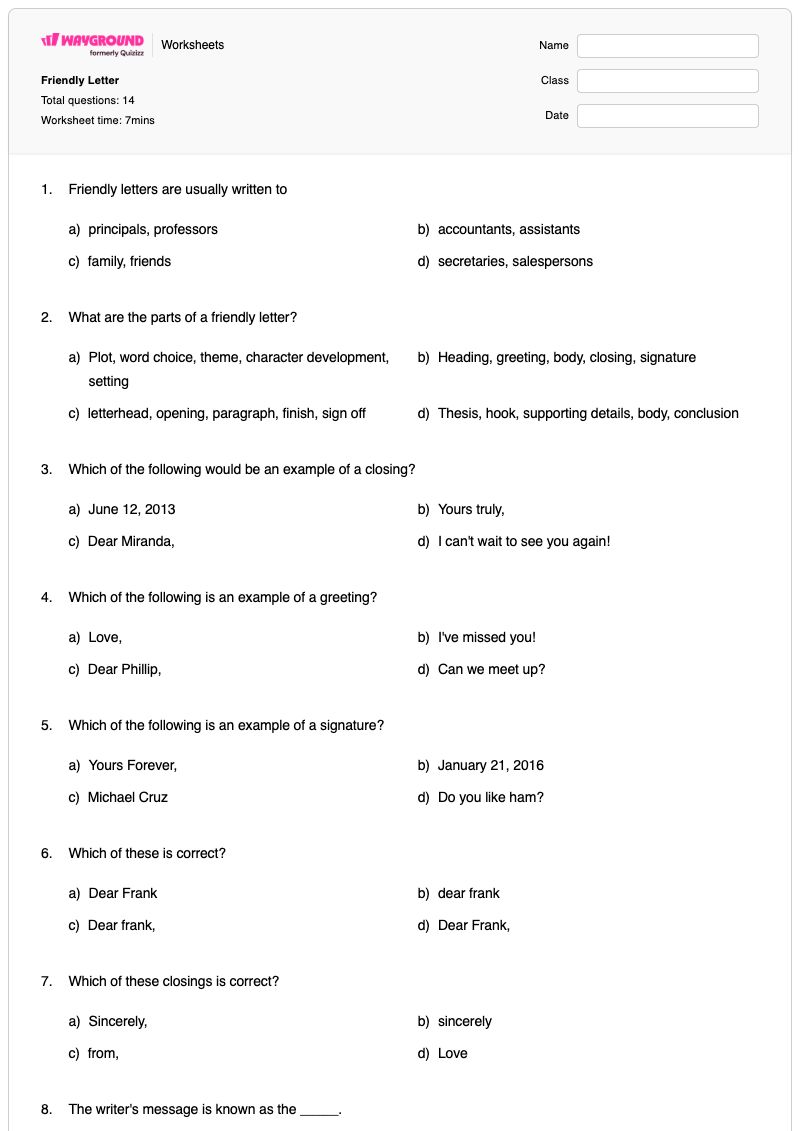
This Grade 6 English worksheet helps students identify the five parts of a friendly letter: heading, greeting, body, closing, and signature. Across 14 questions—13 multiple-choice items and one multiple-select item—students match examples such as dates, salutations, sign-offs, names, and the writer’s message to the correct letter part. They also review who typically receives a friendly letter, recognize correct capitalization and punctuation in greetings and closings, and identify features that do not belong in this letter format.
Use this free printable worksheet to reinforce friendly-letter structure and check whether students can distinguish closely related parts, such as a greeting from a closing or a signature from the body. It works well for Grade 6 English practice, review, or formative assessment after instruction on personal letter writing. A complete answer key is included for efficient checking and feedback.
Worksheet settings
Font size
S
M
L
XL
Worksheets
Friendly Letter
Total questions: 14
Name
Class
Date
1.
Friendly letters are usually written to
a)
principals, professors
b)
accountants, assistants
c)
family, friends
d)
secretaries, salespersons
2.
What are the parts of a friendly letter?
a)
Plot, word choice, theme, character development, setting
Which of the following would be an example of a closing?
a)
June 12, 2013
b)
Yours truly,
c)
Dear Miranda,
d)
I can't wait to see you again!
4.
Which of the following is an example of a greeting?
a)
Love,
b)
I've missed you!
c)
Dear Phillip,
d)
Can we meet up?
5.
Which of the following is an example of a signature?
a)
Yours Forever,
b)
January 21, 2016
c)
Michael Cruz
d)
Do you like ham?
6.
Which of these is correct?
a)
Dear Frank
b)
dear frank
c)
Dear frank,
d)
Dear Frank,
7.
Which of these closings is correct?
a)
Sincerely,
b)
sincerely
c)
from,
d)
Love
8.
The writer's message is known as the _____.
a)
body
b)
salutation
c)
closing
d)
heading
9.
What part of the letter is this?
a)
Heading
b)
Greeting
c)
Body
d)
Closing
10.
What part of the letter is this?
a)
Heading
b)
Greeting
c)
Closing
d)
Signature
11.
How many parts are there in a friendly letter?
a)
There is 1: Body paragraphs
b)
There are 3: Greeting, Body, Closing
c)
There are 5: Heading, Greeting, Body, Closing, Signature
12.
The main or largest part of your letter is the _______.
a)
heading
b)
greeting
c)
body
d)
closing
13.
What part of a letter is the following:
September 12, 2018
a)
greeting
b)
heading
c)
closing
d)
signature
14.
Which of the following is NOT a feature of a friendly letter?
a)
greeting
b)
heading
c)
materials list
d)
signature
Answer Key
Friendly Letter
Total questions: 14
1.
c)
family, friends
2.
b)
Heading, greeting, body, closing, signature
3.
b)
Yours truly,
4.
c)
Dear Phillip,
5.
c)
Michael Cruz
6.
d)
Dear Frank,
7.
a)
Sincerely,
8.
a) body
9.
c) Body
10.
d) Signature
11.
c)
There are 5: Heading, Greeting, Body, Closing, Signature
12.
c)
body
13.
b)
heading
14.
c) materials list
140 %
Browse by subjects
Browse by grades
Browse by format
FAQs
What does this friendly letter worksheet cover?
This Grade 6 worksheet covers the five parts of a friendly letter: heading, greeting, body, closing, and signature. Its 14 multiple-choice and multiple-select questions ask students to identify each part from examples, recall that the body contains the writer’s message, and recognize correct greeting and closing punctuation.
How can I use this worksheet to teach the parts of a friendly letter?
Introduce the five-part structure by having students locate the date, salutation, message, sign-off, and writer’s name in a model friendly letter. Then use the worksheet’s example-based questions to discuss why “Dear Frank,” is a greeting, “Sincerely,” is a closing, and a date such as “September 12, 2018” is a heading. Review the items together and ask students to explain the role of each part.
What mistakes should I watch for on this friendly letter worksheet?
Students may confuse the greeting, closing, and signature because all appear near the beginning or end of a letter; remind them that the greeting addresses the recipient, the closing signs off, and the signature names the writer. Watch for missed capitalization and commas in examples such as “Dear Frank,” and “Sincerely,” and for students choosing a date as anything other than the heading. On the multiple-select item, check that students identify the body as the main or largest part of the letter.
How do I assign and grade this friendly letter worksheet?
The Friendly Letter worksheet is available as a printable PDF and as a digital quiz on Wayground, with a complete answer key for all 14 questions. Grade printed submissions by scanning student work with the Wayground for Teachers app, or use the digital quiz to review responses electronically. The printable PDF can also support schools that are reducing screen time.
How can I differentiate this friendly letter worksheet for my students?
In the worksheet’s Advanced Settings, adjust font spacing or choose a larger font size to make the letter-part examples and answer choices easier to read. You can also apply a dyslexia-friendly font or translate the worksheet into another language while students practise identifying headings, greetings, bodies, closings, and signatures.
Where can I find more worksheets like this on Wayground?
Wayground offers a broad collection of free printable worksheets and practice problems across subjects, with downloadable PDFs and answer keys to help students master essential skills and concepts. Browse more resources at https://wayground.com/en-us/worksheets.

 Worksheets
