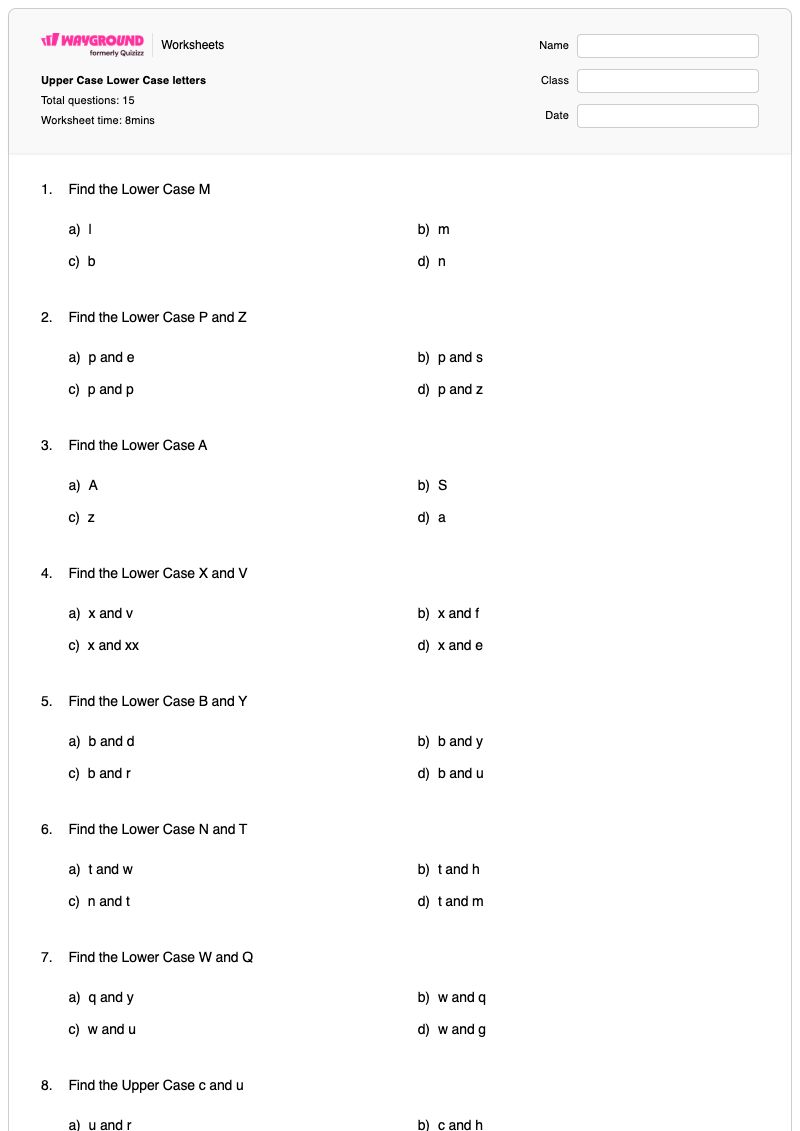
Upper Case Lower Case Letters is a free printable English worksheet for kindergarten students learning to recognize uppercase and lowercase letter forms. Across 14 multiple-choice questions, students identify lowercase letters such as m, p, z, a, x, v, b, y, n, t, w, and q, then identify uppercase letters such as C, U, D, S, R, F, H, E, I, L, G, J, K, and O. Most items ask students to choose the option containing one or two requested letters from visually similar distractors.
The worksheet also includes one multiple-select item in which students choose weekend activities they want to have, giving students practice following a multiple-response direction. It is designed for kindergarten English instruction, early letter-recognition practice, independent work, review, or a quick formative check. The free printable worksheet includes a complete answer key to support efficient checking and feedback.
Worksheet settings
Font size
S
M
L
XL
Worksheets
Upper Case Lower Case letters
Total questions: 15
Name
Class
Date
1.
Find the Lower Case M
a)
l
b)
m
c)
b
d)
n
2.
Find the Lower Case P and Z
a)
p and e
b)
p and s
c)
p and p
d)
p and z
3.
Find the Lower Case A
a)
A
b)
S
c)
z
d)
a
4.
Find the Lower Case X and V
a)
x and v
b)
x and f
c)
x and xx
d)
x and e
5.
Find the Lower Case B and Y
a)
b and d
b)
b and y
c)
b and r
d)
b and u
6.
Find the Lower Case N and T
a)
t and w
b)
t and h
c)
n and t
d)
t and m
7.
Find the Lower Case W and Q
a)
q and y
b)
w and q
c)
w and u
d)
w and g
8.
Find the Upper Case c and u
a)
u and r
b)
c and h
c)
c and u
d)
u and y
9.
Find the Upper Case d and s
a)
d and h
b)
B and D
c)
B and S
d)
D and S
10.
Find the Upper Case r and f
a)
f and r
b)
R and F
c)
R and E
d)
R and B
11.
Find the Upper Case h and e
a)
h and y
b)
h and I
c)
H and E
d)
H and F
12.
Find the Upper Case i and l
a)
I and L
b)
I and H
c)
I and J
d)
i and h
13.
Find the Upper Case g and j
a)
G and R
b)
G and U
c)
G and J
d)
G and O
14.
Find the Upper Case k and o
a)
K and Q
b)
K and P
c)
K and G
d)
K and O
15.
This weekend I want to have
a)
Fun
b)
Play
c)
Relax
d)
Enjoy a good snack
Answer Key
Upper Case Lower Case letters
Total questions: 15
1.
b)
m
2.
d)
p and z
3.
d)
a
4.
a)
x and v
5.
b)
b and y
6.
c)
n and t
7.
b)
w and q
8.
c)
c and u
9.
d)
D and S
10.
b)
R and F
11.
c)
H and E
12.
a)
I and L
13.
c)
G and J
14.
d)
K and O
15.
n/a
140 %
Browse by subjects
Browse by grades
Browse by format
FAQs
What does this uppercase and lowercase letters worksheet help kindergarten students learn?
This worksheet helps kindergarten students distinguish lowercase and uppercase letter forms by selecting requested letters from multiple-choice options. The 14 letter-recognition questions include both individual letters and pairs, such as lowercase m, p and z, and uppercase D and S, so students must attend to both letter identity and case. A final multiple-select item also gives students practice following a direction that requires more than one response.
How can I use this worksheet to teach uppercase and lowercase letter recognition?
Introduce a few target letters at a time by displaying their uppercase and lowercase forms, then ask students to explain how they know which option matches the requested case. Work through one or two multiple-choice examples together before students complete the remaining single-letter and two-letter items independently. Review the distractors afterward and have students say the letter name and whether it is uppercase or lowercase.
What mistakes should I watch for when students complete this letter case worksheet?
Watch for students who identify the correct letter but choose the wrong case, such as selecting uppercase A when the item asks for lowercase a. In two-letter questions, students may find one requested letter but overlook the second, or choose an option with a similar-looking substitute. Also check the final multiple-select item carefully, since students must select all responses that match their choice rather than mark only one.
How do I assign and grade this uppercase and lowercase letters worksheet?
You can assign this worksheet as a printable PDF or use it as a digital quiz on Wayground. It includes a complete answer key for the 14 multiple-choice letter items and the final multiple-select item, and printable submissions can be graded by scanning student work with the Wayground for Teachers app. The printable format also gives schools an option for reducing screen time.
How can I differentiate this letter-recognition worksheet for my students?
Use the worksheet’s Advanced Settings to increase font size when students need clearer letter forms or adjust font spacing to give the multiple-choice options more visual separation. You can also enable a dyslexia-friendly font or translate the worksheet into another language when that supports access to the directions. Keep the letter-identification task the same while changing the worksheet presentation.
Where can I find more free worksheets like this on Wayground?
Wayground offers a comprehensive collection of free printable worksheets and practice problems across subjects, with downloadable PDFs and answer keys to help students master essential skills and concepts. Browse more resources at https://wayground.com/en-us/worksheets.

 Worksheets