

Wayground
Price Controls  - Printable Social Studies Worksheets class 12 - Wayground

Price Controls

20 questions

12th - 12th Grade

Social Studies

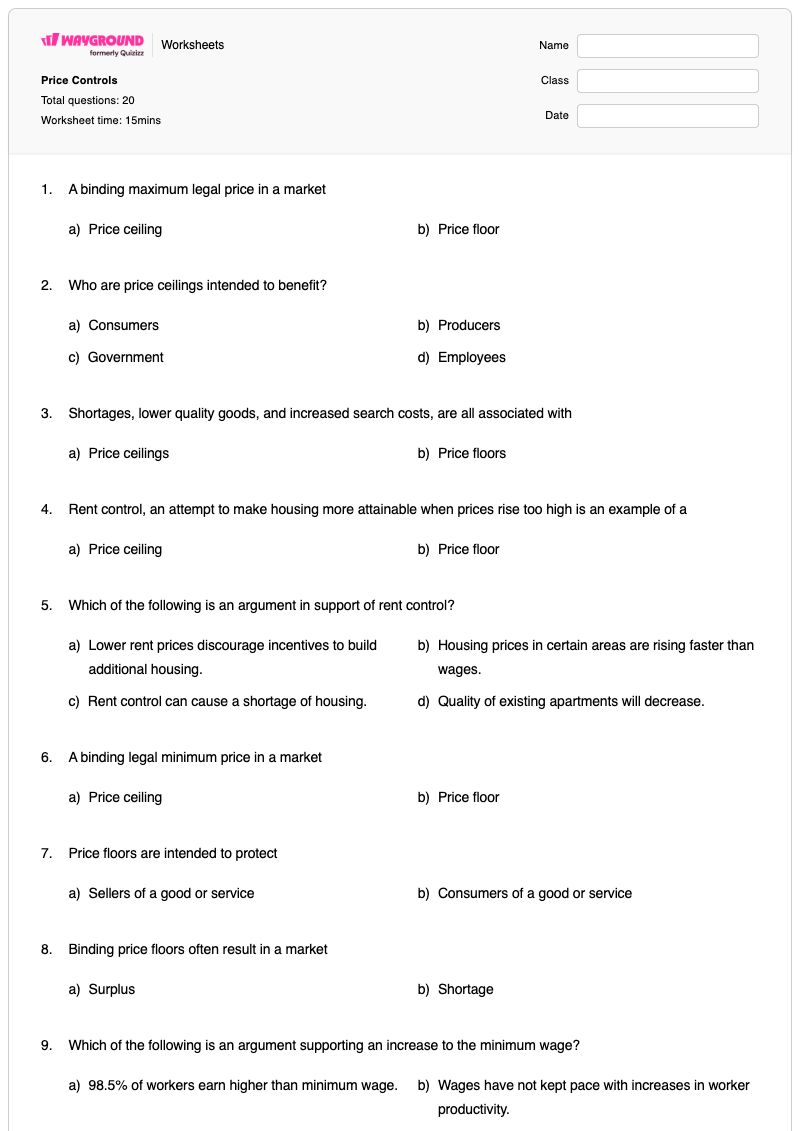
This Grade 12 Social Studies worksheet develops students’ understanding of price controls in markets. Across 20 questions—19 multiple-choice and 1 multiple-select—students identify binding price ceilings and price floors, determine who each policy is intended to protect, and connect rent control and minimum wage arguments to their likely market effects. They also interpret numerical market situations involving equilibrium, shortages, surpluses, quantity demanded, and quantity supplied. The worksheet gives students repeated practice distinguishing whether a legal price is binding, determining whether it creates a shortage or surplus, and selecting the correct market outcome from quantitative choices. It is suitable for economics instruction within a Grade 12 Social Studies course, including guided practice, review, or a formative check after introducing price controls. This is a free printable worksheet with a complete answer key for efficient review and feedback.

Worksheet settings

Font size

S
M
L
XL
Worksheets

Price Controls

Total questions: 20

Name
Class
Date
1.

A binding maximum legal price in a market

a)

Price ceiling

b)

Price floor

2.

Who are price ceilings intended to benefit?

a)

Consumers

b)

Producers

c)

Government

d)

Employees

3.

Shortages, lower quality goods, and increased search costs, are all associated with

a)

Price ceilings

b)

Price floors

4.

Rent control, an attempt to make housing more attainable when prices rise too high is an example of a

a)

Price ceiling

b)

Price floor

5.

Which of the following is an argument in support of rent control?

a)

Lower rent prices discourage incentives to build additional housing.

b)

Housing prices in certain areas are rising faster than wages.

c)

Rent control can cause a shortage of housing.

d)

Quality of existing apartments will decrease.

6.

A binding legal minimum price in a market

a)

Price ceiling

b)

Price floor

7.

Price floors are intended to protect

a)

Sellers of a good or service

b)

Consumers of a good or service

8.

Binding price floors often result in a market

a)

Surplus

b)

Shortage

9.

Which of the following is an argument supporting an increase to the minimum wage?

a)

98.5% of workers earn higher than minimum wage.

b)

Wages have not kept pace with increases in worker productivity.

c)

There will be fewer jobs available for low-skilled workers.

d)

It may increase the cost of bringing goods and services to market.

10.

Where would a binding price ceiling need to be set in this market?

a)

$1500

b)

$1200

c)

$900

d)

$600

11.

A price floor set at $15.00 in this market would be

a)

Binding

b)

Not binding

12.

What would be created if a binding price floor was imposed at $15.00?

a)

A shortage of 10 units

b)

A surplus of 10 units

c)

A shortage of 5 units

d)

A market clearing quantity of 15 units

13.

When a price ceiling is in place keeping the price below the market price, which is true of the quantity demanded & quantity supplied?

a)

Quantity Demanded is greater

b)

Quantity Supplied is greater

c)

Quantity Demanded equals Quantity supplied

14.
At the price of 1.00 there is a 
a)
shortage of 200
b)
surplus of 200
c)
shortage of 400
d)
surplus of 400
15.
An effective price floor must be set above equilibrium, resulting in:
a)
a shortage
b)
a surplus
c)
limited choices
d)
None of the above
16.
If the government set the price at $700, would that be a price ceiling or floor?
a)
Price Ceiling
b)
Price Floor 
c)
Neither
17.
If the government set the price at $300, what would be the result?
a)
Surplus of 4,000
b)
Surplus of 2,000
c)
Shortage of 4,000
d)
Shortage of 2,000
18.
If the government creates a price floor of $80, which one of the following statements is correct?
a)
The quantity demanded = 60
b)
The quantity supplied = 180
c)
There is a shortage of 140
d)
There price floor is ineffective
19.
If the government creates a price ceiling of $30, which one of the following statements is correct?
a)
The quantity demanded = 60
b)
The quantity supplied = 160
c)
There is a surplus of 100
d)
There is a shortage of 100
20.

If the Market price is $50,, which of the following is True of Quantity Supplied and Quantity Demanded

a)

quantity demanded = 120

b)

quantity supplied = 120

c)

quantity demanded = 120 & quantity supplied =120

d)

quantity demanded = quantity supplied

Answer Key

Price Controls

Total questions: 20

1.
a)

Price ceiling

2.
a)

Consumers

3.
a)

Price ceilings

4.
a)

Price ceiling

5.
b)

Housing prices in certain areas are rising faster than wages.

6.
b)

Price floor

7.
a)

Sellers of a good or service

8.
a)

Surplus

9.
b)

Wages have not kept pace with increases in worker productivity.

10.
d)

$600

11.
a)

Binding

12.
b)

A surplus of 10 units

13.
a)

Quantity Demanded is greater

14.
c) shortage of 400
15.
b) a surplus
16.
b) Price Floor 
17.
c) Shortage of 4,000
18.
a) The quantity demanded = 60
19.
d) There is a shortage of 100
20.
d)

quantity demanded = quantity supplied

, a)

quantity demanded = 120

, b)

quantity supplied = 120

, c)

quantity demanded = 120 & quantity supplied =120

FAQs

What does this price controls worksheet cover?

This Grade 12 worksheet uses 19 multiple-choice questions and 1 multiple-select question to assess price ceilings, price floors, rent control, and minimum wage arguments. Students classify legal maximum and minimum prices, identify whether controls are binding, and determine whether they produce shortages or surpluses using both conceptual and numerical market scenarios.

How can I use this worksheet to teach binding price ceilings and price floors?

Introduce the distinction between a legal maximum price and a legal minimum price, then have students explain who each policy is intended to protect before assigning the questions. Use the rent control and minimum wage items for discussion, and pause on the numerical questions to ask students whether the controlled price is above or below equilibrium and what that implies for quantity demanded and quantity supplied.

What mistakes should I watch for when students complete this price controls worksheet?

Students may reverse price ceilings and price floors, or confuse the groups each policy is intended to protect. Watch for errors in deciding whether a control is binding, especially when identifying a ceiling below equilibrium or a floor above equilibrium. They may also select a shortage when the worksheet’s binding floor scenarios create a surplus, or overlook that a binding ceiling makes quantity demanded greater than quantity supplied.

How do I assign and grade this price controls worksheet?

Wayground provides this price controls worksheet as a printable PDF and as a digital quiz, and it includes a complete answer key. You can grade printable submissions by scanning student work with the Wayground for Teachers app, or review responses from the digital quiz.

How can I differentiate this price controls worksheet for my students?

Use the worksheet’s Advanced Settings to adjust font spacing or increase the font size so the multiple-choice options and numerical market scenarios are easier to read. You can also enable a dyslexia-friendly font or translate the worksheet into another language when those changes support access to the price ceiling and price floor questions.

Where can I find more worksheets like this on Wayground?

Wayground offers a comprehensive collection of free printable worksheets and practice problems across subjects, with downloadable PDFs and answer keys to help students master essential skills and concepts. Browse more resources at https://wayground.com/en-us/worksheets.