

Wayground
New Year’s Traditions Around the World 2024 - Printable Social studies Worksheets class 6 - Wayground

New Year’s Traditions Around the World 2024

Emily Joseph

By Emily Joseph

15 questions

6th - 6th Grade

Social studies

55 plays

Updated Mar 2026

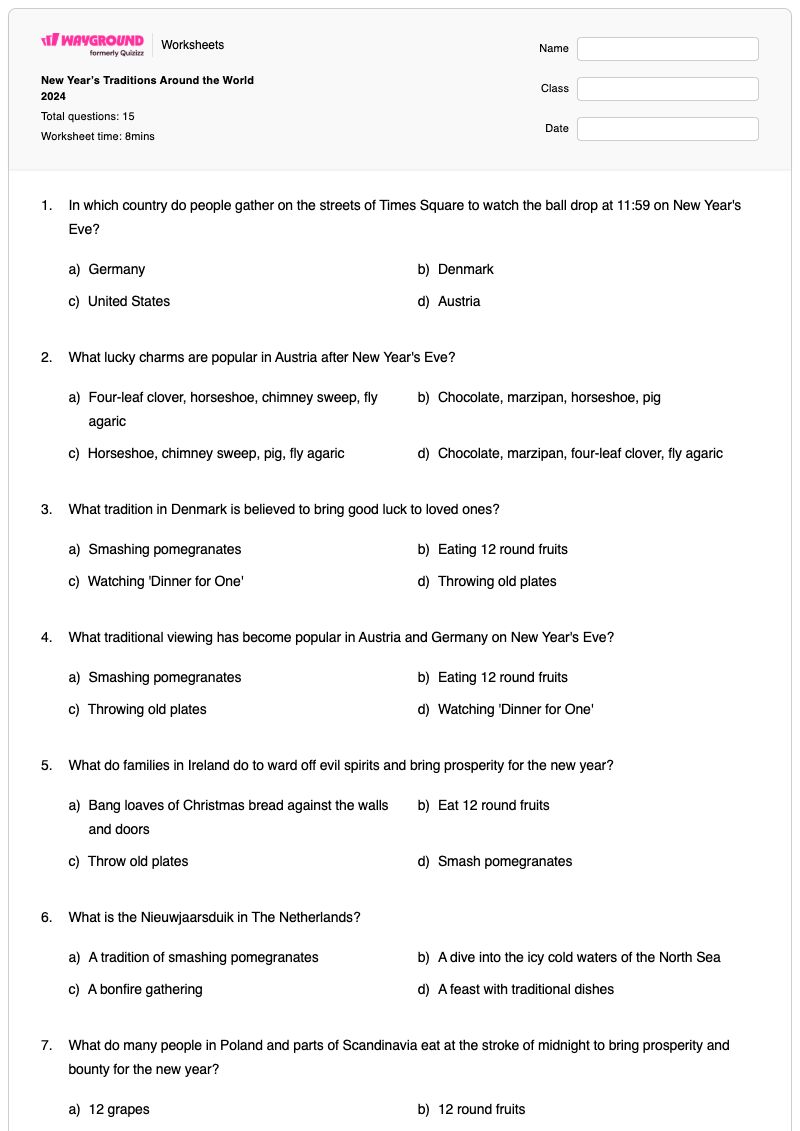
New Year’s Traditions Around the World 2024 is a Grade 6 social studies worksheet that introduces students to New Year’s Eve customs practiced in countries across Europe and the United States. Through 15 multiple-choice questions, students identify the country associated with traditions such as the Times Square ball drop, Denmark’s plate throwing, the Netherlands’ Nieuwjaarsduik, France’s Le Réveillon de Saint-Sylvestre, and Portugal’s 12 raisins. The worksheet builds students’ ability to connect cultural practices with specific places while recognizing how traditions are associated with luck, prosperity, protection, or celebration. It also reinforces careful reading as students distinguish similar answer choices, including different foods, objects, and midnight activities. This free printable worksheet is suitable for social studies instruction, cultural comparison, review, or an introductory assessment, and it includes a complete answer key for efficient checking.

Worksheet settings

Font size

S
M
L
XL
WaygroundWorksheets

New Year’s Traditions Around the World 2024

Total questions: 15

Name
Class
Date
1.

In which country do people gather on the streets of Times Square to watch the ball drop at 11:59 on New Year's Eve?

a)

Germany

b)

Denmark

c)

United States

d)

Austria

2.

What lucky charms are popular in Austria after New Year's Eve?

a)

Four-leaf clover, horseshoe, chimney sweep, fly agaric

b)

Chocolate, marzipan, horseshoe, pig

c)

Horseshoe, chimney sweep, pig, fly agaric

d)

Chocolate, marzipan, four-leaf clover, fly agaric

3.

What tradition in Denmark is believed to bring good luck to loved ones?

a)

Smashing pomegranates

b)

Eating 12 round fruits

c)

Watching 'Dinner for One'

d)

Throwing old plates

4.

What traditional viewing has become popular in Austria and Germany on New Year's Eve?

a)

Smashing pomegranates

b)

Eating 12 round fruits

c)

Throwing old plates

d)

Watching 'Dinner for One'

5.

What do families in Ireland do to ward off evil spirits and bring prosperity for the new year?

a)

Bang loaves of Christmas bread against the walls and doors

b)

Eat 12 round fruits

c)

Throw old plates

d)

Smash pomegranates

6.

What is the Nieuwjaarsduik in The Netherlands?

a)

A tradition of smashing pomegranates

b)

A dive into the icy cold waters of the North Sea

c)

A bonfire gathering

d)

A feast with traditional dishes

7.

What do many people in Poland and parts of Scandinavia eat at the stroke of midnight to bring prosperity and bounty for the new year?

a)

12 grapes

b)

12 round fruits

c)

Homemade tamales

d)

Pickled herring

8.

What is the traditional New Year's Eve practice in Switzerland to ward off accidents and malice?

a)

Throwing old plates

b)

Spreading incense throughout the house and property

c)

Smashing pomegranates

d)

Eating 12 grapes

9.

What is the traditional feast called in France on New Year's Eve?

a)

Le Réveillon de Saint-Sylvestre

b)

Nieuwjaarsduik

c)

Auld Lang Syne

d)

Dinner for One

10.

What is the tradition in Greece to bring good luck for the new year?

a)

Spreading incense throughout the house and property

b)

Hanging an onion outside the door

c)

Eating 12 grapes

d)

Smashing pomegranates

11.

What is the traditional New Year's Eve practice in Iceland?

a)

Eating 12 grapes

b)

Watching a comedy TV show

c)

Throwing old pots and pans out the window

d)

Diving into the icy cold waters of the North Sea

12.

What is the traditional New Year's Eve practice in Italy to banish bad luck for the coming year?

a)

Eating 12 grapes

b)

Watching 'Dinner for One'

c)

Smashing pomegranates

d)

Throwing old pots and pans out the window

13.

What traditional ringed cake is eaten in both Denmark and Norway on New Year’s Eve?

a)

Pancakes

b)

Homemade tamales

c)

Kransekake

d)

Foie gras

14.

What is the traditional New Year's Eve practice in Portugal to bring luck for the year to come?

a)

Eating 12 grapes

b)

Smashing pomegranates

c)

Eating 12 raisins

d)

Placing three potatoes under each family member’s bed

15.

What is the traditional New Year's Eve practice in Turkey to make way for good fortune in the coming year?

a)

Smashing pomegranates

b)

Eating 12 grapes

c)

Placing three potatoes under each family member’s bed

d)

Throwing old pots and pans out the window

WaygroundAnswer Key

New Year’s Traditions Around the World 2024

Total questions: 15

1.
c)

United States

2.
a)

Four-leaf clover, horseshoe, chimney sweep, fly agaric

3.
d)

Throwing old plates

4.
d)

Watching 'Dinner for One'

5.
a)

Bang loaves of Christmas bread against the walls and doors

6.
b)

A dive into the icy cold waters of the North Sea

7.
d)

Pickled herring

8.
b)

Spreading incense throughout the house and property

9.
a)

Le Réveillon de Saint-Sylvestre

10.
b)

Hanging an onion outside the door

11.
b)

Watching a comedy TV show

12.
d)

Throwing old pots and pans out the window

13.
c)

Kransekake

14.
c)

Eating 12 raisins

15.
a)

Smashing pomegranates

FAQs

What does the New Year’s Traditions Around the World worksheet cover?

This Grade 6 social studies worksheet uses 15 multiple-choice questions to help students identify New Year’s Eve traditions associated with specific countries. Students connect practices such as Austria’s lucky charms, Ireland’s bread-banging custom, Greece’s onion tradition, and Turkey’s pomegranate smashing with the correct location and purpose, including luck, prosperity, or protection.

How can I use this worksheet to teach New Year’s traditions around the world?

Introduce the worksheet by locating the featured countries on a map and previewing the idea that celebrations can reflect beliefs about luck, prosperity, and protection. Students can then complete the multiple-choice questions individually or in pairs, explaining why a selected tradition belongs to a particular country—for example, why the Nieuwjaarsduik refers to a cold-water dive in the Netherlands. Review the answers as a class and compare how foods, objects, and activities are used in different celebrations.

What mistakes should I watch for when students complete this worksheet?

Students may match a familiar tradition to the wrong country or confuse similar food-based choices, such as 12 grapes, 12 raisins, 12 round fruits, and pickled herring. They may also overlook distinctions between related practices, such as throwing old plates in Denmark, throwing pots and pans in Italy, and smashing pomegranates in Turkey. Ask students to reread the full option set and use the country named in each question to check their match.

How do I assign and grade this New Year’s traditions worksheet?

The worksheet is available as a printable PDF and as a digital quiz on Wayground, so you can choose the format that fits your Grade 6 social studies lesson. It includes a complete answer key for the 15 multiple-choice questions, and printable submissions can be graded by scanning student work with the Wayground for Teachers app. The printable format can also support schools that are reducing screen time.

How can I differentiate this worksheet for my students?

In the worksheet’s Advanced Settings, adjust font spacing or choose a larger font size to make the 15 multiple-choice questions and their answer options easier to read. You can also enable a dyslexia-friendly font or translate the worksheet into another language while students work with the country-and-tradition matching content.

Where can I find more worksheets like this on Wayground?

Wayground offers a comprehensive collection of free printable worksheets and practice problems across all subjects, with downloadable PDFs and answer keys to help students master essential skills and concepts. Browse more resources at https://wayground.com/en-us/worksheets.