

Wayground
Inference Practice - Printable ELA Worksheets 6th - 8th Grade - Wayground

Inference Practice

Michelle Carter

Created by Michelle Carter

17 questions

6th - 8th Grade

ELA

Updated Oct 2026

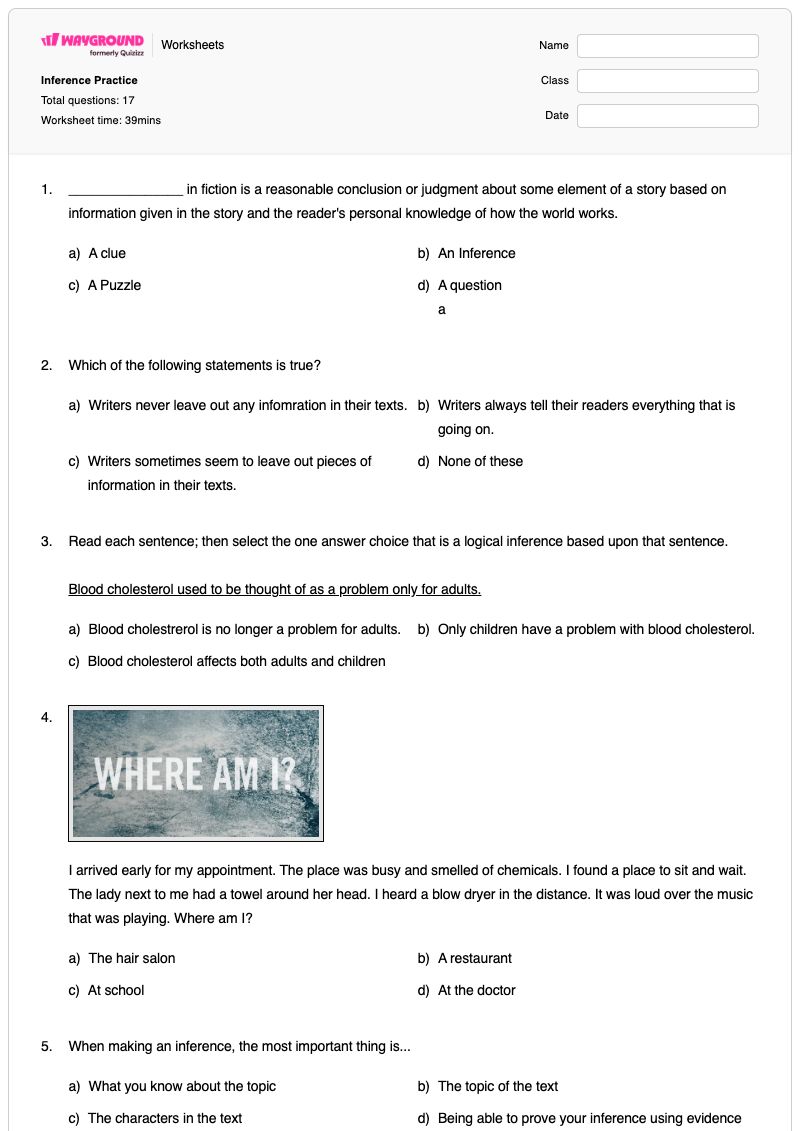
Inference Practice is a Grade 6–8 English reading worksheet focused on drawing reasonable conclusions from text evidence and what the reader already knows. Its 17 items include 16 multiple-choice questions and 1 multiple-select question. Students identify the meaning of inference, distinguish supported conclusions from guesses or directly stated information, and apply the skill to individual sentences, brief scenarios, and informational passages about topics such as health, animals, legends, and neon lights. This worksheet helps students explain why an inference is logical and select conclusions that the text supports. Use it for guided instruction, independent practice, review, or formative assessment after introducing evidence-based reading. It is a free printable worksheet with a complete answer key, making it practical for checking understanding of inference across several reading contexts.

Worksheet settings

Font size

S
M
L
XL
WaygroundWorksheets

Inference Practice

Total questions: 17

Name
Class
Date
1.

_______________ in fiction is a reasonable conclusion or judgment about some element of a story based on information given in the story and the reader's personal knowledge of how the world works.

a)

A clue

b)

An Inference

c)

A Puzzle

d)

A question

a

2.

Which of the following statements is true?

a)

Writers never leave out any infomration in their texts.

b)

Writers always tell their readers everything that is going on.

c)

Writers sometimes seem to leave out pieces of information in their texts.

d)

None of these

3.

Read each sentence; then select the one answer choice that is a logical inference based upon that sentence.


Blood cholesterol used to be thought of as a problem only for adults.

a)

Blood cholestrerol is no longer a problem for adults.

b)

Only children have a problem with blood cholesterol.

c)

Blood cholesterol affects both adults and children

4.
I arrived early for my appointment. The place was busy and smelled of chemicals. I found a place to sit and wait. The lady…
I arrived early for my appointment. The place was busy and smelled of chemicals. I found a place to sit and wait. The lady next to me had a towel around her head. I heard a blow dryer in the distance. It was loud over the music that was playing. Where am I?
a)
The hair salon
b)
A restaurant
c)
At school
d)
At the doctor
5.
When making an inference, the most important thing is...
a)
What you know about the topic
b)
The topic of the text
c)
The characters in the text
d)
Being able to prove your inference using evidence from the text.
6.
An inference is...
a)
Text evidence + what you know
b)
Retelling a text
c)
Making a guess without evidence
d)
Information that is written directly into the text.
7.
"Troy stuttered, blushed and shook as he addressed the crowd."
What can you infer about Troy from this statement? 
a)
Troy enjoys public speaking
b)
Troy is nervous
c)
Troy is an actor
d)
Troy has food poisoning
8.
It is very hot during the day.  At night, it is much cooler.  It hardly ever rains, so the rocky ground is very dry.  Plants with prickly spines called cacti, grow all around.  Jackrabbits, roadrunners, and tarantulas can live here.  But not plants and animals are suited to this climate.  
It is likely that
a)
This is a rain forest
b)
This is a tundra
c)
This is a desert
9.
What is an inference?
a)
A reasonable guess
b)
A short version of a story
c)
A reasonable guess that must make sense
d)
The lesson of the story
10.
Many breeds of dogs are used for work. In many cultures, dogs are used to herd sheep. The dogs keep the flock from being attacked by animals such as wolves. They also keep sheep from wandering off. Sheepdogs are known for their loyalty and gentleness. Based on your reading of the text, you can INFER that:
a)
Sheepdogs are not very smart dogs.
b)
Sheepdogs are a popular choice for herding.
c)
There are many breeds of dogs.
d)
Wolves are afraid of sheepdogs.
11.
What can you infer is wrong with Carol?
a)
She is upset because she has been waiting on hold for a long time.
b)
She is sick and calling in to work.
c)
She hit her head.
d)
Her coffee is too hot!
12.

Read the sentence; then select the one answer choice that is a logical inference based upon that sentence. Even spiders that do not build webs from silk use it for a variety of purposes, such as constructing egg sacs and nersery tents.

a)

All spiders build webs

b)

Spiders that build webs don't build egg sacs or nursery tents.

c)

Silk is used by all spiders

13.
Read the passage - Then select the valid inferences. The term “neon light” was originally applied to a particular type of…

Read the passage - Then select the valid inferences.


The term “neon light” was originally applied to a particular type of vapor lamp using the inert, colorless gas neon. A long tube was filled with neon, which then became luminous at low pressure when an electric current was passed through it. The lamp then emitted the characteristic reddish-orange light of neon. Today, the term “neon light” is given to lamps of this general type which may be filled with a variety of gases, depending on the color that is desired. Argon, for example, is used to produce blue light. Colors can also be altered by changing the color of the glass tube. The tubes must be quite long in all these lamps to produce light efficiently. As a result, high voltages are required. Neon tube lamps are not practical for indoor illumination, but they have found widespread outdoor use in glowing, colorful advertising signs.

a)

The inert gas neon is reddish-orange in color.

b)

The meaning of the term “neon light” has changed over time.

c)

Today’s “neon lights” never actually contain neon.

d)

When stimulated by electricity, different types of gas may produce different colors

14.

Read the passage. Select the statements that make logical inferences.


A legend is a popular type of folk tale. In some ways, legends resemble myths, another type of folk tale. But myths describe events from antiquity and usually deal with religious subjects, such as the birth of a god. Legends tell of recognizable people, places and events and often take place in comparatively recent times. Some legends are based on real persons or events, but many are entirely fictional. The legends of the superhuman accomplishments of Paul Bunyan and Pecos Bill are imaginary, while the legends about Washington and Lincoln are mostly exaggerations of real qualities those two presidents had. All societies have legends. Most legends began as stories about the heroes of a particular region, occupation, or ethnic group. For example, John Henry was a legendary hero of black Americans, and Casey Jones of railroad workers. Over time, however, these figures have become national heroes.

a)

Legends about Washington and Lincoln are not entirely fictional.

b)

John Henry and Casey Jones are today well-known only by small groups of people.

c)

Both legends and myths can be classified as folk tales.

d)

Myths generally take place in comparatively recent times.

15.
Joseph and Caitlin were choosing the players for their teams. It was Caitlin's turn to choose, and only Jason was left. Caitlin said, "Jason."

We can infer that…
a)
Jason was the best player.
b)
Caitlin wanted Jason on her team.
c)
Jason was not a very good player.
d)
Caitlin had a hard time choosing a team member.
16.
I have a head and a tail. My favorite number is one. I am made of copper. I am lucky if you pick me up. What am I?
a)
four leaf clover
b)
leaf
c)
penny
d)
dime
17.
The desert is a very hot, dry place. How might a coyote stay cool?
The desert is a very hot, dry place. How might a coyote stay cool? 
a)
Sleep during the day and hunt at night
b)
Take a bath in the lake 
c)
Grow thicker fur
d)
Build a new home out of cactus 
WaygroundAnswer Key

Inference Practice

Total questions: 17

1.
b)

An Inference

2.
c)

Writers sometimes seem to leave out pieces of information in their texts.

3.
c)

Blood cholesterol affects both adults and children

4.
a) The hair salon
5.
d) Being able to prove your inference using evidence from the text.
6.
a) Text evidence + what you know
7.
b) Troy is nervous
8.
c) This is a desert
9.
c) A reasonable guess that must make sense
10.
b) Sheepdogs are a popular choice for herding.
11.
b) She is sick and calling in to work.
12.
c)

Silk is used by all spiders

13.
b)

The meaning of the term “neon light” has changed over time.

, c)

Today’s “neon lights” never actually contain neon.

14.
a)

Legends about Washington and Lincoln are not entirely fictional.

15.
c) Jason was not a very good player.
16.
c) penny
17.
a) Sleep during the day and hunt at night

FAQs

What does the Inference Practice worksheet cover?

This worksheet teaches students to make reasonable inferences by combining text evidence with what they know. Through 16 multiple-choice items and 1 multiple-select item, students identify supported conclusions from sentences, everyday scenarios, and informational passages rather than choosing guesses or information stated directly.

How can I use this worksheet to teach students to make inferences?

Begin by modeling the worksheet’s core idea: connect a clue in the sentence or passage with relevant background knowledge, then check whether the conclusion is supported. Think aloud with a scenario such as the busy, chemical-smelling place with a blow dryer, asking students which details identify the location. After guided practice, have students complete the passage-based items and explain which details support each selected inference.

What mistakes should I watch for when students complete this inference worksheet?

Watch for students choosing a personal guess without text support, repeating information stated directly, or selecting an answer that is related to the topic but not logically supported by the sentence or passage. In the multiple-select item, students may also choose every plausible-sounding statement instead of checking each option against the neon-light passage. Remind them that a valid inference must make sense and be supported by evidence.

How do I assign and grade this inference worksheet?

On Wayground, assign it as a printable PDF or as a digital quiz, and use the complete answer key to check the 17 responses. For printable submissions, you can scan student work with the Wayground for Teachers app to help grade the completed worksheet.

How can I differentiate this inference worksheet for my students?

Because the worksheet includes sentence-level questions and longer informational passages, adjust font size or spacing in Advanced Settings to make clues and reading text easier to track. You can also apply a dyslexia-friendly font or translate the worksheet into another language when those options support access to the inference tasks.

Where can I find more worksheets like this on Wayground?

Wayground offers a broad collection of free printable worksheets and practice problems across subjects, with downloadable PDFs and answer keys to support mastery of essential skills and concepts. Browse more resources at https://wayground.com/en-us/worksheets.